According to experts, as competitive advantages based on cost and adaptability gradually diminish, Ho Chi Minh City must shift its focus—moving beyond merely meeting international standards toward proactively creating new value that can define benchmarks and serve as a global reference model.
New-generation technical barriers—such as carbon accounting mechanisms, ESG (Environmental, Social, and Governance) standards, supply chain traceability, and the development of sustainable urban infrastructure and operations—are increasingly exerting a direct impact on a business's ability to access markets.
Consequently, competition is no longer defined solely by price or production speed; rather, it is increasingly determined by the capacity to deliver consistent quality, foster innovation, and maintain reliability on a large scale.
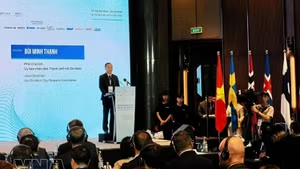
Mohammad Mudasser, Deputy General Director of PwC Viet Nam, noted that competitive advantages rooted in low costs and contract manufacturing are narrowing. Viet Nam and Ho Chi Minh City have moved past the phase where simply meeting existing standards was sufficient to participate in global value chains. The next phase demands the ability to master quality, technology, and management—ultimately creating value that sets new benchmarks for others to follow.
This reality demonstrated that an economy’s competitiveness depends, first and foremost, on the capacity of its enterprises to innovate and develop. When businesses go beyond merely meeting requirements—by proactively maintaining and elevating standards and quality throughout the entire value chain—they drive broader improvements.
Furthermore, by developing the capability to create new products, technologies, and processes, enterprises can help elevate the standing of an entire industry in the international market.
However, a gap remained between potential and actual results. Huynh Cong Thang, Chairman of InnoLab Asia, noted that Viet Nam is standing before a historic opportunity, situated at the heart of a global restructuring wave. Yet, the primary obstacle today is not a technological gap, but an execution gap.
According to him, transforming potential into tangible competitive strength requires bridging this gap through a “5-Helix” connection model—one that establishes innovation as a long-term, vital strategy for businesses.
This imperative presented Ho Chi Minh City with a dual task: fostering the innovation capacity of enterprises while building a favourable environment where scientific and technological resources can be effectively connected and applied in practice.
Tran Trong Tuyen, Deputy Director of the Ho Chi Minh City Department of Science and Technology, stated that Viet Nam is entering a new phase of development, in which science, technology, innovation, digital transformation, and the private sector are identified as key drivers of growth.
For Ho Chi Minh City, this is not merely a development orientation but a requirement for a city that serves as a national leader—a large-scale metropolis with significant influence, now standing before a new horizon for development.
Viet Nam is entering a new phase of development, in which science, technology, innovation, digital transformation, and the private sector are identified as key drivers of growth. For Ho Chi Minh City, this is not merely a development orientation but a requirement for a city that serves as a national leader—a large-scale metropolis with significant influence, now standing before a new horizon for development.
Tran Trong Tuyen, Deputy Director of the Ho Chi Minh City Department of Science and Technology
Furthermore, Ho Chi Minh City aims to strengthen connections with economic, scientific, and technological hubs across the region and the globe, thereby enhancing its competitiveness and laying the foundation for achieving double-digit economic growth.
The Law on Urban Development, which took effect on October 1, 2026, introduced exceptional policies regarding science, technology, innovation, and digital transformation. These include support for innovative startups, the commercialisation of research outcomes, and the controlled testing of new technologies, products, and models.
This is a crucial condition for Ho Chi Minh City—not only to attract resources but also to foster an environment where these resources can be tested, connected, and transformed into development outcomes.
This, in essence, is the role of Ho Chi Minh City: to create an enabling environment, refine institutional frameworks, connect resources, and partner with businesses, scientists, and investors throughout the innovation process.
The city viewed businesses as development partners and encouraged them to invest boldly in technology and innovation. Large enterprises serve as core hubs, connecting with smaller firms and innovative startups. Research institutes and universities are aligning more closely with market demands, while international investors and partners are finding long-term collaboration opportunities in Ho Chi Minh City.
With a new development space, a new institutional framework, a dynamic business community, and an ever-expanding network of partners, Ho Chi Minh City aims to foster new flows of innovation—encompassing knowledge, technology, capital, markets, and international cooperation.
Ultimately, the goal is even greater: to transform innovation into productivity, products, enterprises, and markets, thereby generating enhanced value for both the business sector and the broader economy.