According to Le Hoang Hoan — a member of the Executive Committee of the Viet Nam Real Estate Association and Vice Chairman of the Ha Noi Real Estate Club — while real estate information has become increasingly accessible and buyers can quickly access project data, significant challenges remain regarding document processing, ownership verification, property valuation, and mortgage management. AI expedites these processes by automating information analysis and filtering, thereby reducing workloads and enhancing accuracy in real estate transactions.
“Adopting AI not only optimises investment processes but also unlocks unprecedented avenues and improves decision-making efficiency. This is a trend of growing importance and revolutionary significance in today’s digital era,” Hoan remarked.
In the context of rapid global digital transformation, the traditionally conservative real estate sector is gradually embracing modern technologies, particularly Artificial Intelligence (AI). This shift not only elevates efficiency in management, marketing, and transactions but also cultivates premium customer experiences while optimising operational costs for businesses.
AI steadily revolutionises the real estate industry
In the real estate sector, AI serves a pivotal function in data analysis and market trend forecasting. Specifically, AI can process vast amounts of data from diverse sources — such as zoning information, property prices, market fluctuations, and migration patterns — to generate accurate forecasts regarding future property values.
By processing large datasets, AI provides comprehensive and insightful market overviews — ranging from macro trends to minute fluctuations — enabling investors to comprehend the broader market landscape, including price shifts and customer demand. This empowers investors to more precisely identify investment opportunities and risks.
Notably, AI can automatically assess asset values by analysing property characteristics and streamline document management processes, including ownership verification, legal document checks, and mortgage administration. The use of AI enables real estate professionals to operate with greater speed and efficacy. This optimised workflow requires fewer human resources, ultimately reducing costs associated with real estate investment activities.
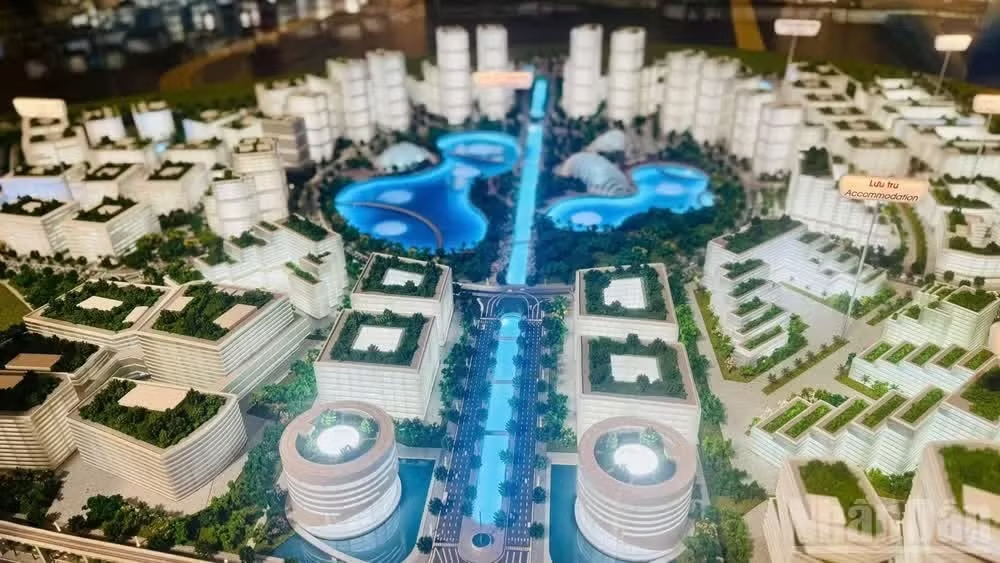
Furthermore, thanks to natural language processing technology, AI chatbots can provide consultations, resolve inquiries, and curate properties tailored to customer needs 24/7, thereby enhancing the user experience. AI can also analyse user preferences and requirements to recommend suitable properties.
Real estate platforms utilise AI to offer personalised suggestions, streamlining the search for their preferred properties. Additionally, AI facilitates customer service through virtual assistants and chatbots; these tools answer frequently asked questions, assist with information searches, and process requests rapidly, eliminating long wait times for customers.
Moreover, AI curtails transaction times and minimise errors across various stages — from property valuation and legal checks to the signing of electronic contracts. AI systems can monitor energy consumption, equipment maintenance, and security, helping to optimise costs and improve management efficiency.
The efficacy of combining robotics and AI
Analysing the advantages of the digital era — specifically the impact of combining robotics and AI on the real estate sector — Hoan posited that this integration will unlock exceptional possibilities for real estate construction and management.
Construction robots will support automated building processes — such as wall construction, electrical and plumbing installation, and interior finishing — thereby accelerating timelines, mitigating errors, and conserving labour. Simultaneously, inspection and maintenance robots can be deployed to climb and inspect roofs, high-rise facades, and piping systems, ensuring both safety and accuracy.
Additionally, modern developments incorporate cleaning and security robots: smart buildings can utilise autonomous cleaning robots to mop floors and vacuum public areas, as well as security robots equipped with cameras, thermal sensors, facial recognition, intrusion detection, and fire/explosion warning systems; there are also robots for exterior cleaning, fault inspection, and firefighting on high-rise structures.

Furthermore, interactive robots have emerged in real estate brokerage centres. “Currently, some real estate companies are deploying robots to act as receptionists, present developments, and guide customers through model home tours,” Hoan stated.
There are also robots designed for transport and industrial cleaning; industrial zones are increasingly deploying robots for cargo transport, industrial cleaning, and critical phases of the production process. Service robots — such as receptionists, delivery units, and cashiers — have also been integrated in shopping malls, restaurants, and hotels.
However, Hoan also emphasised that alongside the benefits of AI and robotics in real estate, there are inherent risks impacting investors. AI systems process and store vast amounts of data regarding real estate and customers, exposing vulnerabilities to information leakage if proper safeguards are not in place. Additionally, these technologies may trigger a surplus of low-skilled labour and create formidable barriers for small and medium-sized enterprises due to high initial costs.
Undoubtedly, for the real estate sector, AI and robotics constitute more than just a trend; they will invariably form the “smart foundation” of this new era. In this context, technology, people, and resources will be seamlessly integrated to cultivate a sustainable and prosperous future.
Integrating AI and robotics is not merely a technological advancement but a sustainable development strategy for the real estate industry in this new era. Harnessing this trend will empower businesses to secure a competitive edge while advancing the development of a modern, smart urban ecosystem for the nation.