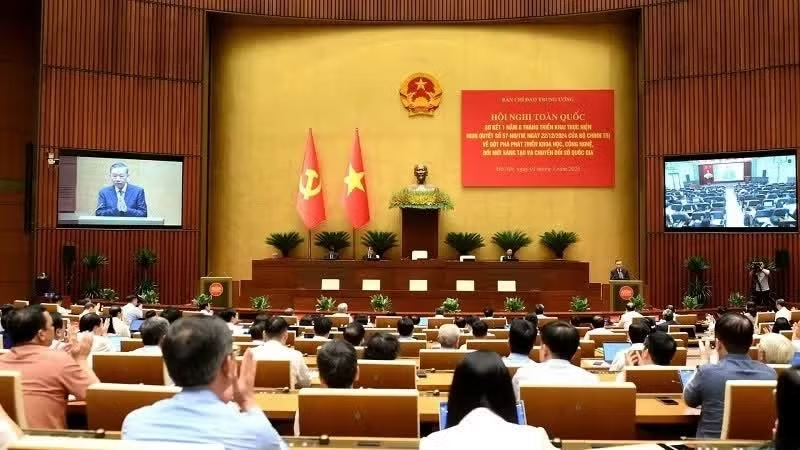
Addressing the national conference reviewing one and a half years of implementing Resolution No. 57-NQ/TW, Party General Secretary and State President To Lam stressed the need to shift decisively from building mechanisms to creating products, from completing tasks to generating value, and from preparing conditions to making direct contributions to national development. Tasks under Resolution No. 57-NQ/TW should only be regarded as completed when there are operational products, verified data, actual users, and measurable effectiveness.
Based on the directions and guidance of the Party General Secretary and State President, a Nhan Dan Newspaper reporter interviewed Nguyen Phuong Tuan, Vice Chairman of the National Assembly's Committee on Science, Technology and Environment, on the formulation and implementation of policies, particularly the role of the National Assembly in improving institutions and removing bottlenecks for science, technology, innovation, and digital transformation.
Q: Party General Secretary and State President To Lam has called for a decisive shift from building mechanisms to creating products, from completing tasks to generating value and making direct contributions to national development. From the perspective of legislation and supreme oversight, how should the National Assembly institutionalise these evaluation principles, and how should it require the Government to establish a system of indicators and criteria so that the implementation of Resolution No. 57-NQ/TW is measured by concrete outcomes rather than primarily by the number of completed tasks, projects, or legal documents?

A: The directions of Party General Secretary and State President To Lam establish a new strategic mindset, shifting from "purely administrative management" to "governance based on effectiveness and practical value". This serves as the guiding principle for change across the entire political system.
With its role as the legislative body and the highest supervisory authority, the National Assembly does not directly formulate or operate detailed sets of management indicators. That falls within the authority and responsibility of the executive branch (the Government). However, in order to translate the Party General Secretary and State President's directions into reality, the National Assembly will perform two decisive roles.
In terms of legislation (institutionalising the principles), the National Assembly will incorporate outcome-based evaluation principles into sector-specific laws, such as the Law on Science, Technology and Innovation and the Law on State Budget.
It will establish a legal framework requiring the Government to build a management ecosystem based on specific techno-economic indicators, including commercialisation rates, the digital economy's contribution to GDP, and improvements in overall labour productivity. All public investment for innovation will be allocated in accordance with these efficiency-based principles.
In terms of supreme oversight, the National Assembly will use the target commitments and performance indicators issued by the Government as benchmarks for supervision. When approving the State budget or questioning Government members, the National Assembly will no longer rely on reports stating "how many legal documents or projects have been completed".
Instead, the National Assembly, in particular its specialised committees and deputies, will base their oversight on actual figures: How many tangible products have been created? How much economic value has the nation's investment of resources generated for the country?
This clear division of responsibilities enables the National Assembly to maintain its independent and objective supervisory role, while at the same time creating strong pressure and momentum for the executive branch to comprehensively reform its approach to innovation governance in line with the directions of Party General Secretary and State President To Lam.
Q: One of the key requirements emphasised by Party General Secretary and State President To Lam is the need for mechanisms to encourage and protect those who dare to think, dare to act, dare to innovate, and dare to take responsibility for the common good. In your view, how should the legal framework continue to be improved so that this provision truly becomes a pillar of support for scientists, technology enterprises, and officials engaged in implementing innovation?
A: The strategic requirement set by Party General Secretary and State President To Lam to encourage and protect those who dare to think, dare to act, and dare to innovate for the common good is an "order for action" to unlock the nation's creative potential. From a legislative perspective, the National Assembly has fulfilled its mission of "paving the way" by initially establishing mechanisms for risk acceptance and intellectual property protection in the Law on Science, Technology and Innovation as well as the Law on Intellectual Property.
However, for these progressive provisions to truly take effect and become a firm pillar of support for scientists, the decisive factor now lies in the transparency, determination, and consistency of implementing documents (decrees and circulars). As a full-time National Assembly deputy working at the central level, I believe efforts should focus on urging the Government and ministries and sectors to improve sub-law implementation mechanisms in three key bottleneck areas.
First, the criteria for "acceptable risk" should be clearly specified in implementing decrees. The law already allows for risk acceptance, but existing circulars governing financial management and project acceptance continue to reflect a strong "administrative capital preservation" mindset.
A decree is needed to clearly define and quantify what constitutes "objective failure within the scope of innovation research" so that audit and inspection agencies have a legal basis for application, helping genuine scientists avoid criminal or administrative liability when high-tech projects fail to achieve their expected results.
Second, detailed sub-law guidance should be issued on the valuation of intellectual property and procedures for establishing spin-off enterprises. This is a highly practical recommendation put forward by leading universities such as Ha Noi University of Science and Technology.
Although the law has opened the way, the absence of detailed circulars on autonomous valuation and benefit-sharing mechanisms has left universities and scientists reluctant to make independent decisions for fear of violating regulations on the management of public assets. Sub-law documents must provide clear formulas and standard procedures to remove this fear of responsibility.
Third, flexible management and project acceptance procedures should be established through sector-specific circulars. At present, high-tech products, particularly those applying AI and big data, evolve from month to month, making it impossible to apply the conventional administrative procedures under which appraisal and acceptance may take a year or longer. Sub-law documents should establish a procedural "green channel", allowing acceptance to be based on final products and enabling objectives to be adjusted flexibly in line with market realities.
In addition, the National Assembly will study the issuance of a resolution providing special mechanisms and policies for handling legal violations in the private sector, the State sector, and the application of science, technology, innovation, and digital transformation, thereby creating a solid legal basis to encourage scientists and experts to dare to think and dare to act.
It can be affirmed that while laws provide the foundation, decrees and circulars are what carry policies to scientists. Only when sub-law documents are developed in the spirit of providing specific, rigorous yet enabling institutionalisation can we create a "safe environment" that protects genuine scientists who are willing to devote themselves to the country's development, in line with the directions of Party General Secretary and State President To Lam.
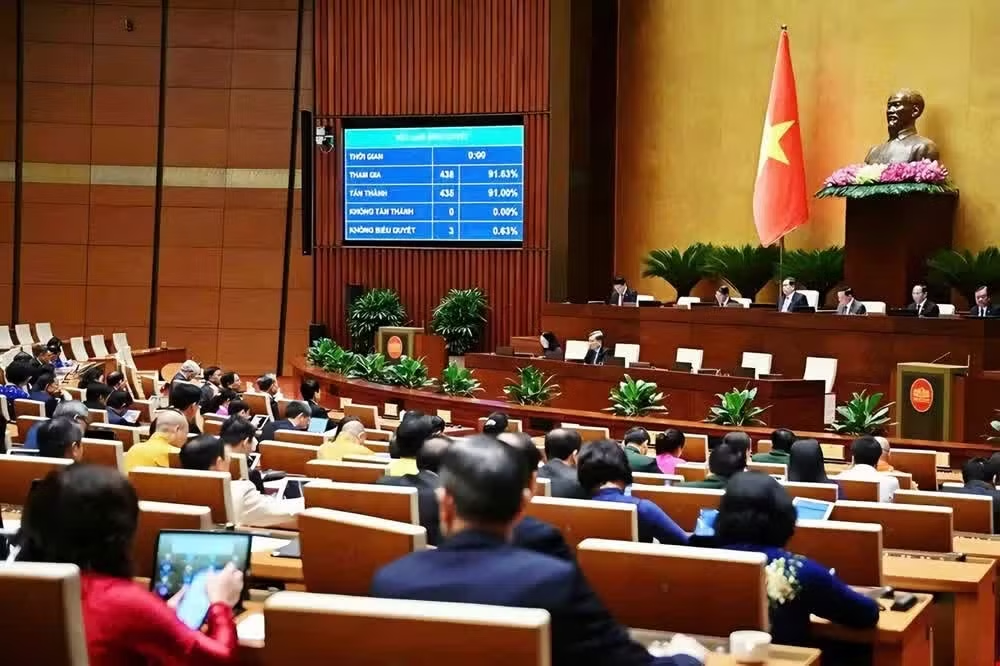
Q: One of the bottlenecks most frequently highlighted at present is the gap between investment commitments, resource allocation, and the absorption capacity of the science, technology, and innovation system. In your view, which provisions on the State budget, financial mechanisms, lump-sum funding mechanisms, or the management of science and technology tasks should the National Assembly continue to amend so that resources can be disbursed more quickly and flexibly and be effectively transformed into tangible products, technologies, and value?
A: This is a pressing issue that the legislative branch has the responsibility to address. The guiding principle set by Party General Secretary and State President To Lam requires that resources be transformed into tangible value. In reality, cumbersome procedures are causing technology to lose its timeliness.
First of all, I would like to reiterate the requirement on allocating resources for science, technology, innovation, and digital transformation set out in Resolution No. 57-NQ/TW: "...allocate at least 3% of total annual State budget expenditure to the development of science, technology, innovation, and national digital transformation, and gradually increase this allocation in line with development requirements..." This is a strong commitment by the Party and the State towards science, technology, innovation, and digital transformation.
The 2025 legal framework on science, technology, and innovation marked a major shift from an "administrative management" mindset to one of "facilitation and promotion", with enterprises placed at the centre, directly addressing the bottlenecks in absorption capacity and disbursement highlighted by Nhan Dan Newspaper.
The Law on Science, Technology and Innovation provides for a risk acceptance mechanism (Article 9 of the 2025 Law), under which the State recognises risk as an inherent characteristic of research and commits to exempting individuals and organisations from civil, administrative, and criminal liability where they have complied with professional procedures but failed because of the objective nature of the technology.
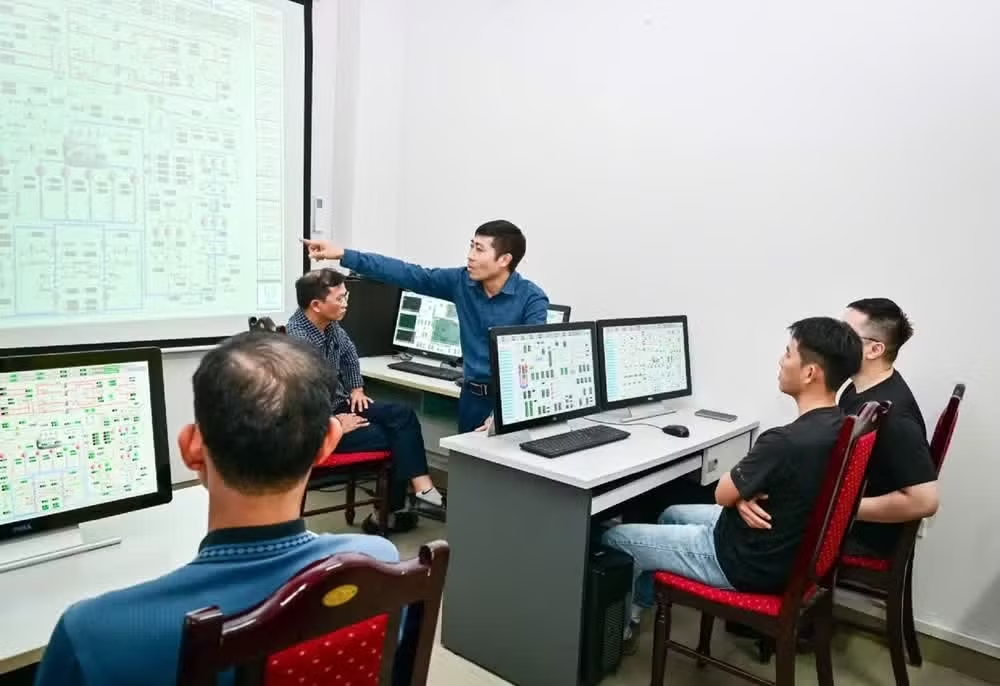
With regard to financial mechanisms, the application of the lump-sum funding mechanism up to the final product (Article 63 of the 2025 Law) allows host organisations to autonomously reallocate funding among expenditure items and determine professional expenditure in line with market prices, enabling resources to be disbursed swiftly on the basis of output results rather than being constrained by documentation requirements.
In particular, autonomy in commercialisation is guaranteed through the automatic transfer of ownership of State budget-funded assets and research results to host organisations immediately upon project acceptance (Articles 24 and 25 of the 2025 Law), together with the right to determine product prices in accordance with market mechanisms (Article 27 of the 2025 Law).
To accelerate implementation, all procedures have now been fully digitalised on the national management platform, with a mandatory approval period of no more than 110 days for science and technology tasks. In addition, the establishment of regulatory sandboxes (Articles 21, 22, and 23 of the 2025 Law) and enterprise support through financial vouchers has created a seamless innovation cycle from the laboratory to the market.
From a legislative perspective, it can be affirmed that the current legal framework is sufficiently comprehensive and secure to enable those responsible for implementation to "dare to act". The remaining issue lies entirely in implementation and practical execution, avoiding the situation where people "complain about bottlenecks and obstacles before taking action". The National Assembly will supervise implementation in order to review, assess, and identify legal bottlenecks and shortcomings in practice so that laws can be amended or new legislation enacted where appropriate.
Q: Party General Secretary and State President To Lam has required that digital transformation be accompanied from the outset by the development of synchronised, interoperable, and secure data infrastructure. In your view, what are the biggest institutional barriers currently hindering the development of shared data infrastructure and a national data ecosystem, particularly when data remains fragmented across ministries, sectors, and localities? Within its mandate, which legal provisions will the National Assembly prioritise to ensure that data truly becomes a new resource for economic development?
A: Now that the fundamental legal framework has been established through the Law on Data, the greatest obstacle is no longer the absence of legislation, but rather implementation capacity, technological infrastructure, and substantive sub-law regulations capable of fundamentally addressing the fragmentation and compartmentalisation of data among ministries, sectors, and localities, as well as the lack of unified standards and secure data-sharing mechanisms.

In its legislative and supreme oversight role, and in order to turn the provisions of the Law on Data into practical development resources, the National Assembly will strengthen its supervision of the Government in implementing the following key areas:
It will promote the issuance of unified technical standards, thereby providing a basis for the National Assembly to oversee the promulgation of sub-law documents aimed at standardising national data. Without common standards, data from different ministries and sectors will not be able to "communicate" with one another, even if access is opened.
It will further specify the "data entrustment" mechanism by providing detailed guidance on a secure legal framework for data sharing among the State, enterprises, universities, and research institutes. Mechanisms must be put in place to safeguard data flows in strategic sectors so that all parties can share data with confidence, without concerns over legal risks or data security breaches.
It will synchronise data with the national AI computing infrastructure. The National Assembly should prioritise approving budgets and investment mechanisms for shared computing infrastructure, such as large-scale data centres and high-performance GPU systems. Data can truly become a new development resource only when it is directly connected to a sufficiently powerful "computing engine", enabling research institutes and enterprises to transform raw data into knowledge and products with a distinct Vietnamese identity.

At the same time, the National Assembly and its agencies will proactively conduct supreme oversight and thematic supervision over the implementation of legislation on data to promptly identify legal inconsistencies, overlaps, and practical shortcomings arising during implementation.
Q: Resolution No. 57-NQ/TW sets the goal of mastering several strategic and core technologies that are decisive to national competitiveness. In the spirit of the resolution, which mechanisms and policies should the National Assembly prioritise to support Vietnamese enterprises in participating more deeply in global value chains, gradually mastering technology, and strengthening their research and development capabilities, rather than continuing to focus mainly on processing and assembly?
A: It can be affirmed that achieving the goal of mastering several strategic and core technologies and enhancing endogenous capacity is an urgent and indispensable requirement for Viet Nam to make a breakthrough. To help enterprises move beyond the "processing trap", the National Assembly has been focusing on improving the following breakthrough legal frameworks:
With regard to creating a breakthrough in legislative thinking, the National Assembly's leadership has consistently promoted innovation in law-making, shifting from the mindset of "if it cannot be managed, prohibit it" to one of facilitation and encouragement of innovation. Foundational legislation such as the 2025 Law on Science, Technology and Innovation has been enacted with an entirely new approach which places enterprises at the centre and promotes the commercialisation of research results.

With regard to substantive investment incentives for research and development (R&D), under the 2025 Law on High Technology (effective since July 1, 2026), high-tech enterprises that invest at least 1% of their net revenue in R&D activities in Viet Nam are entitled to the highest level of incentives: a four-year corporate income tax exemption, a 50% tax reduction for the following nine years, and a preferential tax rate of 10% for 15 years. This represents a very strong financial lever to give enterprises greater confidence in investing in core technologies.

With regard to establishing a "controlled testing" mechanism, the Law on Science, Technology and Innovation has officially introduced the legal instrument of regulatory sandboxes, allowing strategic technologies such as AI, blockchain, and semiconductors to be tested within a limited legal environment. In particular, the policy of exempting civil liability for objective risks arising during the testing process will encourage scientists and enterprises to venture into new fields.
With regard to creating markets through public procurement, the National Assembly has consistently promoted the mechanism under which "the State is the first customer", placing orders with and assigning tasks to domestic enterprises to develop key digital technology products. This not only creates stable market demand but also enables Vietnamese technologies to establish their position in the domestic market before expanding internationally.
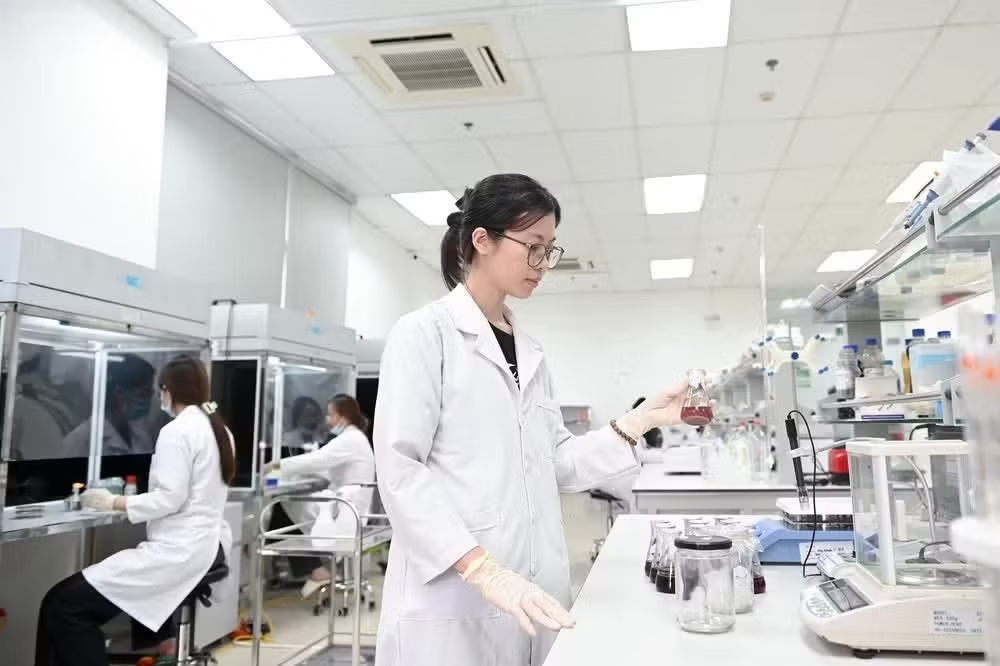
With regard to attracting talent through special mechanisms, we are continuing to improve special policies on naturalisation, home ownership, and competitive income in order to attract leading experts and chief engineers to return to Viet Nam to lead national strategic technology projects.
Q: Party General Secretary and State President To Lam has required that tasks under Resolution No. 57-NQ/TW should only be regarded as completed when they produce tangible products, generate tangible value, and can be measured by practical results. In your view, how will the National Assembly's Committee on Science, Technology and Environment reform its oversight methods to move from supervision based on documents and reports to supervision based on data, output results, and actual impacts on people, businesses, and the economy? Is it possible to establish digital dashboards or mechanisms for publicly disclosing data on the implementation of Resolution No. 57-NQ/TW so that society as a whole can participate in oversight?
A: To shift oversight from one based on "documents and reports" to one based on "data and practical results", the National Assembly's Committee on Science, Technology and Environment is vigorously implementing a range of reforms.
First, it is necessary to strengthen oversight based on "accurate, complete, clean, and live" data. This requires greater attention to and effective use of the synchronised connection of national databases on enterprises, land, and science and technology in order to monitor day-to-day developments instead of waiting for periodic reports. The oversight system will operate in a digital environment, interconnected between the National Assembly and the Government, ensuring absolute transparency.
Second, implementation must be measured against a set of key performance indicators (KPIs). Performance will be quantified through the core targets set out in Resolution No. 57, including a contribution of total factor productivity (TFP) of more than 55%, a digital economy accounting for at least 30% of GDP, and an average annual increase of 16–18% in the number of patents. Tasks will only be regarded as completed when they result in tangible products that can be commercialised or solve practical challenges facing the country.
Third, public digital dashboards should be studied and developed. We believe it is entirely feasible to establish digital dashboards to publicly disclose the progress and results of tasks undertaken by the heads of ministries, sectors, and localities. This would provide a highly effective mechanism for supervising individual accountability, whereby leaders whose performance is slow or ineffective would be criticised or replaced promptly.
Fourth, mechanisms should be established to enable society as a whole to participate in oversight. This should be studied through digital platforms, allowing people and businesses to provide direct feedback and interact around the clock on the impact of policies. Public participation in oversight will help agencies, including the National Assembly's committees, in identifying bottlenecks at an early stage so that timely recommendations can be made to amend and improve institutions.
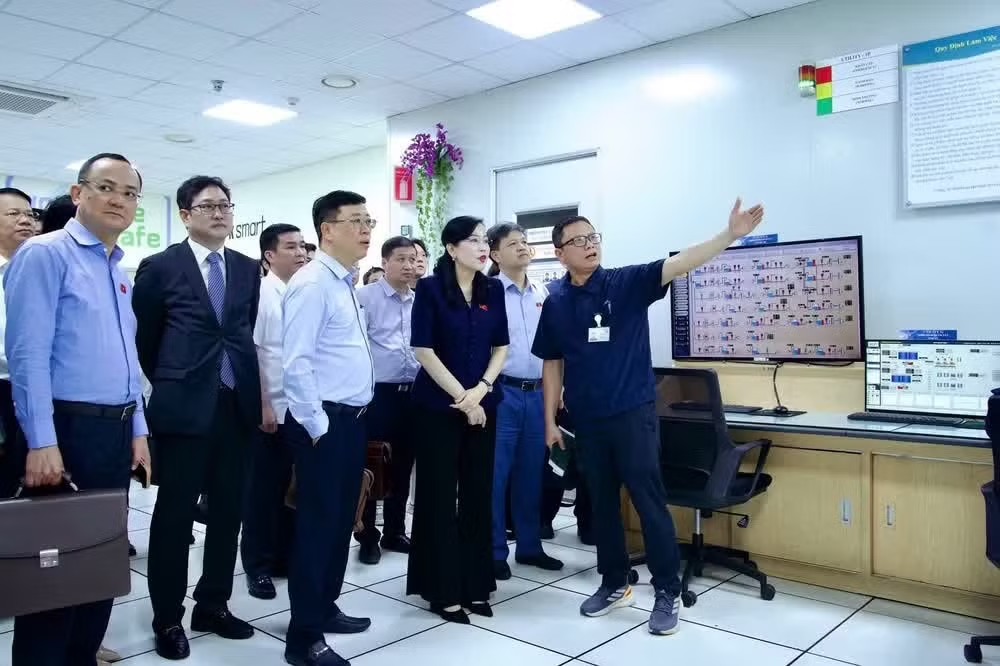
Q: Resolution No. 57-NQ/TW is not merely about science and technology or digital transformation. More fundamentally, it is about transforming national capacity and shifting the growth model towards one driven by knowledge, technology, and innovation. In your view, what will be the most important criteria for confirming that Viet Nam has entered a new stage of development based on productivity, technology, and knowledge, rather than continuing to rely primarily on low-cost labour and investment capital?
A: The strategic vision of Party General Secretary and State President To Lam in directing the implementation of Resolution No. 57-NQ/TW goes far beyond technology itself. At its core, it is about an institutional revolution to transform national capacity. As the legislative body and the supreme supervisory authority, the National Assembly does not assess the shift in the growth model solely through economic statistics, but through the extent to which the legal framework for development has been improved, harmonised, and effectively implemented.
To confirm that Viet Nam has genuinely entered a new stage of development driven by productivity, technology, and knowledge, rather than continuing to rely on low-cost labour, from a legislative perspective we must assess it against the following three core institutional criteria:
Criterion 1 is the transition from "institutions for management and control" to "institutions that facilitate and promote innovation". The first legislative criterion is whether our legal system has truly moved beyond the old mindset of rigid administrative control. A knowledge-based economy can only take shape when specialised laws, such as the Law on Science, Technology and Innovation, the Law on Data, and the Law on Intellectual Property, establish an open legal framework that protects intellectual property and the autonomy of innovation actors.
The clearest evidence that institutions have genuinely paved the way for knowledge to unlock productivity is when legal provisions shift to the lump-sum funding mechanism up to the final product, recognise the "right to take risks" in research, and provide a legal basis for regulatory sandboxes for emerging technologies.
The second is the substantive nature and effectiveness of supreme oversight based on output results. A new growth model requires a new approach to oversight by the National Assembly. The key benchmark here is that, in making budgetary decisions and exercising supreme oversight, the National Assembly will no longer accept reports based merely on the number of completed projects or legal documents.
Instead, its oversight mechanism will require executive agencies to provide full and transparent explanations of the specific products created, the tangible value generated for society, and the extent to which publicly funded technologies have been commercialised. When the pressure of supreme oversight compels implementing agencies to shift towards product-based governance, the new growth model will gain genuine momentum.
The last is the consistency, coherence and seamlessness of specialised legislation in connecting all elements of the innovation ecosystem. A knowledge-based growth model cannot function if the legal framework governing different stages, from research to the market, remains fragmented because of overlaps and conflicts among different laws.
The core legislative criterion is whether the National Assembly has comprehensively removed legal inconsistencies between the Law on Science, Technology and Innovation, the Law on Management and Use of Public Assets, the Law on the State Budget, and the Law on Intellectual Property.This coherence must be demonstrated by the complete removal of administrative barriers to intellectual property valuation procedures, by allowing higher education institutions the greatest possible autonomy in establishing spin-off enterprises, and by ensuring that strategic data flows between the State, research institutes, and enterprises are operating securely under the legal framework provided by the Law on Data.
When the legal system no longer contains gaps or overlapping provisions, enabling knowledge generated in laboratories to be fairly valued under market mechanisms and directly transformed into commercial products, institutions will have fulfilled their mission of providing a solid foundation for a knowledge-based nation.
In short, from the perspective of a legislator, the ultimate criterion for confirming that the country has entered a new stage of development is whether we succeed in building an innovation-oriented legal system,in which institutions are no longer bottlenecks but instead become the greatest driving force for unlocking the full intellectual potential of the Vietnamese people, in line with the direction set by Party General Secretary and State President To Lam.
Thank you very much!