However, to achieve genuine breakthroughs, Viet Nam must still address bottlenecks in institutions, computing infrastructure, human resources and linkages between the State, research institutes/universities and enterprises.
In line with Resolution No. 57-NQ/TW, numerous research and technology development programmes and projects have been implemented in a coordinated manner across ministries, sectors, localities and enterprises, gradually realising the goal of mastering strategic technologies.
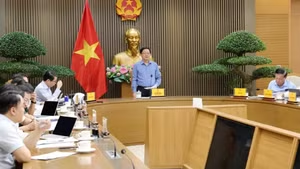
According to Deputy Minister of Science and Technology Bui Hoang Phuong, the Ministry has so far received 28 proposals from ministries and sectors regarding the implementation and development of strategic technologies.
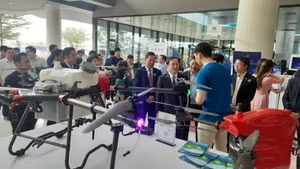
Following an initial review, many technologies – including AI cameras, autonomous mobile robots, UAVs, smart education platforms, as well as several vaccines, biologics and biotechnology products – have been assessed as highly ready, with expectations of breakthroughs and initial results by 2026.
In line with Resolution No. 57-NQ/TW, numerous research and technology development programmes and projects have been implemented in a coordinated manner across ministries, sectors, localities and enterprises, gradually realising the goal of mastering strategic technologies.
These are all areas in which Viet Nam already possesses a research base or pilot products, and which are ready to help address challenges in urban management, transport, security, agriculture, industrial production, logistics, healthcare and education.
Many enterprises are also proactively investing to master strategic technologies. Vingroup has built a Vietnamese-language dataset of more than 350 billion tokens, developed large language models with up to 420 billion parameters, and is gradually forming an AI application ecosystem across the Group.
Similarly, Phenikaa Group has chosen to focus on five core technology groups: semiconductors, autonomous technologies, biomedical technologies for precision medicine, advanced materials and energy storage. These are all priority fields identified in Resolution No. 57-NQ/TW as national strategic technologies.
Importantly, each research direction is linked to the United Nations Sustainable Development Goals, spanning education, employment, industrial infrastructure, healthcare and clean energy. This approach demonstrates that the objective is not only to master technology but also to transform it into solutions for national development challenges, thereby improving quality of life.
Although certain results have been achieved, the implementation of strategic technologies currently faces many obstacles: an unsynchronised legal framework, shortages of skilled personnel, fragmented research infrastructure, and weak connections between institutes, universities and enterprises.
Speaking at the national conference reviewing one year and six months of Resolution No. 57-NQ/TW’s implementation, Luu Anh Tuan, Deputy General Director of VinSmart Future Joint Stock Company, noted that most Vietnamese enterprises still rely on foreign AI models, resulting in high costs, technological dependence and potential data risks.
Additionally, computing infrastructure remains a major bottleneck, as the cost of purchasing or co-investing in graphics processing units (GPUs) exceeds the capacity of many enterprises and research institutions.
In his view, in the current AI race, the greatest barrier is no longer algorithms but institutions and infrastructure.
To overcome these bottlenecks, he proposed that the Government establish a national AI programme, focusing on the development of foundational AI models such as large language models, multimodal models, AI for robotics, smart manufacturing and other strategic fields.
He also emphasised the need to invest in a national AI computing infrastructure under a shared-use model, similar to cloud computing, to enable research institutes, universities and enterprises to access computing capacity at reasonable cost; and to improve institutions to create a favourable environment for AI development, such as building an AI sandbox mechanism for new technologies.
Realising Viet Nam’s strategic technology development goals is a completely new task – highly complex and interdisciplinary – and it requires coordinated involvement from ministries, sectors, agencies and localities.
Deputy Minister of Science and Technology Bui Hoang Phuong
Responding to the requirement to realise strategic technology development goals, Deputy Minister Bui Hoang Phuong stated that this is a completely new task, highly complex and interdisciplinary, requiring coordinated involvement from ministries, sectors, equivalent agencies and localities.
For highly complex fields such as satellite technology, high-speed railways or rare earth exploration and processing, research and development must be carried out systematically, with a clear roadmap to 2026 and a vision to 2030.
In the coming period, the Ministry of Science and Technology will mobilise resources to review and appraise all proposals and strategic technology challenges, thereby selecting key tasks for concentrated investment.
To create additional momentum, the Ministry has also proposed advising the Government to implement a controlled testing mechanism (sandbox) for the ordering and procurement of strategic technology products and for venture capital funds.
The focus is on expanding the scope of special mechanisms such as research commissioning, results-based contracting, procurement of the first batches of strategic technology products developed by domestic enterprises, and state-capital venture investment.