At the national conference evaluating the 18 months of executing Resolution No.57-NQ/TW, Party General Secretary and State President To Lam emphasised that science, technology, innovation, and digital transformation are the primary drivers of Viet Nam's new development and growth model. He reiterated that these are not matters of choice, but an inevitable path towards actualising the nation's development aspirations.
Notably, alongside directives on institutions, infrastructure, and technology, the Party General Secretary and State President placed particular emphasis on the development of human resources — a fundamental, long-term task that must begin without delay. He observed that if Viet Nam strives to cultivate a high-quality workforce capable of advancing science and technology over the next decade, it must determine today whom to train, in which disciplines, in what areas of basic science, and under what training models.
He emphasised that a highly skilled workforce cannot be cultivated overnight but demands systematic investment and a long-term vision, particularly as fewer than two decades remain before Viet Nam's 2045 development goals.
These directives demonstrate that human resource development is no longer solely the responsibility of the education sector. Rather, it has become a strategic national priority that will dictate the success of Resolution No.57-NQ/TW and fortify the country's competitiveness in the new era of development.
Eliminating the bottleneck in the scientific workforce
Experience over the past 18 months of executing Resolution No.57-NQ/TW has demonstrated that research institutes and universities are increasingly acknowledging their role not only as providers of education and training, but also as hubs for identifying, nurturing, and attracting talent, developing new technologies, and contributing directly to the country's economic growth. Mastering strategic technologies requires, first and foremost, a pool of highly capable scientific talent. Yet for that talent to actualise its full potential and deliver sustained contributions, competitive remuneration alone is not enough. Equally important are world-class academic environments, opportunities to tackle major national challenges, and an enabling policy framework that allows researchers to innovate freely and catalyse knowledge into tangible value for national development.
According to Professor Dr Tran Hong Thai, President of the Viet Nam Academy of Science and Technology (VAST), the spirit of Resolution No.57-NQ/TW transcends merely attracting scientific talent. It seeks to forge a comprehensive ecosystem for discovering, nurturing, attracting, empowering, and fully deploying outstanding researchers.
In line with the Party General Secretary and State President's directives on preparing the workforce of the future and instituting new mechanisms for scientists, VAST has proactively actualised these orientations into a comprehensive policy framework covering every stage of talent development — from talent identification, education, and recruitment to career development, incentives, and recognition — ensuring that every scientist has a clear career pathway and long-term opportunities to contribute.
To actualise this vision, the Academy has instituted a range of dedicated programmes to bolster early-career researchers, attract outstanding talent, cultivate leading scientists, and establish internationally competitive research groups. At the same time, it has continued to enhance working and living conditions for its research staff.
Entering a new stage of development, VAST is transitioning from merely executing existing policies to proactively proposing and taking the lead in actualising the breakthrough mechanisms envisaged under Resolution No.57-NQ/TW and the Law on Science, Technology, and Innovation. These include instituting competitive salary and remuneration schemes for leading scientists, adopting outcome-based funding mechanisms that recognise the inherent risks and time lags of scientific research, and granting greater institutional autonomy to research organisations and principal investigators.
In addition, the Academy has designated the work of talent attraction as a targeted endeavour, aligned closely with the National List of Strategic Technologies issued under Decision No. 21/2026/QD-TTg. This approach ensures that human resources are concentrated in the strategic fields where the Government expects VAST to secure technological mastery, rather than being spread too thinly across multiple disciplines. This strategic shift is set to reshape the Academy's talent development agenda over the coming term.
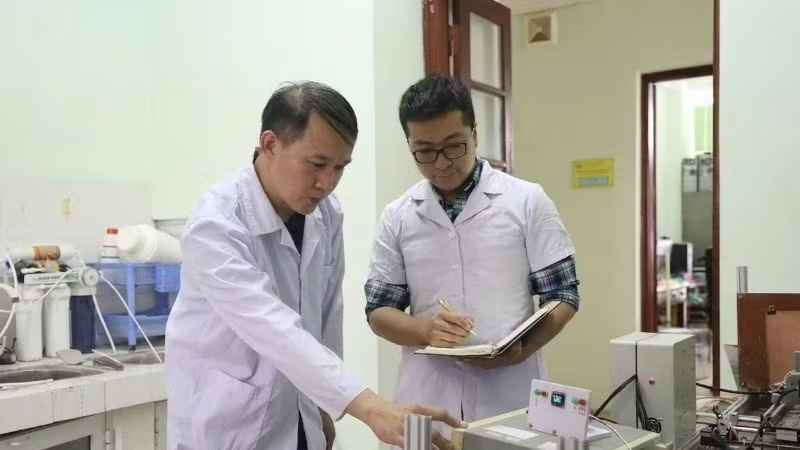
According to Professor Dr Tran Hong Thai, the essence of Resolution No. 57-NQ/TW lies in integrating science and technology into practice, addressing the country's major challenges, and contributing directly to economic growth. With this in mind, VAST has committed to working closely with ministries, sectors, local authorities, and businesses to execute interdisciplinary initiatives spanning low-altitude economy development, space monitoring, agriculture, and disaster prevention and control. These missions demand not only outstanding scientists but also chief engineers and chief designers capable of bridging scientific research with practical applications and market demand.
However, based on the implementation experience, Professor Dr Tran Hong Thai asserts that the greatest challenge today does not lie in policy direction. Resolution No.57-NQ/TW and related policies have already forged a relatively comprehensive institutional framework. The real bottleneck, he argued, remains implementation.
One pressing issue is staffing. While public-sector streamlining policies demand workforce reductions, many leading scientists are reaching retirement age, making it increasingly difficult for the Academy to recruit and cultivate the next generation of researchers. At the same time, remuneration remains insufficiently competitive, exacerbating an ongoing brain drain, particularly in strategic technology fields.
The slow execution of new mechanisms governing finance, institutional autonomy, and incentives has also constrained the effectiveness of policies designed to attract experts, especially overseas Vietnamese professionals and international scientists.
Experience from executing Resolution No.57-NQ/TW suggests that, despite encouraging progress in institutional reform and heightened awareness of the importance of science and innovation, significant bottlenecks remain in developing the country's scientific, technological, and innovation workforce. The challenge extends beyond policies on attracting, employing, and rewarding talent. It also lies in how the education, research, and innovation ecosystem is organised to ensure that resources are effectively connected and fully deployed.
A report presented by Viet Nam National University, Ho Chi Minh City, at the national conference evaluating the first 18 months of Resolution No.57-NQ/TW pinpointed the higher education system's most critical weakness: education, research, and innovation continue to function largely as separate activities, rather than as an integrated value chain linking education, research, technology transfer, and the commercialisation of research outcomes.
In response, Viet Nam National University, Ho Chi Minh City, has instituted a government–university–business partnership ecosystem, with universities serving as the central hub connecting talent, knowledge, technology, and social resources. The model strives to catalyse knowledge into technologies, businesses, and new engines of national economic growth.
Overhauling education and training for high-quality human resources
The reality demonstrates that, amid intensifying global technological competition, competitive advantage no longer belongs to countries that merely educate skilled workers, but to those capable of attracting, cultivating, and fully harnessing top talent. From semiconductors and quantum technology to artificial intelligence and data science, the availability of a highly skilled workforce has become a decisive factor in national competitiveness. In line with the spirit of Resolution No.57-NQ/TW, science and technology must become a genuine driver of economic growth and be actualised into practical solutions for national development.
To actualise this objective, experts and scientists agree that Viet Nam must urgently eliminate institutional bottlenecks while executing coordinated measures to develop, attract, and effectively deploy high-quality human resources.

According to Associate Professor Dr Dao Ngoc Chien, Director of the National Foundation for Science and Technology Development (NAFOSTED), identifying, nurturing, and supporting young scientists should be designated as a strategic priority if Viet Nam is to forge a world-class scientific workforce. Beyond education and remuneration policies, he emphasised the importance of fostering a supportive academic environment where young researchers can join leading research groups, access modern research infrastructure, and expand their engagement with international scientific networks, enabling them to cultivate their expertise and pursue long-term research careers.
To actualise this vision into action, NAFOSTED will initiate the Viet Nam Research Excellence Fellowship (VREF), a new programme designed to identify, select, and support outstanding doctoral candidates in priority fields of science and technology. In addition to providing research funding, the programme will enable fellows to participate in leading research groups and collaborate with distinguished scientists in Viet Nam and abroad, helping to cultivate a new generation of internationally competitive researchers capable of commanding strategic technologies.
To further advance the exectuion of Resolution No.57-NQ/TW in line with the directions of the Party General Secretary and State President, Professor Dr Tran Hong Thai emphasised the urgent need to eliminate institutional bottlenecks to secure breakthroughs in cultivating and attracting scientific talent. Priority should be given to establishing special mechanisms governing staffing, salaries, and incentives for research organisations; accelerating the execution of the provisions set out in Resolution No.57-NQ/TW and the Law on Science, Technology, and Innovation; and instituting sufficiently attractive policies to attract international experts, overseas Vietnamese intellectuals, as well as chief designers and chief engineers capable of bridging research, production, and the marketplace.
At the same time, he advocated for granting greater autonomy to scientific organisations and fostering favourable conditions for the establishment of science and technology enterprises, thereby accelerating the commercialisation of research outcomes.
Looking ahead to the exectuion of Resolution No.57-NQ/TW, Professor Dr Tran Hong Thai stated that the VAST strives for outstanding talent to account for at least 20% of all new recruits by 2030. The Academy also intends to diversify its talent attraction mechanisms by appointing leading researchers to head scientific projects and expanding programme- and project-based research collaborations, rather than relying solely on permanent staffing quotas. Alongside prioritising strategic technology fields, VAST is committed to forging a research environment capable of retaining young scientists over the long term. As Professor Thai observed, attracting talent is only the first step; the greater challenge is fostering the conditions for talented individuals to actualise their full potential and contribute meaningfully to the country's development.
With the strategic ambition of becoming Asia's leading innovation and entrepreneurial university, Ha Noi University of Science and Technology (HUST) has already instituted many of the key components of a university-based innovation ecosystem. Although collaboration among government, universities, and businesses has been forged to varying degrees, its sustainability and broader impact remain limited. According to Professor Dr Le Anh Tuan, President of HUST, the successful execution of Resolution No.57-NQ/TW and Resolution No.71-NQ/TW demands a fundamental shift from the traditional education model towards an innovation ecosystem in which education, research, and technology transfer are integrated into a unified value chain.
Accordingly, HUST is comprehensively overhauling its education, research, and innovation activities with the goal of forging a fully integrated ecosystem within the university itself, enabling technologies to move rapidly from laboratories to businesses and the marketplace. Professor Le Anh Tuan elucidated that this ecosystem is built upon three pillars: generating frontier knowledge and core technologies through research institutes and key laboratories; strengthening university–industry collaboration via joint laboratories and prototyping centres; and accelerating the commercialisation of research outcomes.
This approach is designated as a crucial solution for cultivating a highly skilled workforce, synchronising scientific research with real-world demand, and meeting the country's strategic technology development goals.
Experience has demonstrated that, in the global race for technological leadership, opportunities will not wait for countries that are slow to reform. Eliminating institutional barriers in a timely manner and developing, attracting, and effectively deploying top talent are therefore not merely priorities for the science and technology sector. They are strategic imperatives for elevating Viet Nam's national competitiveness, actualising the vision articulated by Party General Secretary and State President To Lam, and catalysing the transformation of the goals of Resolution No.57-NQ/TW into tangible results.