Experts and scientists note that the documents of the 14th National Party Congress and the 13th‑tenure Politburo’s resolution have shaped a development path that places science, technology, innovation and digital transformation at its core; economic growth will move from breadth to depth and establish a new model capable of achieving double‑digit rates.
Significantly, Politburo’s Resolution No. 57‑NQ/TW dated December 22, 2024 identifies science, technology, innovation and digital transformation as the foundation and principal drivers for renewing the development model, improving productivity, quality and competitiveness, developing new productive forces and building an independent, self‑reliant economy.
The resolution not only underscores the role of science and technology but also sets out requirements to build a national innovation ecosystem, digital infrastructure, a national data system, a science and technology market, new policy‑testing mechanisms, risk‑acceptance mechanisms and incentives to foster enterprise innovation.
Associate Professor Dr Vu Sy Cuong from the Academy of Finance described Resolution No. 57‑NQ/TW as a bold shift marking a strategic turning point: moving from a growth model reliant on capital and cheap labour to one based on productivity, science, technology and innovation.
Resolution No. 57‑NQ/TW as a bold shift marking a strategic turning point: moving from a growth model reliant on capital and cheap labour to one based on productivity, science, technology and innovation.
Associate Professor Dr Vu Sy Cuong from the Academy of Finance
Likewise, Politburo’s Resolution No. 68‑NQ/TW dated May 4, 2025 on private‑sector development defines the private sector as a pioneering force in advancing science, technology, innovation and digital transformation. These documents and resolutions provide crucial policies and orientations to make science and technology the central drivers of growth.
Alongside the Party’s orientations, the National Assembly, via its Committee for Economic and Financial Affairs, has translated policy into law by enacting statutes such as: the Law on Science, Technology and Innovation (Law No. 93/2025/QH15); the Law amending and supplementing certain articles of the Technology Transfer Law (Law No. 115/2025/QH15); the High Technology Law (Law No. 133/2025/QH15); and the Law amending and supplementing certain articles of the Intellectual Property Law (Law No. 131/2025/QH15), among others.
These laws hold strategic significance, creating a firm legal framework and a springboard to promote science, technology, innovation and digital transformation as central drivers of economic growth.
Although policies, strategies and laws specify development requirements based on science and technology, experts and scientists point out that practical operation of the economy still faces barriers: an administrative mindset and rigidity in scientific management persist; there is a shortage of financial resources and inadequacies in allocation mechanisms; and a gap remains between laboratory research and consumer markets.
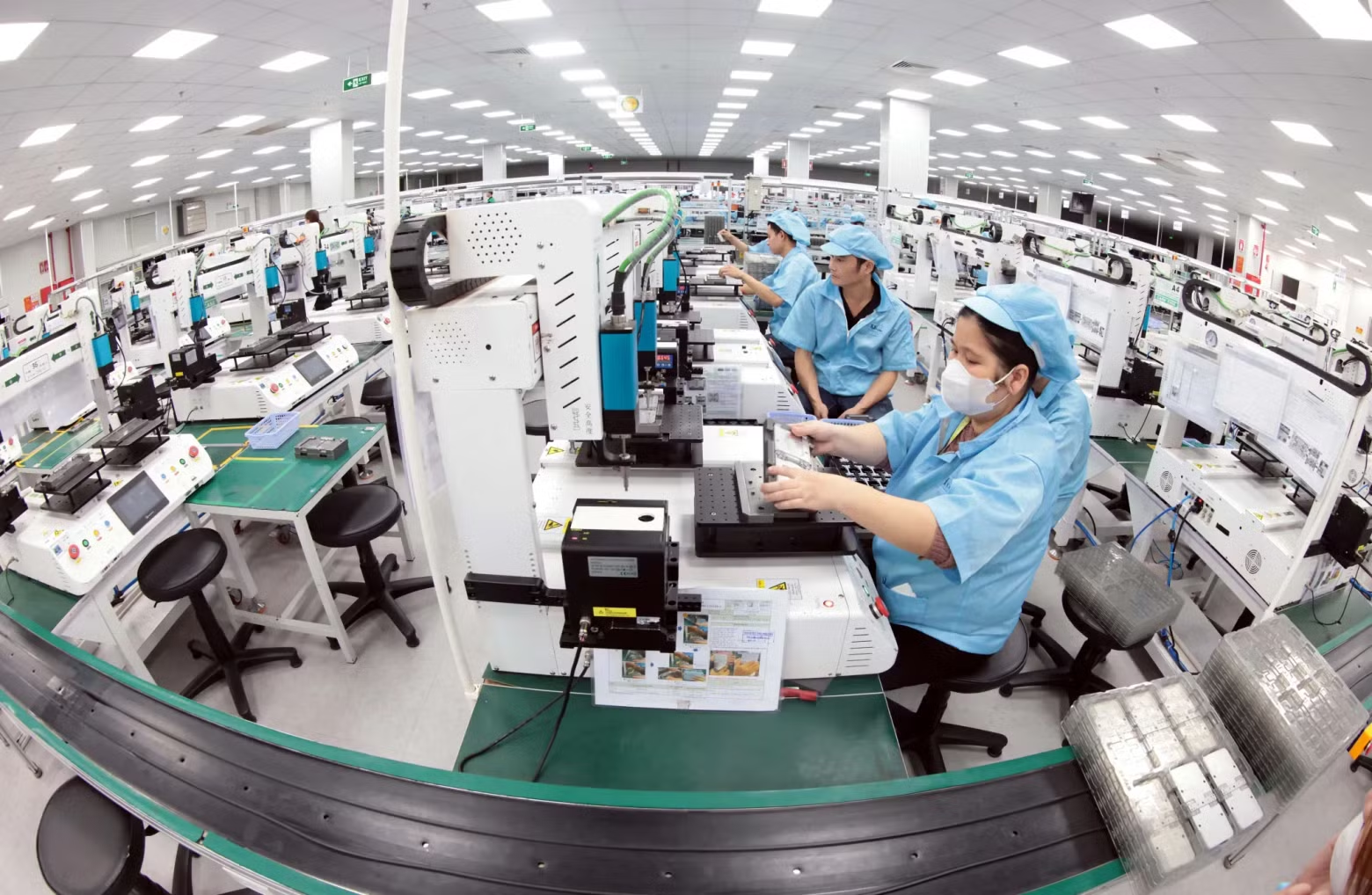
In addition, enterprises have not been genuinely placed at the centre of the innovation ecosystem, while issues around intellectual property, valuation and appraisal of research assets remain problematic.
Therefore, to make science, technology, innovation and digital transformation the central drivers of economic growth, Tran Kim Chung, former Deputy Director of the Central Institute for Economic Management, stressed that resources must be concentrated on developing science and technology; in particular, attention should be paid to developing strategic industries and technologies such as artificial intelligence and big data, while accelerating the training and utilisation of high‑quality human resources. The development process needs to properly assess and leverage the role of science and technology in creating new economic forms based on new resources.
According to Associate Professor Dr Vu Sy Cuong, it is necessary to complete and simplify disbursement procedures at financial funds supporting small and medium‑sized enterprises; simplify procedures so businesses can access policy incentives.
At the same time, mechanisms should be implemented to allow co‑funding of research and development for enterprises; pilot mechanisms for commissioning or purchasing enterprises’ innovative products to create markets for start‑ups.
A thorough restructuring is needed of the state budget management mechanism for science, technology, innovation and digital transformation — moving from a post‑audit, invoice‑based system to one managed by output results and performance targets.
Notably, state management agencies should improve financial management mechanisms for public‑sector scientific and technological activities and use budgets in a simpler way, with units held accountable for final results.
Many experts and researchers believe a thorough restructuring is needed of the state budget management mechanism for science, technology, innovation and digital transformation — moving from a post‑audit, invoice‑based system to one managed by output results and performance targets.
Mechanisms should be established to grant full ownership rights, including rights of use, valuation and transfer for patents and intellectual property created using public funds to the leading research organisations or directly to the scientists.
When these assets are properly valued and successfully contributed as capital to spin‑off enterprises that generate commercial profit, the State will recover its investment through corporate income tax and personal income tax from the new value chains formed. This will help ensure that science, technology, innovation and digital transformation have indeed become the central drivers of economic growth.