Beneath the simple thatched roof
Visiting Kim Lien at this time of year, perhaps the most memorable image is the sight of lotus ponds in full bloom, their gentle fragrance spreading through the air as if welcoming Uncle Ho’s birthday.
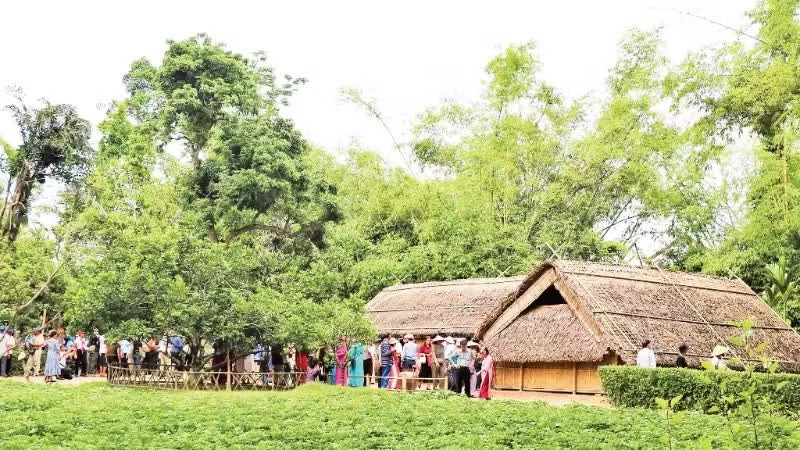
Standing beside the simple thatched house and familiar bamboo hedges, Nguyen Bao Tram from Dong Nai Province slowed her steps. Looking at the sacred keepsakes associated with President Ho Chi Minh’s childhood that are now weathered by time, and listening to the warm, heartfelt stories about his life shared by a female guide in the distinctive Nghe dialect, tears rolled down her cheeks. Having followed her parents from Nghe An to settle in the Southeast region when she was young, this was her first opportunity to return to her ancestral homeland during the emotionally charged days of May.
One hundred and thirty-six years later, the bamboo-walled thatched house in Hoang Tru Village remains almost unchanged. The small courtyard, areca trees, hibiscus fence, and green bamboo groves still stand there. Inside the house are the small xoan wood bed and the weaving loom once used by Hoang Thi Loan, President Ho Chi Minh’s mother, to spin thread and weave cloth. The rhythmic sound of weaving and lullabies by the hammock helped nurture young Nguyen Sinh Cung’s character and values. Hoang Tru may be seen as the image of a hardworking mother, while Sen Village embodies the example of a dignified father. Together, these roots shaped a Ho Chi Minh, who was both great and deeply connected to his homeland.
Among the crowds returning to Hoang Tru, the homeland of President Ho Chi Minh mother’s and Sen Village, the homeland of President Ho Chi Minh father’s, are people of all ages from every corner of the country, carrying fresh lilies and lotus flowers to offer in tribute. Deeply moved, Nguyen Van Phuong, who was born in 1955 and is a member of the Veterans Association of Phu Son Commune in Ninh Binh Province, said: “Listening to the guides introduce the sacred keepsakes associated with Uncle Ho’s childhood and family made me love and admire him even more. There are emotions beyond words.” Meanwhile, Tran Nguyen Chau Anh, an eighth-grade student from Le Loi Secondary School in Thanh Vinh Ward, Nghe An Province, expressed pride in being among 77 outstanding students selected by her school to visit Uncle Ho’s homeland.
Some visitors come to Kim Lien for the first time, while others know every small path by heart. Yet each journey remains an emotional experience, both intimate and sacred. Though they come from different regions and carry different feelings, all share profound respect and gratitude for the beloved father figure of the Vietnamese nation. Veteran Lai Huu Anh, born in 1962, said that each year on President Ho Chi Minh’s birthday, he wishes to return with his children and grandchildren to offer incense in remembrance of the leader who devoted his entire life to the country. He then emotionally recited lines from poet To Huu: “Oh Uncle, your heart was vast indeed / Embracing the nation and every human life.”
Promoting value of relics dedicated to President Ho Chi Minh
On average, the Kim Lien National Special Relic Site receives more than two million domestic and international visitors each year. To fulfil its role as a bridge connecting visitors with President Ho Chi Minh’s legacy, the site’s management has consistently focused on training guides, improving foreign-language proficiency, refining communication and service skills, and enhancing professional standards.
Nguyen Bao Tuan, the director of the relic site, said that among the 17 guides currently working there, five can provide tours in English and eight in Lao, leaving strong impressions on international visitors.
Bui Thi Bich Dam, Head of the Communications and Education Division at the site, shared that guides always carry deep affection in their hearts and strive through every story and artifact to convey meaningful messages that touch visitors emotionally. The profound affection that people nationwide hold for President Ho Chi Minh serves as a great source of encouragement for staff to continue promoting the site’s values and the people’s enduring love for him.
For its outstanding achievements, the collective of officials and employees at the Kim Lien National Special Relic Site has received numerous prestigious honours from the Party and State. Most notably, the site was awarded the Labour Order, First Class for the second time by the State President on the occasion of the 70th anniversary of its establishment and the 136th anniversary of President Ho Chi Minh’s birth (May 19, 1890 – May 19, 2026). According to the site’s director, the award recognises the lasting contributions of generations of staff and serves as a major source of motivation for them to continue preserving and promoting President Ho Chi Minh’s heritage in his homeland.
Tran Thi My Hanh, Director of the Nghe An Provincial Department of Culture, Sports and Tourism, said that over many terms, Nghe An Province has consistently identified the preservation, restoration, and promotion of the Kim Lien National Special Relic Site as an especially important political task. The province has introduced numerous policies, projects, and investment programmes aimed at developing Kim Lien Commune through cultural and tourism development, with the relic site serving as the central core and a “red address” of special historical, cultural, political, and spiritual significance.
Accordingly, the province has not only focused on preserving the original relics but also expanded the Ho Chi Minh cultural space; invested in transport infrastructure, landscapes, and tourism facilities; and strengthened connections among destinations. After years of investment and improvements in tourism management and infrastructure, the Ministry of Culture, Sports and Tourism recently recognised the Kim Lien National Tourism Area based on the Kim Lien National Special Relic Site.
The recognition as a National Tourism Area affirms the important role and status of the Kim Lien National Special Relic Site within Viet Nam’s system of national tourism areas. It is a source of pride for the Party organisation, authorities, and people of Nghe An Province, further highlighting the special place of President Ho Chi Minh’s homeland in preserving national cultural heritage, educating younger generations about patriotism, and promoting sustainable tourism development.