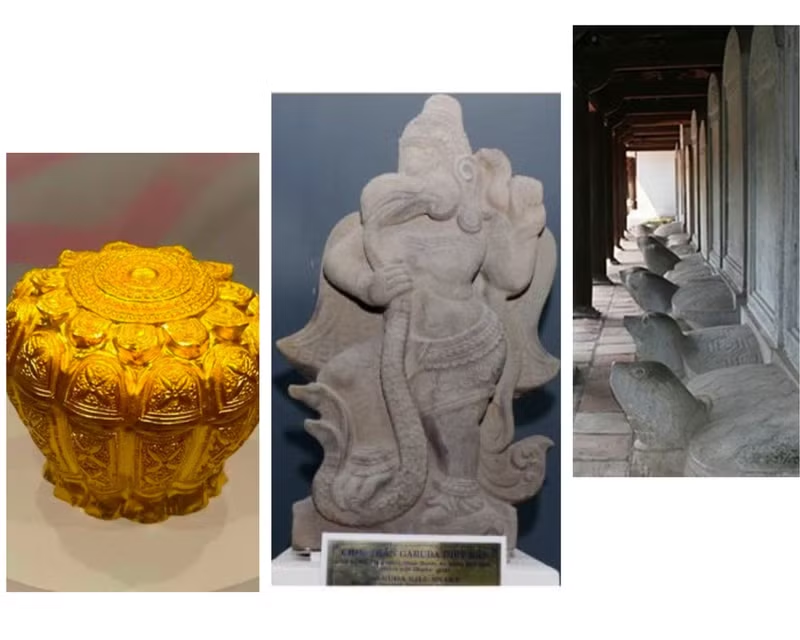
From authentication and conservation to heritage urban development, digitisation, and bringing Vietnamese heritage to the world, the goal is to turn heritage into a resource for development while safeguarding its authenticity, integrity, and core values.
Nhan Dan Newspaper has met with Le Thi Thu Hien, Head of the Department of Cultural Heritage, to discuss policies and solutions to protect and promote the value of Viet Nam's cultural heritage in the new period.
Establishing rapid response mechanism to bring antiquities home
Q: To implement the policy of a 100% tax exemption for the non-profit repatriation of antiquities, together with a mechanism for “timely” funding to bid for antiquities at overseas auctions under National Assembly Resolution No. 28/2026/QH16, dated April 24, 2026, how will the Ministry of Culture, Sports and Tourism coordinate with other ministries and sectors to establish a “rapid response process”, helping Viet Nam avoid missing opportunities to bring national treasures home?
A: To institutionalise Politburo Resolution No. 80-NQ/TW, dated January 7, 2026, on developing Vietnamese culture, the National Assembly issued Resolution No. 28/2026/QH16, dated April 24, 2026, on developing Vietnamese culture, while the Government issued Decree No. 282/2026/ND-CP, dated July 14, 2026, detailing a number of articles and providing guidance on the implementation of Resolution No. 28/2026/QH16 dated April 24, 2026.
These documents have removed two major bottlenecks in bringing antiquities home: creating preferential mechanisms to mobilise social resources and ensuring the timely allocation of state budget funds.
Accordingly, organisations and individuals that purchase, bid for, and bring to Viet Nam, on a non-profit basis, objects meeting the conditions prescribed by law will be exempt from 100% of import tax and customs fees and will not be subject to value-added tax.
In particular, Article 23 of Government Decree No. 282/2026/ND-CP dated July 14, 2026 specifically stipulates the timely allocation of funds to bring national treasures and valuable and rare Vietnamese-origin antiquities held overseas back to the country.
Accordingly, the Ministry of Culture, Sports and Tourism will identify objects in accordance with the law on cultural heritage and submit them to the Prime Minister for consideration and approval of the policy on using state budget funds. It will then prepare a dossier and send it to the Ministry of Finance for submission to the competent authority for funding allocation.
This includes necessary costs for purchasing or bidding for the objects, transfer of ownership, legal services, insurance, packaging, transportation, temporary storage, and ensuring the security and safety of the objects.
On this basis, the Ministry of Culture, Sports and Tourism will serve as the focal point for coordinating with the Ministry of Foreign Affairs, Ministry of Finance, Ministry of Public Security, Ministry of Justice, and Vietnamese representative missions overseas to establish an early-warning, appraisal, and dossier-processing mechanism.
The Ministry of Foreign Affairs will support the identification of opportunities, establishing contacts, and handling procedures in the host country; the Ministry of Public Security will coordinate in verifying provenance, legality, and signs of unlawful transactions; the Ministry of Justice will support the handling of international legal issues; and the Ministry of Finance will arrange funding and direct customs authorities in implementing policies on taxes, fees, and customs procedures.

The goal is to process cases swiftly while ensuring rigour and transparency, accurately determining the value and lawful provenance of objects; avoiding missed opportunities to bring the nation's valuable heritage home while using state budget funds effectively.
This provides the basis for establishing a “rapid response” mechanism, shortening the time needed for consideration and decision-making while ensuring close and transparent coordination among ministries and sectors at every stage of the process of bringing heritage home.
Building a team of heritage experts as “gatekeepers”
Q: After antiquities have been recovered, authentication and display become pressing issues. How will the ministry use state budget support to quickly build a specialised team in authentication and curatorship — those who serve as “gatekeepers” of the quality and value of the nation's heritage?
A: Article 41 of the 2024 Law on Cultural Heritage clearly stipulates the conditions for the authentication of relics and antiquities and the standards applicable to authentication experts, while clearly establishing their legal responsibility for authentication results.
Government Decree No. 308/ND-CP, dated November 28, 2025, which details a number of articles and measures for organising and guiding the implementation of the Law on Cultural Heritage, stipulates in Section 2, Chapter IV (Articles 27, 28, and 29) the order, procedures, and dossiers for the issuance, reissuance, and revocation of certificates for experts authenticating relics and antiquities. These strict regulations will help improve the quality of the team of experts authenticating relics and antiquities and prevent violations during the authentication process.
At present, experts in archaeology, history, fine arts, museology, and materials science have basically demonstrated their capabilities, contributing to determining the authenticity, provenance, and value of objects. However, authentication is a highly specialised field that depends heavily on experts' accumulated knowledge and experience. Therefore, the long-term requirement is to pass on and transfer knowledge, train a new generation of experts, and strengthen the application of science and technology in authentication.
Article 28 of Government Decree No. 282/2026/ND-CP, dated July 14, 2026, detailing a number of articles and providing guidance on the implementation of National Assembly Resolution No. 28/2026/QH16 dated April 24, 2026 on developing Vietnamese culture, provides a mechanism for financial support for domestic and overseas training and professional development for high-quality human resources in the cultural sector. This includes two groups that directly serve as “gatekeepers”: curatorial personnel and personnel responsible for authenticating cultural and artistic works and cultural heritage.
Developing heritage cities while preserving core values
Q: Building on accurately authenticated heritage, what criteria will the Ministry of Culture, Sports and Tourism advise localities to use when piloting the “Heritage City” model, so that they can make effective use of land and fee incentives to develop cultural industries while preserving the original core values amid commercialisation pressures?
A: To institutionalise the provisions on “Heritage Cities” in National Assembly Resolution No. 28/2026/QH16 dated April 24, 2026, Government Decree No. 282/2026/ND-CP dated July 14, 2026 sets out specific criteria, principles, and authorities for determining the scope and areas in which the cultural heritage urban model will be piloted. It also provides preferential mechanisms and policies on land, fees, and charges to create resources for conserving and promoting heritage values and developing cultural industries.
Accordingly, a locality may be selected to pilot the cultural heritage urban model when it meets five groups of criteria: a) it has heritage associated with the process of its formation and development and a close relationship in which heritage values contribute to creating the value of the city; b) it has at least two tangible or intangible cultural heritage properties or documentary heritage recognised, ranked, or inscribed by Viet Nam or UNESCO, which are effectively protected and promoted and contribute to socio-economic development, tourism, and cultural industries; c) it has effective regulations and systems for managing, protecting, and promoting cultural heritage values, ensuring the preservation of original elements, the community's cultural space, spatial structure, landscape, and architecture, while appropriately controlling construction and service activities in heritage areas; d) it has practical experience in investment, conservation, restoration, management, and promotion of heritage values, while ensuring sustainable cultural, economic, social, and environmental development; and e) it has a World Heritage site whose overall economic value has been assessed and internationally published, as well as a museum meeting Grade II standards or higher.
Government Decree No. 282/2026/ND-CP dated July 14, 2026 provides preferential mechanisms on land, fees, and charges for localities piloting the cultural heritage urban model. The application of these incentives must be linked to heritage planning and management and protection plans, ensuring that they do not affect original elements, landscapes, cultural spaces, or the carrying capacity of urban infrastructure.
Revenue from entrance fees to monuments, museums, and cultural facilities in the locality will be used to conserve, repair, restore, and promote heritage values, creating a mechanism for reinvesting in the protection of cultural heritage. This approach seeks to harness the value of cultural heritage to generate resources, while using those resources to further protect and promote heritage values, thereby limiting the risk of commercialisation undermining core values.
The ultimate goal is to establish “heritage cities” in which cultural heritage is not separated from contemporary life but becomes a resource for development. At the same time, all activities that exploit and use cultural heritage for socio-economic development, tourism, and cultural industries must respect the authenticity, integrity, original elements, landscape, and cultural space of heritage and ensure the interests of the communities that are the custodians of the heritage.
CRITERIA FOR PILOTING THE “HERITAGE CITY” MODEL
A locality may be selected for the pilot model when it meets five groups of criteria:
- It has heritage associated with its formation and development and contributing to the value of the city.
- It has at least two heritage properties recognised, ranked, or inscribed by Viet Nam or UNESCO and effectively protected and promoted.
- It has an effective system for managing, protecting, and promoting heritage, ensuring the preservation of original elements, landscapes, and cultural spaces.
- It has experience in conserving, restoring, and promoting heritage, linked to sustainable development.
- It has a World Heritage site whose overall economic value has been assessed and internationally published, as well as a museum meeting Grade II standards or higher.
Building a digital ecosystem to bring heritage closer to the public
Q: Beyond physical spaces, so that heritage is not confined to localities, what solutions does the ministry have to ensure that funding for national-level heritage digitisation and the pilot “Open Museum” model on digital platforms form a comprehensive digital cultural ecosystem, enabling the public to access heritage easily anytime and anywhere?
A: The Ministry of Culture, Sports and Tourism's policy is that the digitisation of cultural heritage must be implemented in a coordinated, interconnected, and substantive manner, rather than having each museum or locality develop a separate system with limited connectivity.
The central budget will prioritise developing shared infrastructure, standardising data, and digitising representative collections and heritage; local budgets and social resources will be mobilised to develop digital content and products suited to the characteristics of each locality.
Accordingly, the Ministry of Culture, Sports and Tourism has developed and completed the “Platform for Managing, Protecting and Promoting Cultural Heritage Values” by upgrading and integrating cultural heritage management information systems already deployed nationwide, developing a new digital map system for cultural heritage, displaying artefacts in the electronic environment, digitising 100 national treasures in 2D and three special national monuments in 3D, and updating them on the new platform.
The “Open Museum” model will not only expand exhibition spaces beyond museum walls but also connect museums with monuments, communities, schools, and the public on digital platforms. During implementation, priority should be given to researching and developing engaging stories centred on the value of cultural heritage and public needs. At the same time, modern, concise, visual, and interactive digital content should be developed to suit current trends in information consumption and technology use. Technology should serve as a tool to support storytelling and enhance experiences rather than replace the scholarly content and authentic value of cultural heritage.
The Ministry of Culture, Sports and Tourism will issue detailed guidelines for localities to implement the “Open Museum” model, clearly defining its objectives, criteria, content, organisational methods, technological requirements, data standards, coordination mechanisms, and resource mobilisation. Artefact data will gradually be standardised, assigned identification codes and connected to the national database. Forms of access will also be developed, including digital displays and exhibitions to serve storage needs, representation on digital maps, recreating historical artefacts in the digital environment, enabling 360-degree virtual visits and reproducing traditional art forms in accordance with Government Decree No. 277/2026/ND-CP dated July 9, 2026 on digital cultural infrastructure.
Effective pilot models will be evaluated, refined, and replicated with a view to establishing a unified digital cultural ecosystem that enables the public to easily access, explore, and interact with Vietnamese cultural heritage anytime and anywhere.
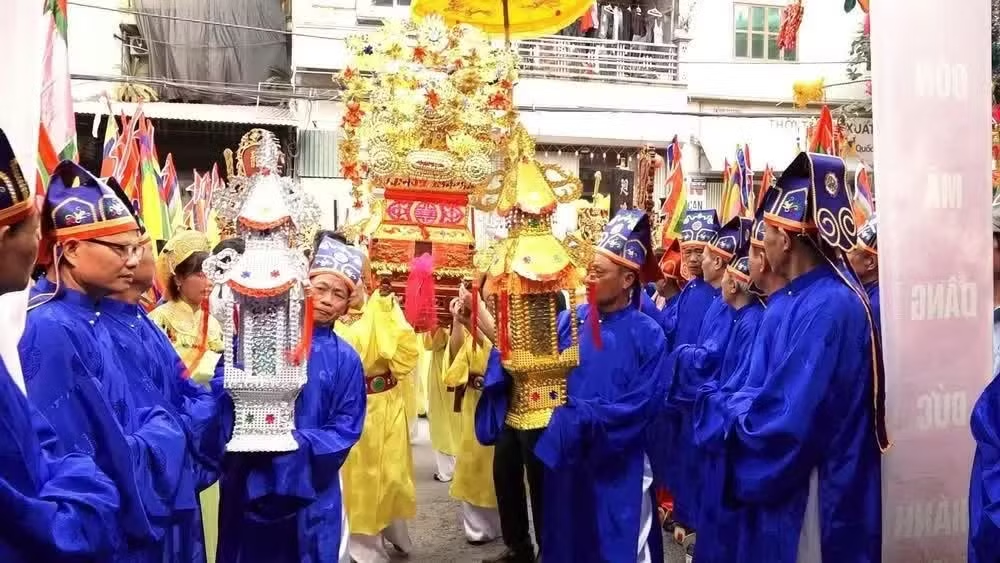
Q: Once heritage has been well preserved both on site and in the digital environment, could you share which representative collections the ministry has prepared so that it can proactively use state support funding to organise thematic exhibitions at prestigious museums around the world, completing the process of bringing Vietnamese heritage to global audiences?
A: At present, the country has more than 40,000 relic sites and nearly 70,000 inventoried intangible cultural heritage properties, including 37 heritage properties inscribed by UNESCO (comprising nine tangible cultural heritage properties, 17 intangible cultural heritage properties, and 11 documentary heritage properties); 149 special national relic sites ranked by the Prime Minister; 3,688 national relic sites; 735 intangible cultural heritage properties included in the National Intangible Cultural Heritage List; and 357 artefacts or groups of artefacts recognised by the Prime Minister as national treasures, 161 of which are preserved, displayed, and promoted at museums. Nationwide, there are 177 museums (including 94 public and 83 non-public museums), holding and displaying more than four million documents and artefacts, including many particularly rare and valuable collections and artefacts.
Politburo Resolution No. 80-NQ/TW dated January 7, 2026 identifies strengthening the promotion of Vietnamese culture and enhancing the country's soft power and international standing as one of the key tasks. To concretise this policy, Clause 2, Article 9 of National Assembly Resolution No. 28/2026/QH16 dated April 24, 2026 on developing Vietnamese culture stipulates that the state shall provide financial support for enterprises to implement programmes to promote, introduce, and export representative Vietnamese cultural products overseas. Article 20 of Government Decree No. 282/2026/ND-CP dated July 14, 2026 further provides specific regulations on developing and organising thematic exhibitions of representative Vietnamese cultural heritage collections at prestigious museums around the world.
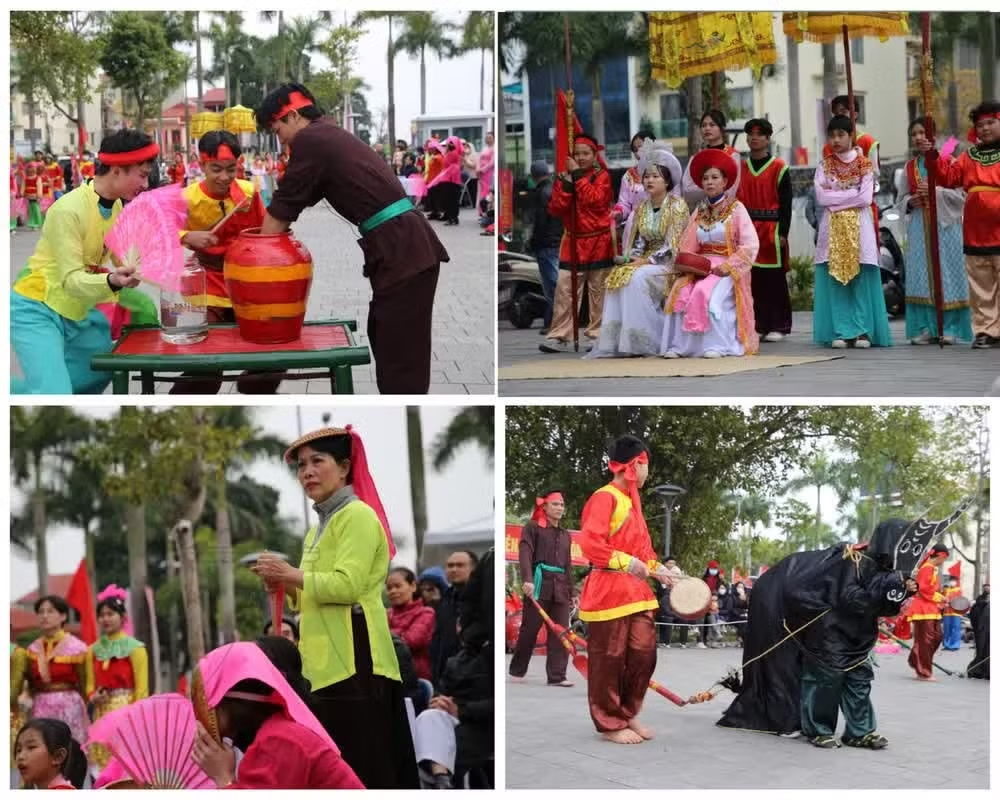
On this basis, the Ministry of Culture, Sports and Tourism will direct museums and localities to review and develop lists of representative valuable collections, prioritising national treasures, rare and valuable antiquities, and collections that clearly reflect Vietnamese cultural identity through different historical periods. Initial priorities will focus on representative historical cultures such as Phung Nguyen, Dong Son, Sa Huynh, Champa, and Oc Eo; imperial antiquities; Vietnamese ceramics and porcelain; traditional and Indochina art; the cultural heritage of ethnic groups; and Vietnamese cultural achievements in the modern period.
Selection will not be based solely on the value and rarity of artefacts and collections; it must also involve developing scholarly and engaging narratives capable of engaging international audiences and aligned with the country's foreign policy. In addition, every artefact and collection must have clear provenance, meet conservation and transportation requirements, have insurance and security and safety plans, and be approved by the Minister of Culture, Sports and Tourism.
The Ministry of Culture, Sports and Tourism will prioritise cooperation with prestigious museums with broad reach in key foreign-affairs locations and major cultural centres around the world. Through exhibitions of original artefacts combined with digital content, education, communications, and introductions to intangible cultural heritage, the ministry aims to present Viet Nam as a country with a long history, rich cultural identity, strong creativity, and a proactive approach to international integration, gradually bringing Vietnamese cultural heritage into the wider global cultural landscape.
Reporter: Thank you very much!