During the days of May, the relic site of Nguyen Thi An’s house on An Duong Vuong Street in Phu Thuong Ward, Ha Noi, welcomes many groups of visitors. Cong Ngoc Dung busily receives the guests. Whenever he stands before a crowd, he seems rejuvenated, speaking endlessly about the beloved house his grandparents built more than a century ago. It was the first place where President Ho Chi Minh stayed upon returning to Ha Noi after the success of the August Revolution, as he prepared for National Day on September 2, 1945.
Dung’s family donated the house to the capital’s authorities many years ago to become a memorial site dedicated to Uncle Ho, while he himself has remained an enthusiastic guide ever since.
When asked why, after so many years, he still recounts the same stories about Uncle Ho with such pride and passion, Dung replied: “I never had the chance to meet Uncle Ho, but stories about him have been passed down through generations in my family, from my grandmother Nguyen Thi An to my father and aunt. Everyone said that when Uncle Ho arrived, he had just recovered from an illness and looked very thin. Yet he worked all day long and took very little time to rest. Later, even when he became president and was burdened with countless affairs of state, he still returned to visit the house and ask after the family. He even shared a warm meal with us. How could anyone not feel moved and proud of such lessons in dedication, simplicity, and closeness to the people?”
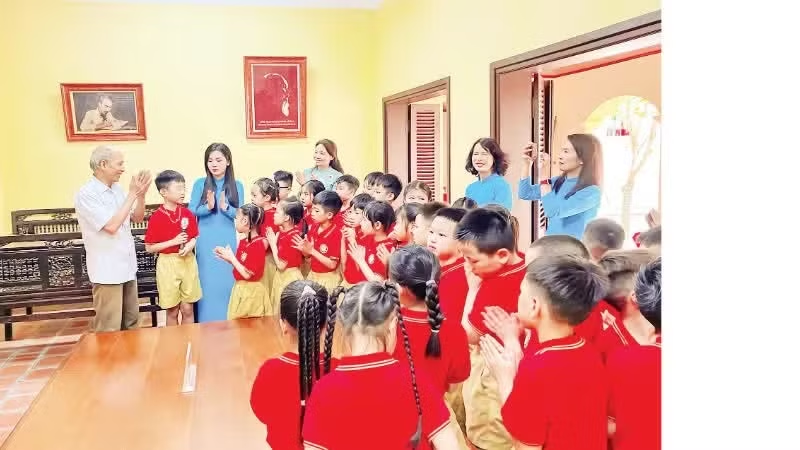
For decades, Dung’s family has maintained a beautiful tradition of gathering together to recall memories of Uncle Ho and teach younger generations about their family heritage. He happily shared that he had recently welcomed teachers and students from Phu Thuong Primary School to visit the site. “Local history lessons like these are truly necessary so that children can better understand their homeland and the beloved leader of the nation,” he said.
Ha Noi has hundreds of relics and locations connected to the life and activities of President Ho Chi Minh. Some are places where he lived and worked for many years, such as the Presidential Palace, the stilt house, and the K9 Da Chong historical site, which are all managed by the Ministry of Culture, Sports and Tourism. Others were places where he stayed or worked only briefly, including Nguyen Thi An’s house in Phu Thuong; House No. 48 Hang Ngang Street in Hoan Kiem Ward, where he wrote the Declaration of Independence; and the Ho Chi Minh memorial house in Van Phuc Ward, where he drafted the “Call for National Resistance.”
There are also sites where he stayed and worked while preparing to move to the Viet Bac resistance base, such as the Ho Chi Minh memorial house in Xuyen Duong Village, Dan Hoa Commune, and the memorial house in Phu Da Hamlet, Ha Bang Commune. Regardless of how long he stayed, the Party committees, authorities, and people of the capital have carefully preserved every site because even places Uncle Ho visited only briefly still hold precious lessons.
The year 2026 marks 80 years since Uncle Ho came to Xuyen Duong Village in Dan Hoa Commune. He arrived there during one of the country’s most difficult periods, shortly after issuing the “Call for National Resistance” in Van Phuc Silk Village. Throughout his stay in Xuyen Duong, he worked under tremendous pressure, making major national decisions while directing resistance efforts on multiple fronts across the country. Despite the overwhelming workload, he still found time to invite Nguyen Huy Chuc and his wife for a conversation. At the time, Nguyen Thi Dan had just given birth to their first daughter. Uncle Ho gave the baby a silver necklace and personally named her.
Another memorable story concerns Uncle Ho’s visit to members of Quan La Cooperative, now part of Tay Ho Ward. All cooperative members were surprised when he walked directly to the Vau field where they were harvesting rice. Deeply moved by his simplicity and care for the people’s lives, everyone spontaneously shouted: “Long live President Ho Chi Minh!” During that same visit, while admiring the ancient trees at Quan La Communal House, Uncle Ho reminded the local residents to preserve them carefully so future generations could continue to enjoy them.
Those ancient trees have continued to grow and are now cherished and protected by the people of Tay Ho Ward as priceless treasures. Within the grounds of Quan La Communal House, two relief sculptures of Uncle Ho have been erected to commemorate his visits to the local Party organisation, authorities, and residents. Generations of Tay Ho residents, especially youth organisations and schools, regard the site as an important place for traditional education.
Ha Noi was honoured to welcome Uncle Ho many times. Preserving sites associated with him is a source of pride for the people of the capital. Nguyen Doan Van, Director of the Ha Noi Relics and Landscapes Management Board, said that as the agency responsible for preserving and promoting historical sites across the city, the board has always worked closely with local authorities where relics linked to Uncle Ho are located to ensure the best possible preservation and promotion of their values.
The board has also promoted innovation in preserving and spreading the value of these relics. House No. 48 Hang Ngang Street, where Uncle Ho wrote the Declaration of Independence, has now integrated digital technology. On the second floor of the house, hologram technology recreates the image of President Ho Chi Minh drafting the Declaration. Meanwhile, the walls of the room use 3D mapping technology to project the historic moment when he read the Declaration of Independence at Ba Dinh Square. These technologies allow visitors and learners to vividly experience his expressions, smile, and voice.
In addition, artifacts associated with President Ho Chi Minh are now equipped with QR codes, enabling visitors to access detailed information and learn more about the objects and related historical stories. This has become an increasingly popular trend.
In recent years, Ha Noi has expanded local history lessons conducted directly at historical sites, with many classes being held at places connected to President Ho Chi Minh. Students in the capital can visit the places where he wrote the Declaration of Independence and where he drafted the “Call for National Resistance,” as well as other locations marking his visits and conversations with the people. In this way, the stories and lessons about the morality and lifestyle of President Ho Chi Minh continue to spread from generation to generation.