When support programmes are carried out in line with actual demands, these changes are reflected not only in statistical figures but also in every village and hamlet.
Thanh Hoa Province currently has 78 communes and 1,462 hamlets in ethnic minority-inhabited and mountainous areas, including 57 communes and 653 hamlets classified as particularly disadvantaged areas.
During the 2021–2025 period, the National Target Programme for socio-economic development in these areas has been implemented with total resources of more than 2.749 billion VND, mainly focusing on essential infrastructure investment, support for production development, vocational training, and improving living conditions for local people.
From these resources, more than 2,800 households have received support for production development linked to value chains; over 1,100 households have been supported with housing; more than 18,000 households have benefited from dispersed clean water supply; and over 20,000 people have received vocational training and employment support.
At the same time, hundreds of essential infrastructure projects such as transport roads, water supply works, cultural facilities, and healthcare facilities have been built or upgraded.
Policy-driven changes are creating visible improvements in ethnic minority-inhabited areas in Thanh Hoa Province. The rate of poor households in mountainous areas has fallen from 20.46% in 2022 to 5.19% in 2025.
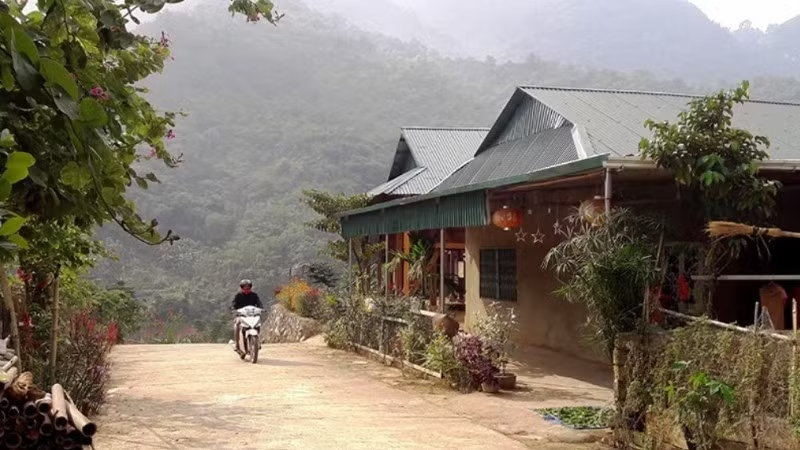
In the border commune of Muong Lat, improvements in infrastructure and living conditions are becoming increasingly evident. Inter-hamlet roads, once difficult to travel, are gradually being upgraded. The national power grid and clean water have reached most households. Schools, health stations, and cultural facilities have also been invested in, contributing to better living conditions.
“In recent years, ethnic policies and programmes have been implemented quite synchronously. Essential infrastructure has been gradually improved, creating conditions for people to develop production and stabilise their livelihoods,” said Trinh Van Bac, Chairman of the People’s Committee of Muong Lat Commune.
Livelihood support programmes have also gradually proven effective, helping people improve income and stabilise their lives. The commune’s rate of poor households has decreased by around 7% annually.
Per capita income in 2025 is estimated at 32.3 million VND, a significant increase compared to previous periods.
Cut Van Dan, Secretary of the Party cell and Head of Doan Ket Hamlet, said that changes in the village can be clearly felt year by year.
“In the past, it was very poor, roads were damaged, and many households still lived in temporary houses. In recent years, although difficulties remain, infrastructure has improved, housing is more solid, and living conditions are better,” he said.
Along with infrastructure investment, policies on production support and preferential credit have created additional conditions for people to develop household economies. For many households, these resources are crucial in helping them gradually stabilise their lives and escape poverty.
“Our family has received a lot of support from the State. My wife and I were supported with housing, production capital, health insurance cards, and even rice assistance,” shared Mong Van Dom from Doan Ket Hamlet.
Other mountainous communes in Thanh Hoa Province have also recorded positive changes as policies and programmes are effectively implemented.
In Dong Luong Commune, according to local data, at the beginning of 2021 the commune had 777 poor households, accounting for more than 30% of total households; by the end of 2025, this figure had dropped to 32 households, equivalent to 1.21%. This result stems from effective allocation of support resources, along with a focus on technical guidance and changes in production methods.
“We have implemented many policies to support production and preferential credit for poor, near-poor, and newly escaped-poverty households. Production models are built based on actual demands, helping people develop household economies. With access to capital and technical support, people are more confident in investing, and their incomes have been improved,” said Nguyen Thi Thanh Hoi, Vice Chairwoman of the People’s Committee of Dong Luong Commune.
Pham Van Nho, Head of Chieng Khat Hamlet, Dong Luong Commune, said that improvements in infrastructure and livelihoods are motivating people to change their ways of doing business. “When roads were rough like before, it was difficult to sell products. Now transport is more convenient, and people can access preferential loans, so many households have started expanding production,” he noted.
With access to capital and support programmes, many families in Chieng Khat Hamlet have gradually improved their livelihoods and escaped poverty.
The family of Pham Van Lanh is one example. “Life used to be very difficult. Thanks to preferential loans and support with livestock, our family started developing animal husbandry. By working hard step by step, we have managed to save and stabilise our lives,” he shared.
When policies are implemented in line with local conditions, people not only receive immediate support but also gain opportunities for long-term livelihood development. However, policy implementation in mountainous areas still faces many challenges due to complex terrain, scattered populations, and uneven production capacity.
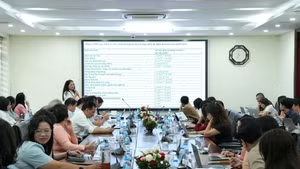
“During implementation process, programmes and policies are regularly monitored and evaluated to promptly resolve emerging difficulties. Coordination between sectors and localities is strengthened to ensure resources are used for the right purposes and beneficiaries” said Cam Ba Tuong, Deputy Director of the Department of Ethnic and Religious Affairs of Thanh Hoa Province.
According to Tuong, the effectiveness goes beyond poverty reduction, contributing to changes in the socio-economic landscape in mountainous areas.
“The difference in current ethnic policy implementation is the shift from direct support to supporting sustainable livelihoods. Ethnic policies are also integrated into a comprehensive programme, allowing financial resources to be more focused,” he added.
Bringing ethnic policies into practice is not just about individual support programmes, but a long-term process requiring synchronous, coordinated efforts across sectors and levels, as well as the participation of the people themselves.
When policies are implemented in the right direction and aligned with reality, positive changes will continue to spread to each household and hamlet, contributing to promoting socio-economic development in mountainous areas.