Co Dam Commune, Ha Tinh Province, is renowned for its centuries-old tradition of Ca Tru singing. In the face of changing social conditions, passing on these cultural values to younger generations has become an important task for the locality. In 2026, the Commune People's Committee launched a programme to teach Ca Tru in schools, creating opportunities for students to experience traditional music while identifying and nurturing future generations to continue preserving this cultural heritage. The programme is conducted on a voluntary basis and adapted to the practical conditions of each school.
Co Dam Primary School is one of the leading schools in bringing Ca Tru closer to students. The school incorporates Ca Tru into its educational activities through experiential learning, clubs, and extracurricular programmes, in cooperation with local artisans and Ca Tru clubs. As a result, students have the opportunity to explore and appreciate first-hand the beauty of their homeland's traditional performing art.
Nguy Minh Duc, Vice Principal of the school, shared: “Our greatest hope is to help students understand, love, and take pride in their local culture, thereby strengthening awareness of preserving and promoting cultural heritage among the younger generation.”
Alongside school-based initiatives, community teaching activities are also helping to bring traditional folk music closer to young people.
Vi and Giam folk songs were inscribed by UNESCO on the Representative List of the Intangible Cultural Heritage of Humanity. Today, these traditional melodies continue to be promoted through various approaches that are closely connected to contemporary life.
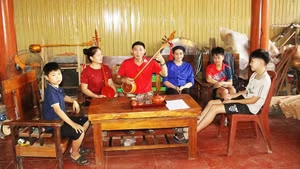
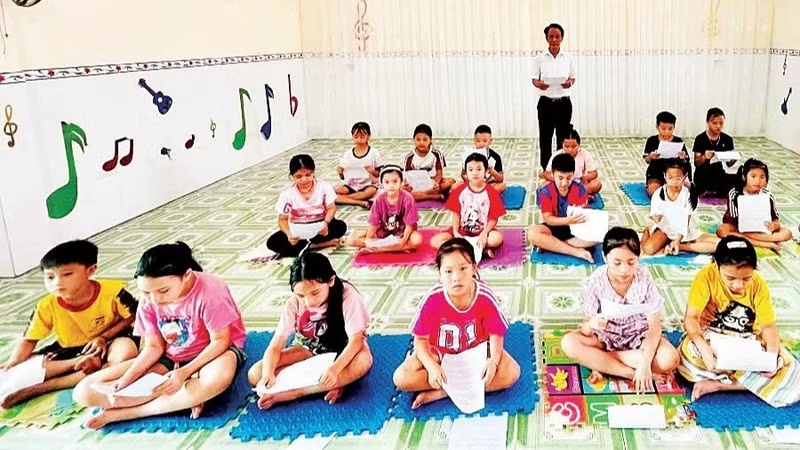
In Nghia Dong Commune, Nghe An Province, the “Keeping the Soul of Vi and Giam Alive” class has become a familiar gathering place for many students who love folk singing.
According to Hoang Xuan Hanh, Vice Chairman of the Commune People's Committee, the class is organised as a community activity under the direct guidance of artisans and enthusiasts of Vi and Giam folk songs. During the school year, the class meets once per week, while in the summer it is held three times a week. Most participants are children and teenagers, with enrolment at times reaching as many as 60 students. The support of parents, together with the enthusiasm of students, has helped the class gain wider recognition. To sustain the programme, the local authority provides facilities, meeting venues, and communication support to encourage students to participate, while also creating opportunities for the class to join exchange activities and performances.
Behind the success of the “Keeping the Soul of Vi and Giam Alive” class in Nghia Dong Commune are the dedicated individuals who have devoted themselves wholeheartedly to the cause. Meritorious Artisan Ngo Tri Minh is one of those directly involved in teaching the class. Before joining the local initiative, he had already opened a Vi and Giam folk singing class at his home in 2023.
Although now in his sixties, he continues to devote great passion to collecting, composing, and promoting Vi and Giam folk songs. The courtyard in front of his home has become a special classroom, where folk songs are passed on through his deep enthusiasm and love for this heritage.
“I love and am passionate about Vi and Giam folk songs. I worry that today's younger generation, growing up in the digital age and later studying or working away from home, may gradually forget these values if they are not taught regularly,” said Ngo Tri Minh.
When the class first opened, it had only four or five students. However, thanks to his perseverance and love for folk music, Meritorious Artisan Ngo Tri Minh's class has gradually attracted more participants, not only from the local area but also from neighbouring communes. What moves him most is not the increasing number of students but seeing them naturally develop a genuine love and appreciation for folk songs.
Nguyen Ngo Thao My, a student at Nghia Dong Secondary School who joined the class in 2025, said she was drawn to Vi and Giam folk songs because of her love for her homeland and her special affection for these traditional melodies.
“I always look forward to every class because the artisans teach us many new melodies. I find Vi and Giam folk songs very beautiful and meaningful. I will continue attending the class for a long time so that I can gain a deeper understanding of their values and contribute to preserving the cultural beauty of my homeland,” Thao My said.
For Meritorious Artisan Ngo Tri Minh, teaching is not simply about helping children learn to sing a melody or memorise lyrics. More importantly, it is about nurturing a love for Nghe Tinh Vi and Giam folk songs, as well as traditional music in general, among the younger generation.
“I want young people to understand, love, and take pride in Vi and Giam folk songs. That is the way to ensure that the traditional melodies of our homeland continue to resonate for generations to come,” said Minh.
The initiatives currently being implemented demonstrate that preserving the sounds of the nation's traditional music requires the joint efforts of many stakeholders. When safeguarded and passed on with love and a strong sense of responsibility, these musical heritages will be embraced, cherished, and further promoted by younger generations for the future.