Clear objectives and concrete plans
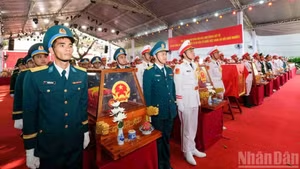
Military Region 2 - a strategic area in northern and north-western Viet Nam where fierce battles took place during the resistance war against the French colonialists as well as in the struggle to defend the northern border — still bears deep scars of war to this day.
Major General Nguyen Ngoc Ngan, Deputy Director of the Political Department and Standing Deputy Head of the Military Region 2 Steering Committee for the Search, Recovery and Identification of Martyrs' Remains, affirmed that the work of searching for, recovering, and identifying martyrs' remains is "an exceptionally important political task and a command from the heart of every soldier."
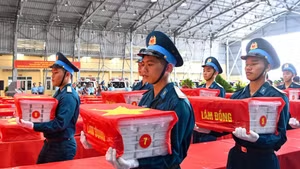
That spirit has been translated into concrete targets under the 500-day campaign. Military Region 2 aims to recover more than 800 martyrs' remains across the region, more than three times the number achieved during the 2021–2025 period, while completing the collection of biological samples from more than 11,000 graves lacking identification information for DNA analysis, thereby gradually restoring the names of fallen heroes.
To achieve these objectives, the Military Region Party Committee has issued a specialised resolution and formulated an implementation plan for the 2026–2030 period. Major General Nguyen Hong Thai, Deputy Political Commissar and Head of the Military Region 2 Steering Committee for the Search, Recovery and Identification of Martyrs' Remains, has instructed that implementation must follow the principle of "clear personnel, clear tasks, clear timelines, clear responsibilities, clear outputs, and clear authority" while remaining steadfast in action, focusing only on moving forward, never on retreating.
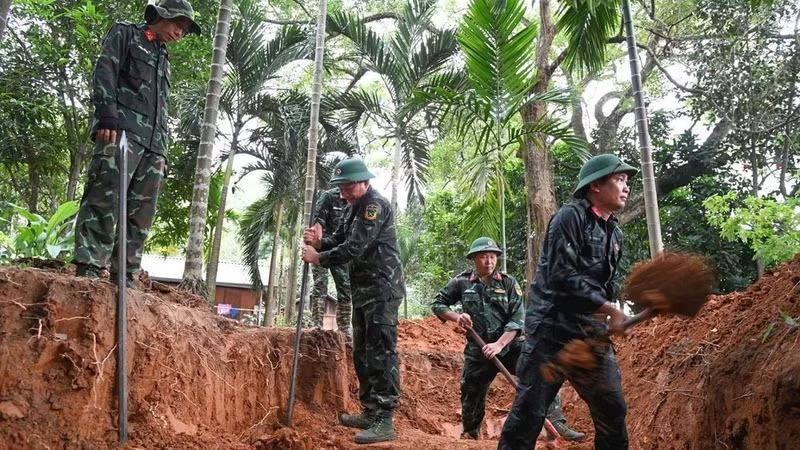
Leading every search team are combat engineers. Nearly 170 bomb and mine clearance teams have cleared almost 12,000 hectares of land contaminated with unexploded ordnance in core operational areas, completing the task one year ahead of schedule and opening safe routes for search forces. The Tuyen Quang Provincial Martyrs' Remains Recovery Team has been reinforced with additional personnel, while a temporary search team has been established in Lao Cai with its strength increased sixfold. All participating forces received field-based training before carrying out their missions.
Within just 10 days of training, the teams recovered one collective grave at Hill 211 and one set of martyrs' remains at Hill 233 in Thanh Thuy Commune, Tuyen Quang Province. On May 7, the Tuyen Quang Provincial Martyrs' Remains Recovery Team continued its search and discovered the remains of four more martyrs, including three at Hill A5 in Thanh Thuy Commune and one in Hoang Ly Pa Hamlet, Minh Tan Commune, Tuyen Quang Province. These initial results have strengthened confidence that perseverance will ultimately be rewarded, regardless of the difficulties encountered.
Searching for memories beneath the layers of earth
The war ended long ago, and for that very reason every search undertaken today is far more difficult than before. Time has erased many witnesses' memories. Those who personally buried their fallen comrades are now mostly in their old age, and their recollections are no longer complete. Many military units have been dissolved or merged, while records have been lost or scattered. Former battlefields have also been transformed by natural disasters and socio-economic development. Places that were once scenes of fierce combat have become farmland, roads, or civilian infrastructure.
The challenges are even greater in key areas such as Vi Xuyen and Lao Cai. Due to the rugged mountainous terrain and the extremely heavy artillery bombardment once inflicted on these areas, many martyrs' remains are no longer intact. After lying underground for decades, numerous remains dating back to the Dien Bien Phu Campaign have deteriorated significantly, reducing the possibility of successful DNA identification. Meanwhile, in the six northern provinces of Laos, where more than 300 martyrs have yet to be recovered, information about burial sites has almost completely disappeared. Consequently, searching for martyrs' remains today involves not merely excavating the soil metre by metre, but also comparing archival records, verifying information, clearing unexploded ordnance, applying science and technology, and patiently following every remaining clue.
These days, officers and soldiers of the Martyrs' Remains Recovery Team under the Lao Cai Provincial Military Command continue to tirelessly examine every centimetre of soil, carefully preserving every button, fragment of fabric, and piece of bone found beneath rocks and tree roots at Hill 350B, Fortress K30, and Hill 658 in Thanh Thuy, Tuyen Quang Province. Every small trace may provide the clue needed to bring a fallen soldier home.
Lieutenant Colonel Pham Khac Truong, Political Commissar of the Martyrs' Remains Recovery Team under the Lao Cai Provincial Military Command, said that despite facing countless hardships and dangers, the officers and soldiers have never allowed themselves to become discouraged or lose heart. For them, every search is not merely a mission but also a responsibility and an expression of gratitude to those who made the ultimate sacrifice.
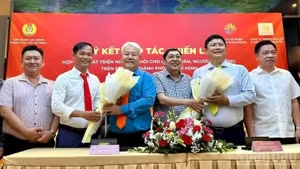
One of the most commendable aspects of the 500-day campaign is the coordinated participation of numerous forces. On July 14, 2026, at the ceremony marking the 10th anniversary of the National Association for the Traditional Veterans of the Vi Xuyen–Ha Tuyen Front, the organisation called upon its 22,000 members and the public to provide information to support the search, recovery, and identification of martyrs' remains. Many veterans, despite their advanced age and declining health, have returned to former battlefields to provide information and guide search teams. Based on information supplied by veteran Le Van Ha, formerly an officer of Post 206, recovery forces discovered the remains of seven martyrs in the Fortress K30 area.
Alongside these efforts is a large-scale nationwide review. Local authorities are surveying every household and meeting village elders, hamlet heads, veterans, and elderly residents to verify every piece of information. At the same time, the press, social media platforms, and social organisations are mobilising people both inside and outside the country to provide relevant information. In this journey, even a vague memory can sometimes offer hope of finding a comrade who has lain undiscovered for decades.
A major highlight of the campaign is the application of science and technology. According to the plan, by July 27, 2027, Military Region 2 will complete the collection of biological samples from more than 11,000 unidentified martyrs' graves across 179 martyrs' cemeteries in the region. Pilot sampling in Lao Cai is gradually helping to standardise procedures for sample collection, preservation, transportation, and digitalisation of data. Each biological sample serves not only DNA analysis but also contributes to building a comprehensive database on martyrs' remains.
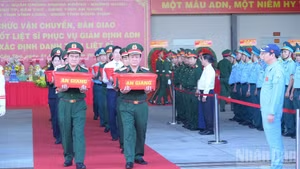
Military Region 2 is also continuing to expand cooperation with Laos in the search for and recovery of martyrs' remains. Over the past 30 years, the Martyrs' Graves Recovery Team under the Political Department of Military Region 2 has searched for and recovered nearly 2,000 sets of martyrs' remains, handing them over to 25 provinces and centrally governed cities, with nearly 400 sets having been successfully identified. In the very first days of the 500-Day Campaign, dozens of martyrs' remains were recovered and returned to their homeland. Every set of remains that is found not only brings to an end a search that has lasted for decades but also opens the way for a reunion after half a century. In places such as Vi Xuyen, Dien Bien, Lao Cai, and across the border in Laos, these searches continue.