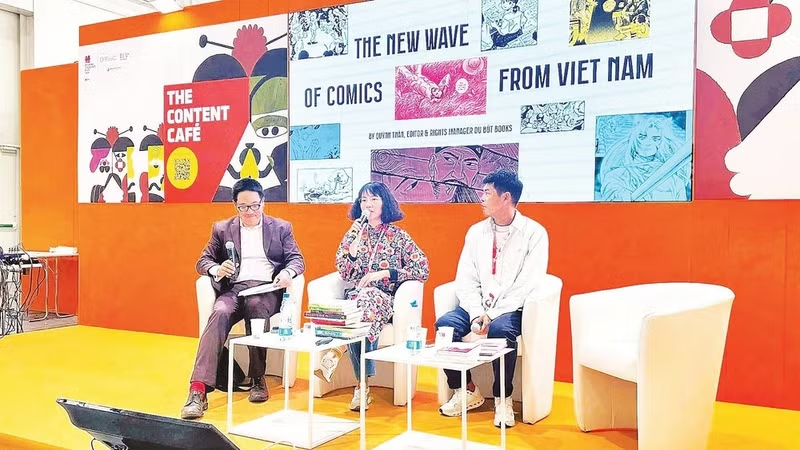
At international book fairs, domestic children’s literature has begun to stand out. The picture book Khu Vuon Trong Tim Ta (The Garden in Our Hearts) by author–illustrator Pham Quang Phuc, published by Crabit Kidbooks, was selected for the 150-title Amazing Bookshelf of the BolognaRagazzi Awards 2026 at the Bologna Children’s Book Fair.
The presence of a Vietnamese title in The BRAW Amazing Bookshelf 2026 can be regarded as a positive milestone for the country’s children’s publishing sector, indicating that works with serious investment in content, artistry, and production quality are gradually meeting international standards and gaining recognition in prestigious global professional platforms.
Previously, Khu Vuon Trong Tim Ta was named among the Top 100 outstanding manuscripts by dPICTUS in 2022 and was later presented at the Japan Foundation in Tokyo in September 2025 before an audience of more than 60 editors, journalists, and interested readers.
Meanwhile, Dao Buoc Voi Thoi Gian (Strolling with Time) by author Quynh Huong and illustrator Maru was named in the 2025 White Ravens category of the International Youth Library. These recognitions mark significant professional milestones for Vietnamese children’s literature.

Behind these achievements lies a notable shift in creative thinking and book production. In the past, children’s books often leaned towards direct moral lessons, but today authors and illustrators place greater emphasis on artistry, suggestiveness, and stimulating imagination. Storytelling has become more subtle, emotionally rich, and closer to the common language of global children’s literature.
Yet, compared with developed publishing industries, the gap remains clear. Vietnamese appearances are still sporadic and have not yet formed a distinct profile. At the Bologna Children’s Book Fair – the premier global event for children’s publishing – each country showcases a complete ecosystem, from support policies and copyright strategies to cultural branding.
Viet Nam, however, has mainly participated through individual entities, lacking a scaled national booth. This means the image of Vietnamese children’s books has not yet been recognised as a unified whole, limiting the ability to establish a brand internationally.
Experts highlight copyright trading as a decisive factor in reaching global markets. In developed publishing industries, copyright activities are organised professionally with representatives, strategies, and partner networks.
Stories for children shape character, emotions, and worldview; authenticity, subtlety, and humanistic depth remain irreplaceable.
In Viet Nam, this still relies heavily on individual efforts. Independent publishers have proactively joined fairs, built catalogues, and connected with partners, but scale and resources remain limited.
Translation is another challenge. Works aiming for international readers need high-quality translations that convey spirit and cultural nuance. This remains a shortfall, requiring long-term investment and professional translators.
Global children’s publishing is increasingly emphasising cultural diversity, with international publishers seeking unique identities and perspectives. Viet Nam, with its rich traditions, abundant folk tales, and dynamic society, has plentiful creative material. Yet telling stories imbued with national identity in a modern artistic language accessible to children worldwide is not easy.
Another issue raised at international forums is artificial intelligence. While technology can support editing and data management, most publishers agree that creativity in children’s literature must retain core values. Stories for children shape character, emotions, and worldview; authenticity, subtlety, and humanistic depth remain irreplaceable.
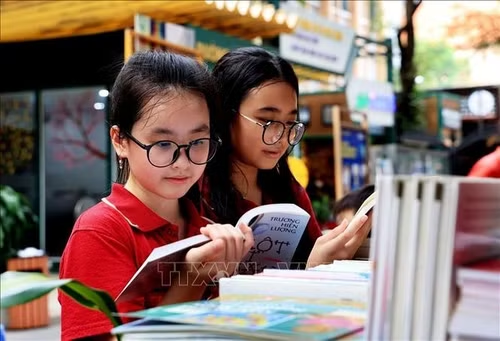
Experts argue that a systemic strategy is needed for Vietnamese children’s literature to reach the world. A synchronous support mechanism for creation, publishing, and promotion must be built. Participation in international book fairs should be part of a national cultural industry strategy, not just isolated efforts.
Investment in training authors, illustrators, editors, translators, and copyright experts is essential, alongside a long-term vision to build a “brand” for Vietnamese children’s literature rooted in national culture while expanding dialogue with the world.
Vice Chairman of the Viet Nam Writers’ Association, poet Tran Dang Khoa, praised the presence of children’s literature at international book fairs as evidence of efforts to raise creative quality, invest in illustrations, and promote native culture globally.
“We need to shift from a state of presence with some achievements to affirming a clear position. That is a long journey, requiring persistence and systematic investment. And when that happens, the appearance of children’s literature at international events will no longer be special, but a natural part of the integration and development journey,” he stated.