As traditional weaving adapts to the demands of modern life, the craft practised by local ethnic minority communities is gradually evolving, creating livelihoods, improving living standards, and helping preserve the values that form the community's cultural identity.
Preserving a traditional craft through perseverance
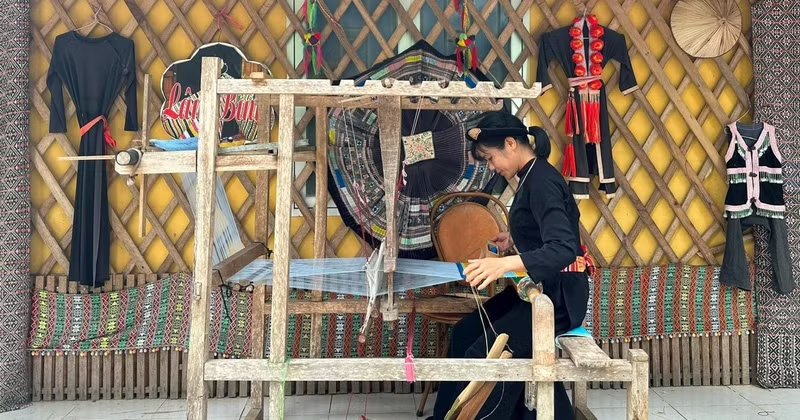
In Lam Binh Commune, many women continue to sit at their looms after a day working in the fields, patiently creating vibrant patterns and colours. For previous generations, a Tay girl’s weaving skills were considered a measure of her dexterity. Patterns resembling diamonds and eggplant flowers embody traditional beliefs about harvests, fertility, and a peaceful life.
More than ten ethnic minority groups live in the commune, with the Tay, Dao, H’Mong, and Pa Then communities making up the largest populations. Each community has its own approach to colours, patterns, and weaving techniques. Their distinctive motifs and colour palettes give Lam Binh brocade its rich variety and unique character. However, preserving the craft amid modern life has never been easy. Cheap industrial fabrics have reached even remote villages, while younger people have left their hometowns to seek work elsewhere. How to ensure that brocade does not survive only in people's memories is a shared concern for both local authorities and residents.
In early 2021, the Lam Binh Brocade Cooperative was established with 30 members, mainly Tay and Dao women. Rather than leaving each household to produce goods and find buyers independently, the cooperative organises groups specialising in weaving, embroidery, sewing, design, and promotion. This collaborative approach gives artisans access to suitable orders, opportunities to learn new techniques, and a platform to share experience. Today, the cooperative has seven core members responsible for its operations, alongside more than 20 artisans directly involved in production, most of whom are women, people facing difficult circumstances, and people with disabilities. Nguyen Thi Thuy, who is hearing-impaired, was fortunate to be welcomed by the cooperative and taught a trade, helping her gain confidence and affirm her self-worth. Thuy now works directly at the cooperative’s product display and sales stall.
Cooperative's director Nguyen Thi Yeu explained how it operates: the cooperative supplies materials, provides technical guidance, and purchases products from households before displaying them at its stall for visitors. Products such as traditional Tay clothing and the cooperative's brocade scarves have been awarded the three-star One Commune One Product (OCOP) rating. The cooperative also maintains a tradition of “those who know the craft teaching those who do not,” organising training classes within the community. “We continue to promote and pass on the craft so that younger generations can carry it forward and preserve their ethnic identity, ensuring that traditional values do not fade away,” Yeu said.
According to local authorities, weaving is suitable for people of different ages, particularly rural women. Sustaining the craft helps preserve cultural heritage while providing livelihoods. Weaving currently brings participating members an income of around 5–6 million VND per person per month, mainly by utilising spare time between farming activities. This figure offers some indication of the craft's economic value, but its greater significance may lie in its ability to maintain people's ties with their hometowns and communities while safeguarding traditional cultural values.
Connecting brocade with tourism and the digital economy
The revival of weaving in Lam Binh is still at an early stage. Demand for its products remains unstable, and the range of designs is not yet sufficiently diverse, while tourists' tastes, particularly those of younger and international visitors, continue to shift.
In late 2025, during a working visit to the Lam Binh Brocade Cooperative, Secretary of the Lam Binh Commune Party Committee To Viet Hiep and commune People's Committee leaders examined the cooperative's production, workforce, and markets. Local leaders called for further innovation in product designs, stronger promotional initiatives, and gradual efforts to establish Lam Binh brocade as a recognised brand in the domestic market, with a view to expanding internationally.
Turning this vision into reality will require a coordinated support chain, from design training and skills development to quality standardisation, improved packaging, branding, and traceability. Products must be made available at accommodation establishments and tourist destinations, while artisans need to be connected with tour operators, designers, and distribution channels.
Tuyen Quang Province's plan for developing cultural industries through 2030 identifies handicrafts, creative design, cultural tourism, and digital content as sectors with considerable potential. It also sets out the task of developing craft villages, OCOP products, and ethnic traditional attire in conjunction with tourism. This provides a foundation for Lam Binh brocade to integrate more deeply into the cultural and tourism value chain.
Another opportunity has emerged from the project entitled “Digital Content Creation Village Linked to Tourism Development in Lam Binh Commune for 2026–2030”. The project places local residents at its centre as active participants and beneficiaries. By 2030, it aims to ensure that more than 90% of households have received training and participate in digital economic activities, while at least eight products are digitised and promoted.
For weaving, digitalisation could begin with videos capturing the hands of artisans working the shuttle, livestreams showcasing traditional patterns, or traceability codes linking products to the stories of the artisans who made them. A scarf or traditional outfit becomes more appealing when buyers understand how it was produced. Used effectively, technology can help local knowledge and heritage reach a wider audience.
Alongside digital markets, community-based tourism can create additional spaces for the craft to thrive. According to tourism experts, the commune should expand hands-on activities rather than simply display products for sale. Visitors could try weaving with a shuttle, learn about indigo dyeing, and discover the meanings behind decorative motifs. When these experiences are combined with traditional stilt houses, festivals, cuisine, and local landscapes, the value of each piece of fabric is enriched by the memories and stories of the region.
In this way, preserving the craft becomes more than an effort to hold on to an old tradition. It becomes a means of building sustainable livelihoods for local people through the heritage of their homeland.