In this remote rural area, the Vi and Giam folk songs of Nghe Tinh are being revived in the breath of honest farmers and younger generations. A steady continuity is taking place, beginning right from a familiar and welcoming household courtyard.
Thuy Nga Intellectual Home
Watching today’s children absorbed in books, elderly residents in Hamlet 6 of Nghia Dong Commune often recall the journey of Tran Thuy Nga. Before becoming the Intellectual Home it is today, the library was only about 15 m² in size, initiated and established by Nga in 2004. Over the years, from this small room, many young people have found inspiration for a meaningful life and confidence in learning, gaining admission to universities and building stable careers. Nga, the founder, despite living with a physical disability, has through her determination turned pages of books into wings for countless young dreams in a poor rural area. “I believe that if one works with sincerity for the community, others will join hands. Each of us is a living book, continuing to write our own life with kindness,” Nga shared.
Phan Thu, who staffs the library each week, constantly reflects on how to make reading a joy. She said: “To ensure that book borrowing and returning, as well as reading-and-reward activities, run in an orderly and effective manner, besides the main staff member, the library also has volunteers to help readers choose suitable books, arrange seating, keep records, and hand out gifts.” The book collection is carefully selected, with diverse genres to spark interest for each age group. After each reading session, children are invited to write down their feelings on feedback slips and receive small encouraging gifts.
Recently, Nga has been studying away in Lam Dong Province. Maintaining activities at the Intellectual Home now relies on Nguyen Thi Vi, Principal of Nghia Dong Kindergarten, together with the Management Board of Thuy Nga Intellectual Home. Vi shared that Nga’s dedication deeply moved her: “Nga has endured many hardships yet lives very positively. I want to accompany her so that the children always have a healthy space and their access to knowledge is not interrupted on this land.” The enthusiasm of the class also comes from small gestures; for example, at each session Vi prepares sweets, biscuits, or small books as rewards for children who confidently speak up.
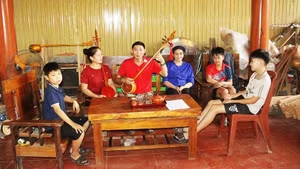
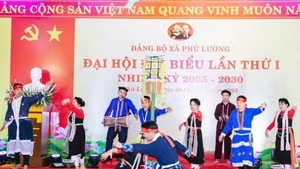
Persistent efforts were rewarded when the library joined the Intellectual Home network, becoming a genuine community learning space. Right in the Nghe An region, children in Nghia Dong Commune can study English online free of charge with volunteers who are overseas students in the US. Computer screens open up, blurring regional distances. Beyond that, other community projects have been launched, such as “Living Books”, aimed at connecting people, where parents, children, friends, teachers, and students put away their phones to sit together, listen, and share. Notably, the project “Anchoring the Soul of Vi and Giam” — a class passing on Nghe An folk songs — began on December 28, 2025, right in Nga’s home courtyard, where her family willingly supports her so that every weekend dozens of children can come to learn folk songs.
Songs that extend local affection
The idea for the “Anchoring the soul of Vi and Giam” project originated from a trip to Hue City by Nga and her close friend Lam Ca. Witnessing artisans passing on Hue singing to children, Ca reflected: “Vi and Giam from our homeland are so precious, yet children are gradually becoming unfamiliar with them. We wanted to do something so that children in Nghia Dong would not forget the songs and melodies of their ancestors.”
The aspirations of these young people met the lifelong dedication of Meritorious Artisan Ngo Minh. A simple man, Minh admits he is not eloquent in speech, but when he sings, he pours all his feelings into each rustic Vi verse. Previously, he had tried to open classes, but only during summer months. Minh confided: “If today’s young generation is not taught, they cannot know how to sing or understand the essence of Nghe Tinh Vi and Giam. That is why I prioritise time for this transmission.” His method lies in gentle, attentive, and patient guidance. He shared: “Theory needs to be easy to understand, close, and engaging. Practice must be expressive, conveying the emotions of the context of the lyrics. In the past, our elders sang Vi while ploughing or planting rice. I explain and guide how to recreate those contexts, then sing as a model, so the children become more and more passionate.”
The dedication of Minh and the project members — unpaid volunteers who overcome personal busyness to sustain the class — has brought results. After just over a month, eager faces have moved beyond initial shyness to harmonise with friends. Some even travel far; for example, Nguyen Thi Tu Huong and her daughter Duong Tue Lam travel 20 km every Sunday to attend. Huong, currently Standing Deputy Secretary of the Party Committee of Nghia Dong Commune and also a mother, spoke positively about the model: “This is a very practical form of community cultural activity, combining reading culture with traditional folk songs. The rustic melodies help children love their homeland and live more compassionately.”
Vi and Giam folk songs are a distinctive cultural beauty of the homeland, representing the soul and essence of the native land... We want children to anchor themselves in memories — where simple things once quietly nurtured our souls as we grew up.
TRAN THUY NGA
After only five to six general sessions, the number of students gradually increased to as many as 60, and the project has even begun to select potential “core members” for more in-depth training. A typical example is Khanh Ngoc, a diligent class vice-monitor who loves books and has a highly expressive voice. Ngoc not only memorises lyrics and melodies quickly but also inspires other children at each practice. She shared: “I really love afternoons learning to sing with my friends. It feels like listening to my grandmother telling stories about our homeland. I want to sing better to sing for my grandparents and to carry our homeland’s melodies far and wide.”
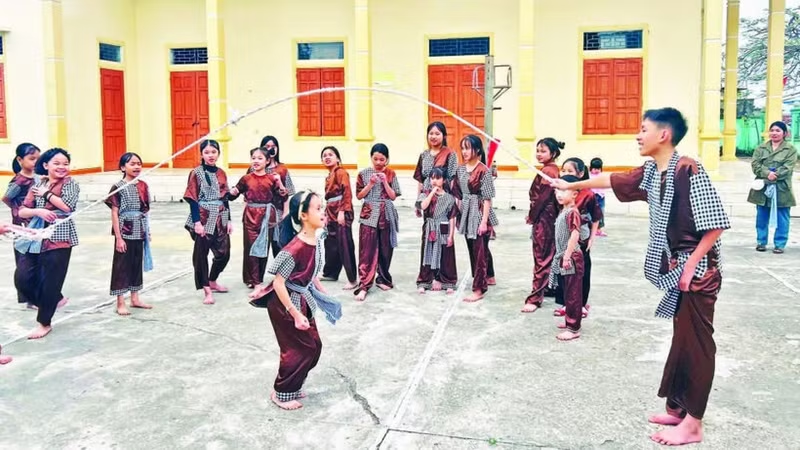
Nga shared: “Vi and Giam folk songs are a distinctive cultural beauty of the homeland, representing the soul and essence of the native land... We want children to anchor themselves in memories — where simple things once quietly nurtured our souls as we grew up.” She believes that folk songs are a pathway to awaken love for the homeland and inspire attachment to roots. Although studying far away, Nga remains closely involved with the Management Board to ensure the project’s roadmap. In the days before Lunar New Year, Minh, Vi, and members of the Nghia Dong Vi and Giam Folk Song Club brought the class to a new and meaningful space — Dinh Sen, a 100-year-old communal house. There, children offered incense in remembrance of the Village Tutelary Deity and heroic fallen soldiers, listened to elderly villagers from Lang Sen sing Vi and Giam, and played traditional folk games. Minh affirmed that combining reading culture with Vi and Giam singing is a meaningful approach. In addition, integrating roots-return activities and traditional games at side events helps diversify the projects of Thuy Nga Intellectual Home and makes it easier for children to access folk culture, thereby deepening their love for the homeland and motivating them to study well.