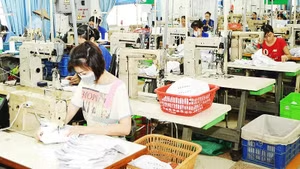
According to the State Bank of Viet Nam (SBV), by the end of November 2025, outstanding green credit was estimated at around 750 trillion VND (27.2 billion USD), with an average growth rate higher than that of overall credit growth in the economy.
“Greening” capital flows for production
In Tam Duong, a purely agricultural commune in Phu Tho Province, the circular livestock farming model run by Dao Xuan Hai’s household once faced the risk of downsizing due to rising input costs and increasingly stringent environmental requirements. Thanks to a loan from the Viet Nam Bank for Agriculture and Rural Development (Agribank), his family invested in a waste treatment system and reused by-products as production inputs, thereby reducing costs and enhancing product value.
“With a closed-loop circular farming process, our poultry farm is able to produce its own feed, supplying 13–15 tons per day. Waste is then processed and sold to the market, totaling more than 1,000 tons annually. This production process not only cuts operating costs but also meets environmental standards, helping stabilise output and increase added value,” Hai emphasised.
Hai’s case represents a typical example showing that, if directed to the right recipients, green credit can become a powerful driver of sustainable growth, even in the agricultural and rural sectors, which are often considered challenging. Years of practice have shown that a growth model relying mainly on resource extraction, cheap capital, and broad credit expansion has reached its limits. Environmental pressures, climate change, and green barriers from international markets are forcing the economy to shift toward a new trajectory—growth based on quality, efficiency, and low emissions.
According to SBV leaders, green credit has made positive progress in recent years, focusing on sectors such as renewable energy, high-tech agriculture, the circular economy, waste treatment, and energy efficiency. Commercial banks remain the primary capital providers, accounting for about 88% of total outstanding green credit. Green capital mobilised by banks mainly comes from green bond issuance and international loans. Statistics show that during the 2020–2025 period, the total value of green bonds issued in Viet Nam exceeded 1.5 billion USD.
According to SBV leaders, green credit has made positive progress in recent years, focusing on sectors such as renewable energy, high-tech agriculture, the circular economy, waste treatment, and energy efficiency.
However, the current scale of green capital remains disproportionate to the economy’s transition needs, while the legal framework is still being refined. Pham Thi Thanh Tung, Deputy Director of the Credit Department for Economic Sectors at the SBV, noted that although green credit has grown rapidly—averaging over 21% per year since 2017—it still accounts for only nearly 5% of total outstanding credit in the economy, which has reached approximately 18.2 quadrillion VND.
Diversifying capital to “green” growth
One major limitation is the economy’s heavy reliance on bank credit, while green projects typically involve long payback periods, high initial investment costs, and higher risks than conventional projects. Nevertheless, as the green capital market is still taking shape, the leading role of the banking system, especially state-owned commercial banks, has become particularly important.
Vuong Van Quy, Deputy Head of the Credit Policy Division at Agribank, stated: “Agribank has focused on three main issues: investing credit to support green growth; implementing programs related to green credit investment; and complying with regulations while integrating environmental, social, and governance (ESG) criteria into internal governance and credit appraisal processes, in order to increase the share of green credit in Agribank’s total outstanding loans.”
In practice, Agribank’s capital flows are concentrated on closed-loop livestock farming models, organic agricultural production, sustainable aquaculture, and deep processing linked to environmental protection. As of the third quarter of 2025, Agribank’s outstanding green credit reached 28.355 trillion VND, serving nearly 40,000 customers. Its green credit structure clearly reflects a priority for sustainable development: renewable and clean energy (over 53%), sustainable forestry (over 24%), and green agriculture (over 21%).
Resolution No. 68-NQ/TW dated May 4, 2025, of the Politburo on private economic development, along with Resolution No. 198/2025/QH15 of the National Assembly, identified policies to support interest rates for green projects. In line with the Politburo’s directives, the SBV is coordinating with the Ministry of Finance to submit to the Government a decree providing a 2% annual interest rate subsidy from the state budget for private enterprises and household businesses borrowing bank loans to implement green and circular economy projects. The decree is expected to be issued in the early months of 2026, with budget support allocated to localities. “For the policy to be effective, strong coordination is needed among the interest rate subsidy decree, support mechanisms through funds, and the Prime Minister’s decision on the list of green and circular economy projects,” Thanh Tung stressed.
Beyond bank credit, according to data from the Ministry of Finance, as of October 2025, outstanding green corporate bonds amounted to nearly 1 billion USD. “This is a positive signal showing that businesses are proactively seeking long-term capital from the capital market rather than relying entirely on banks. At the same time, to create additional funding channels for green projects, the Ministry of Finance is studying a pilot scheme for issuing green service bonds, which is expected to be submitted to the Government in 2026,” said Pham Thi Thanh Tam, Deputy Director of the Department of Financial Institutions under the Ministry of Finance.
To further diversify capital sources, Nguyen Quoc Hung, Vice Chairman and Secretary General of the Viet Nam Banks Association, proposed establishing a green credit guarantee fund under a public–private partnership model to support businesses in accessing capital, while drawing lessons from the shortcomings of existing guarantee funds. “The early operation of a carbon credit trading platform is seen as an important tool to encourage banks to develop new financial products linked to the carbon market,” he suggested.
Thus, stories from farmers and enterprises using green credit to transform their production models show that sustainable growth is not an abstract concept, but begins with concrete investment decisions closely tied to everyday life. The capital challenge for sustainable growth, therefore, is not merely about how much funding is mobilised, but whether those financial flows truly help change production methods, reduce emissions, and improve the quality of growth.
Viet Nam stands before a major opportunity to restructure its growth model. To seize this opportunity, it is essential to implement three pillars in a coordinated manner: diversifying capital sources, completing the legal framework for green classification, and ensuring close coordination between fiscal and monetary policies, within which the banking system, as the key financial intermediary, will continue to play a pioneering role.







![[Infographic] GRDP growth scenarios for 34 provinces and cities in fourth quarter of 2026](https://en-cdn.nhandan.vn/images/nyM650OGFWrOVWc-xajqN-rTZ68Rlmc1fiGJOhBRYHFSa4DhrHNDxEFdnz313Vk5dNJuxdkHglPA3rLeaPeiaUheNuCI723k2lNssd-YLJuKR58epWq7s21lV5WjM-HR2-Qpbi4MwAzqt9wRjL4WjGkfEz7RO9qhcwg8o8LQFK8/grdp-growth-scenarios-for-34-provinces-and-cities-in-q42026-anh-dai-dien.jpg.avif)