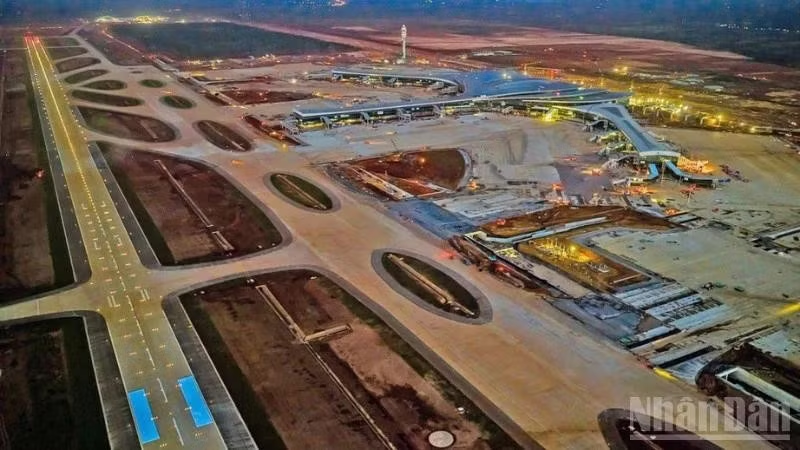
According to Official Dispatch No.912/VPCP-CN (dated January 27, 2026) from the Government Office, based on a review of the Ministry of Construction’s report on the project’s implementation, the deputy prime minister issued a series of specific instructions aimed at removing obstacles and accelerating the progress of critical items.
The deputy PM assigned the Ministry of Construction to step up inspections and supervision, urging investors to complete design work in line with the approved schedule, and to promptly consolidate and report any issues beyond its authority to the prime minister for consideration and direction.
For Dong Nai Province, the deputy PM requested a strong focus on expediting the appraisal of the basic design for the fuel pipeline route (under Sub-project 4), creating favourable conditions for construction, with efforts to complete and bring it into synchronised operation by June 2026.
Emphasising that no delays are acceptable, the deputy PM instructed the Airports Corporation of Viet Nam (ACV) to regularly review and adjust detailed schedules for each component and contract package under Sub-project 3.
For large-scale packages that pose a risk of delays — such as Package No. 4.8 (internal airport transport and technical infrastructure) and Package No. 5.10 (passenger terminal) — contractors are required to organise construction on a “three-shift, four-team” basis, working through weekends and public holidays to recover progress, while strictly ensuring quality, technical standards, and construction safety. ACV was also tasked with urgently preparing the pre-feasibility study report for Phase 2 of the project.
At the same time, Viet Nam Airlines (VNA) must accelerate investment in aviation service facilities — including catering facilities, ground service maintenance areas, and hangar no.1 — to ensure their synchronised operation by mid-2026.
Beyond progress requirements, the deputy prime minister called on ministries, sectors and local authorities to thoroughly grasp the guidance of Party General Secretary To Lam and the prime minister regarding the project’s long-term development vision.
Accordingly, Long Thanh International Airport is not only a key national transport infrastructure project but is also to be oriented towards becoming a regional aviation hub. The comprehensive development of a modern aviation services ecosystem will provide an important foundation for the formation and future development of the “Long Thanh Airport City” model.
The Government Office was assigned to continue monitoring and consolidating implementation updates, and to report promptly to the prime minister to ensure the project is carried out in line with the approved schedule, objectives, and requirements.