As of the end of 2025, the country had more than 35,000 cooperatives and 164 cooperative unions, bringing together approximately 7.1 million members and providing regular employment for nearly 2 million workers. The total assets of the cooperative sector reached around 538.9 trillion VND, with 78.1% of cooperatives operating fairly well or well.
Enhancing the value of Vietnamese agricultural products
Established in 2019, Ky Nhu Cooperative in Thanh Hoa Commune, Can Tho City, has 11 OCOP products, including 10 four-star products made from clown knifefish and one five-star snakeskin gourami product. To enhance the competitiveness of its key products through deeper processing, at the end of 2025, Ky Nhu Cooperative invested more than 10.3 billion VND in building and upgrading its facilities and installing synchronised equipment for preliminary processing, processing, freezing, cold storage, and packaging. The cooperative has also focused on quality control from raw-material areas, maintained VietGAP-certified farming areas, and standardised its production processes in accordance with ISO 22000:2018.
As of the end of 2025, the country had more than 35,000 cooperatives and 164 cooperative unions, bringing together approximately 7.1 million members and providing regular employment for nearly 2 million workers. The total assets of the cooperative sector reached around 538.9 trillion VND, with 78.1% of cooperatives operating fairly well or well.
This approach has enabled the cooperative to better control product quality and increasingly meet market requirements.
Ky Nhu Cooperative Director Nguyen Kim Thuy said the cooperative had accumulated experience and enhanced its capacity to meet export requirements, thereby expanding its markets to the US and the Republic of Korea. Building on its existing foundation, the cooperative continues to expand raw-material areas, accelerate digital transformation, develop e-commerce, enhance management capacity, and gradually approach higher standards, with the goal of joining the ranks of the country’s leading cooperatives.
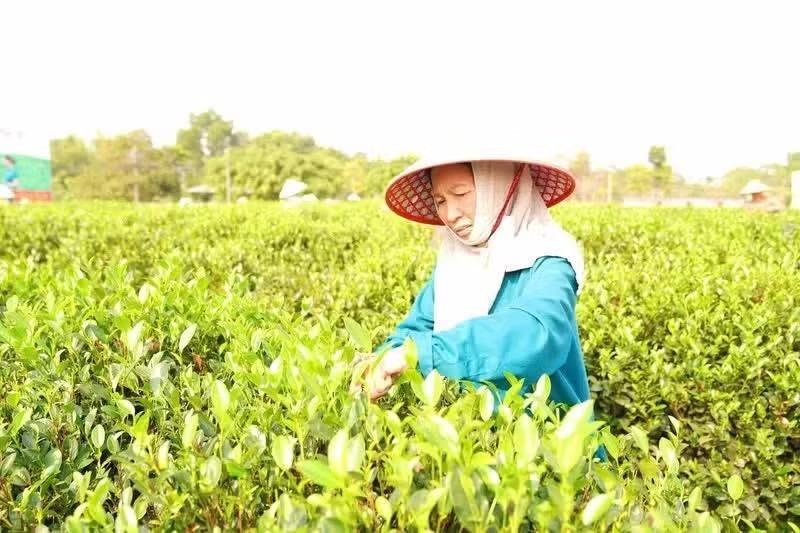
Starting from the need for innovation to enhance competitiveness, Hien Thi General Agricultural Services Cooperative in Lac Duong Commune, Lam Dong Province, has chosen its own path by restructuring production, applying high technology in the fields, and establishing close links with businesses. From small-scale production, the cooperative has gradually reorganised its operations along the value chain, linking around 40 households covering an area of 80–100ha.
VietGAP processes, including electronic traceability, pesticide residue control, drip irrigation, sprinkler irrigation, and substrate cultivation, have been applied in a coordinated manner. The cooperative has also boldly introduced seed-sowing machines, soil milling machines, soil-tray planers, and automatic temperature-monitoring equipment into production, helping reduce labour costs and working hours by around 50%. As a result, the cooperative’s revenue reached nearly 10.9 billion VND in 2025, while average worker income exceeded 9.3 million VND per person per month.
However, to expand its scale and participate more deeply in modern distribution channels, Nguyen Thi Hien, Director of Hien Thi General Agricultural Services Cooperative, said the cooperative needed additional support in terms of capital, technology, and markets. This is also where the role of the Viet Nam Cooperative Alliance needs to be brought into sharper focus, not only in providing support but also in connecting cooperatives and facilitating their access to development resources, thereby contributing to the formation of sustainable value chains.
According to Nguyen Khai, Chairman of the Lam Dong Provincial Cooperative Alliance, the early completion of a province-wide cooperative database will provide a foundation for management, supervision, and policymaking. In the long term, priority should be given to resources for personnel training, trade promotion, capital support, and replication of effective cooperative models, particularly high-tech cooperatives, value-chain linkages, OCOP, community-based tourism, and the green economy.
A foundation for strengthening the collective economy
Over the years, the collective economy has expanded in scale and renewed its operating methods. Accompanying this process, the Viet Nam Cooperative Alliance has effectively promoted its role in connecting and supporting cooperatives in areas ranging from management and technology to markets, helping production gradually become part of linked value chains.
As a result, product costs have fallen by 8–21%, while selling prices have increased by 10–12% compared with individual production. The value of agricultural products therefore lies not only in the products themselves, but also in how production is organised so that products can reach farther and secure a place in the market.
Drawing on practical experience in developing the collective economy, the Viet Nam Cooperative Alliance has been creating a new shift, moving from a representative organisation towards a role in creating an enabling environment, connecting stakeholders, and supporting cooperatives in enhancing their competitiveness.
One important instrument is the Viet Nam Cooperative Development Assistance Fund. The fund not only serves as a source of capital support but also provides cooperatives with additional resources to innovate technology, expand production, and participate more deeply in value chains.
According to Nguyen Hung Tien, General Director of the Viet Nam Cooperative Development Assistance Fund, during the 2021–2025 period, the fund provided loans for more than 500 production and business projects and plans, with total disbursements of nearly 2.4 trillion VND. Its outstanding loans stood at 943 billion VND at the end of 2025. Notably, the fund’s charter capital increased from 100 billion VND to 1 trillion VND, demonstrating that resources to support the collective economy are being increasingly strengthened.
Beyond capital support, the Viet Nam Cooperative Alliance is also guiding cooperatives in renewing management practices, standardising financial management, applying technology and digital transformation, and gradually meeting market standards.
However, according to Cao Xuan Thu Van, Chairwoman of the Viet Nam Cooperative Alliance, the collective economy still has a gap to bridge in meeting development requirements and international standards. Therefore, during the 2026–2031 period, a strong shift is needed from focusing on quantity to enhancing quality, management capacity, and competitiveness, while also creating substantive changes in digital transformation, green transformation and international integration.
The Alliance has identified the development of the collective economy and cooperatives in a fast, effective, and sustainable manner as its goal, with members at the centre and operational efficiency as the benchmark. Accordingly, the Alliance’s role needs to be elevated from supporting individual cooperatives to building an enabling ecosystem, connecting cooperatives with the State, businesses, financial institutions, science and technology organisations, and markets.

To turn these orientations into reality and ensure their effectiveness, the immediate task remains to continue removing bottlenecks related to mechanisms, resources, and markets. These are issues on which the collective economy has placed high expectations ahead of the seventh National Congress of the Viet Nam Cooperative Alliance, contributing to creating new room for cooperatives to develop.