In this context, the people’s credit fund system is increasingly asserting its role as a community financial institution directly linked to socio-economic life at the grassroots level. Therefore, strengthening and improving the efficiency of this system is considered a crucial requirement in the new stage of economic development.
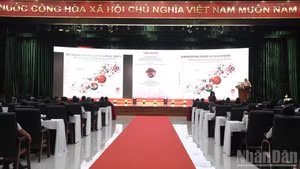
At the recently held seminar on strengthening and enhancing the role of people’s credit funds in the economy and collective economic sector, Bui Anh Tuan, Director of the Department of Private Enterprise and Collective Economic Development under the Ministry of Finance, emphasised that Viet Nam is entering a pivotal stage of development, aiming to become a developing country with modern industry and high middle income by 2030 and a developed country with high income by 2045.
To achieve these goals, the State needs to mobilise and effectively utilise all resources from all economic sectors. Among these, the private and collective economic sectors are identified as important driving forces of the economy.

According to Tuan, the Party and State have issued many guidelines and policies to promote the development of the collective economic sector, including Resolution No. 20-NQ/TW of the Party Central Committee on continuing to innovate, develop, and improve the efficiency of the collective economy.
The goal is to build a dynamic, efficient, and sustainable collective economic sector, which, together with the state economy, will become a solid foundation of the national economy.
This is not just a simple economic development goal, but also a strong political commitment to inclusive growth, in which all citizens and all economic sectors have the opportunity to access development resources.
Bui Anh Tuan, Director of the Department of Private Enterprise and Collective Economy Development, the Ministry of Finance
“This is not just a simple economic development goal, but also a strong political commitment to inclusive growth, in which all citizens and all economic sectors have the opportunity to access development resources,” Tuan emphasised.
However, reality shows that the cooperative and collective economic sector is still facing many difficulties, especially in accessing credit capital. It is in this context that the people’s credit fund system has emerged as a cooperative finance model with a special role.
According to the Strategy for the Development of the Collective Economy for the 2021–2030 period, the people’s credit fund system is one of the important components of the financial ecosystem serving the collective economic sector.
From a state management perspective, the Ministry of Finance is finalising the dossier to submit to the Government for approval of the overall programme for the development of the collective economy for the 2026–2030 period. In this programme, the development of the fund system is identified as a crucial component.
From a practical perspective, representatives of the funds also proposed many solutions such as improving governance capacity, strengthening internal control, promoting digital transformation, and training human resources. At the same time, specific guidance is needed regarding the operational areas after the merger of administrative units, as well as a coordination mechanism between funds to avoid unnecessary overlap and competition.
In the coming period, if supported by appropriate policies and mechanisms, improved governance capacity, and adaptation to the trend of digital transformation, the fund system can fully continue to play its role as an effective capital channel, making a significant contribution to the sustainable development of the Vietnamese economy.
Currently, the country has more than 1,100 people’s credit funds, with a total capital of approximately 191 trillion VND and a total outstanding loan balance of approximately 138 trillion VND. This is a significant financial resource that has contributed to promoting socio-economic development in many localities, especially in rural areas.