From major challenges to specific products
The approach to developing strategic technologies is clearly shifting from fragmented research towards organising tasks around major national challenges. From the outset, each task needs to clearly identify its product, technical specifications, application area, and implementing entity, while organising the process from identifying the challenge and determining core technologies to developing products and putting them into use.
Assoc. Prof. Dr. Bui The Duy, Director of VNU - Ha Noi, said the university had shifted from fragmented research to interdisciplinary programmes and clusters of tasks in areas such as semiconductors, artificial intelligence (AI), automated robotics and unmanned aerial vehicles (UAVs), biomedical technology, materials, new energy, and quantum technology. Many of these tasks have clearly defined products and completion timelines.
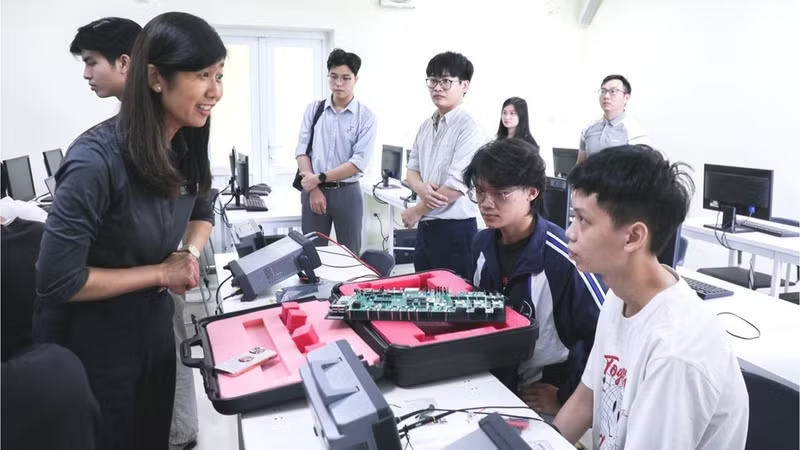
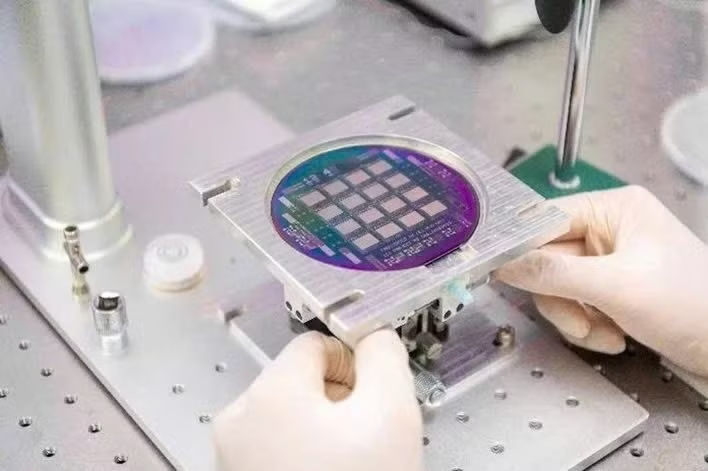
In the field of semiconductors, VNU - Ha Noi is designing a low-power, open-source RISC-V microprocessor IP core for IoT devices, which is expected to be completed in 2026 for transfer to domestic businesses for further development.
In biomedical technology, VNU - Ha Noi is developing a lab-on-a-chip system for the early detection of lung cancer cells, with trials expected to take place in 2026.
The tasks are being developed jointly with businesses, with market demand, output products and commercialisation potential serving as evaluation criteria. Ongoing tasks are now more clearly linked to products, deadlines, and implementing entities.
However, a prototype or research result is only the first step. What matters is whether the product can be put into use, scaled up, and gradually establish a position in the market.
Focusing on areas with real-world demand
The need to enhance technological self-reliance is particularly evident in cloud computing.
Domestic cloud platforms currently account for only around 20% of the market share, while foreign businesses hold the majority of the market. The goal is to gradually raise the market share of domestic businesses to around 50%, thereby strengthening their ability to master digital infrastructure and enhance competitiveness.
To achieve this goal, businesses need to select the right products, invest intensively in research and development, gradually master core technologies, and improve service quality. For AI, choosing the right direction for development is also crucial.
Rather than spreading investment too thinly, Viet Nam needs to focus on areas with real-world demand and significant value-creation potential, such as healthcare, education, law, social welfare, and public administration, while ensuring data security and safety and the ability to master technologies.
From a business perspective, Chairman of MK Group Nguyen Trong Khang said national competitiveness increasingly depended on the degree of self-reliance in core technologies, production technologies, and intellectual property.
Major national challenges provide an environment for businesses to build up their teams, develop research capacity, improve production technologies, and establish their own intellectual property assets. The requirement to master technology also applies to traditional sectors such as agriculture.
ThaiBinh Seed Group has identified molecular biotechnology, gene technology, AI, and big data in breeding as core technological directions for the next 10 years.
The business aims to master a number of AI and molecular-marker-based breeding technologies by 2030, while developing at least five to seven strategic crop varieties for export.
From cloud computing, AI, and semiconductors to agriculture, the development of strategic technologies requires close coordination among the state, research institutes, universities, and businesses.
The state identifies challenges, creates mechanisms, and directs resources; research institutes and universities develop knowledge and foundational technologies; while businesses complete products and organise production. An important step in bringing products into practical use is to create an initial market.
According to the Ministry of Science and Technology, mechanisms for commissioning, assigning tasks, hiring, and procuring digital technology products and services need to be promoted to create conditions for businesses to test and validate their products and make long-term investments in core technologies.
Alongside market creation, the policy framework for developing strategic technologies is continuing to be refined.
According to Resolution No. 57-NQ/TW, Viet Nam is focusing on strengthening its capacity for self-reliance and mastery of core and strategic technologies. Decree No. 260/2026/ND-CP has specified a number of implementation mechanisms, including identifying major national challenges and linking tasks with the resources and responsibilities of each ministry, sector, and business.
The national science, technology, and innovation programme, with a specific focus on strategic technologies, organises tasks into three groups: tasks assigned by the government; tasks arising from the needs of ministries, sectors, and localities; and projects seeking breakthrough technological solutions.
The programme aims to master at least four strategic technologies, develop and commercialise at least 15 products, and establish at least 20 businesses capable of mastering strategic technologies and products by 2030.
At a conference on disseminating documents guiding the implementation of strategic technology research and development tasks, Le Xuan Dinh, Deputy Minister of Science and Technology, emphasised the need to shift from procedure-heavy management towards output-based management, starting with real-world challenges and using the capacity to master technologies and develop applicable products as the measure.
Under Circular No. 49/2026/TT-BKHCN, tasks are organised into work packages linked to specific evaluation milestones. Results at each milestone serve as the basis for payment, final settlement, and funding for the next phase.
The state budget can provide up to 100% of funding for certain core and foundational technology tasks, state-commissioned tasks or tasks involving a high level of risk. A maximum support rate of 70% applies to strategic technology products with potential for application, technology transfer, and commercialisation.
The current priority is to put the mechanisms already introduced into practice. Selecting the right challenges, assigning them to capable entities, providing sufficient resources, and closely monitoring the products will determine the effectiveness of each task. This will give businesses greater opportunities to accumulate technologies, enable research institutes and universities to strengthen their research capacity, and create greater opportunities for products to be put into practical use.