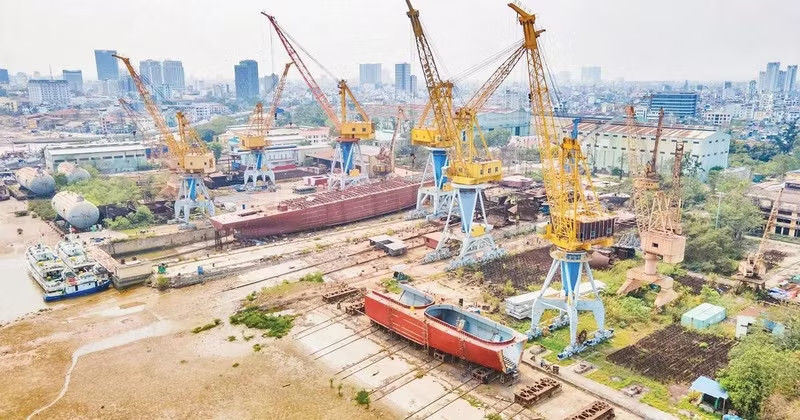
Shipbuilding units under the Viet Nam Shipbuilding Industry Corporation (SBIC) are tasked with a “dual mission”: maintaining production and business operations while simultaneously implementing restructuring tasks under Resolution No. 220/NQ-CP dated December 22, 2023, with the expectation of “revival” and the formation of large-scale ship repair and newbuilding centers.
Securing orders with care
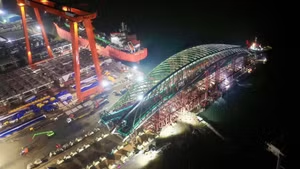
In late December 2025, the 65,000 DWT cargo vessel Truong Minh 02 was successfully launched by workers at Nam Trieu Shipbuilding Company. This is the second vessel in a series of four—the largest ships built by a Vietnamese shipbuilder to date—and a source of pride for the country’s shipbuilding industry. The vessel was designed by the joint venture between Viet Nam Shipbuilding Engineering Joint Stock Company (VISEC) and Bluetech (Finland), constructed by Nam Trieu Shipbuilding Company under the supervision and classification of NK (Japan) and VR (Viet Nam) classification societies.
According to Pham Quang Tuyen, General Director of Nam Trieu Shipbuilding Company, the series of 65,000 DWT vessels built for Dong Bac Shipping Company are 200 metres long and over 32 metres wide, equipped with modern technologies, compliant with the latest international maritime conventions, capable of operating in all international waters, and meeting the stringent environmental requirements of ports worldwide.
The construction of the largest cargo vessels ever designed and built domestically by Viet Nam at this time clearly demonstrates the production organisation capacity, technical management, and construction execution capabilities of SBIC and Nam Trieu Shipbuilding Company, while gradually implementing the Party’s resolutions and the Government’s directives on restructuring the shipbuilding industry.
“In 2025, Nam Trieu’s output and revenue exceeded more than 100% of the planned targets, ensuring an average monthly income of 14 million VND for workers. However, the company remains classified as a non-performing debtor, with no assets or cash flow to secure contract guarantees. As a result, we are unable to undertake turnkey contracts or independently bid for and execute large-value projects,” Tuyen expressed with concern.
Previously, Viet Nam invested in building a relatively complete system of shipbuilding and ship repair yards along the length of the country, with a total newbuilding capacity of about 3.5 million DWT per year. Enterprises under SBIC possess sufficient capacity to build various types of large-capacity and specialised vessels. In reality, however, over the past five years, output has reached less than 50% of capacity, largely because companies have lacked the resources to invest in technological and equipment upgrades over an extended period.
Vu Huu Chien, General Director of Pha Rung Shipbuilding Company, said that in 2025, Pha Rung achieved a production value of approximately 846 billion VND, exceeding the plan by 25%, while revenue and other income reached around 644 billion VND, surpassing the plan by 27%.
Despite efforts to optimise production, accelerate the construction of 10 oil/chemical tankers of 13,000 DWT (two of which have already been delivered), and hire hundreds of subcontracted workers, the company has been unable to keep pace due to labor shortages and outdated technology, forcing it to turn down orders.
Challenges in the “post-restructuring” phase
According to development orientations, by 2030, Viet Nam’s merchant fleet is expected to reach around 1,200 vessels, with a total tonnage of 13–14 million DWT. The shift of the global shipbuilding market toward Asia presents an opportunity for Viet Nam to leverage existing conditions to participate in export shipbuilding and develop a national fleet serving the Strategy for Sustainable Development of Viet Nam’s Marine Economy to 2030.
Tran Manh Ha, General Director of SBIC, said that in 2026, SBIC aims for a production value of 5.245 trillion VND, equivalent to 107% of the 2025 plan, and revenue of nearly 4.4 trillion VND, equivalent to 109% of the 2025 plan. Currently, the corporation has filed for bankruptcy proceedings in accordance with regulations, under the supervision of judges and administrators, while still maintaining production and business operations to ensure employment and income for workers.
Tu Minh Hung, General Director of Bach Dang Shipbuilding Company, noted that the handling of legacy financial issues from previous periods has significantly affected the company’s recent production and business performance. The company continues to maintain core activities such as shipbuilding, steel structure fabrication, and ship repair. However, once the court initiated bankruptcy procedures, the company became restricted in accessing large contracts, unable to provide advance payment guarantees or performance commitments.
Most leaders of shipbuilding enterprises expressed support for the guiding spirit of Resolution No. 220, which seeks to harmonise the interests of the State, investors, enterprises, and workers. They also emphasized that if legacy financial issues are resolved definitively, while retaining production sites, infrastructure, and the workforce, restructuring would be feasible.
With transparent and sufficiently attractive mechanisms, shipyards could attract investors with strong financial capacity and experience. Enterprises also proposed maintaining shipbuilding and ship repair as their core business lines.
New investors would acquire consolidated assets and technological production lines, be granted land-use rights, continue unfinished economic contracts, and take over the workforce.
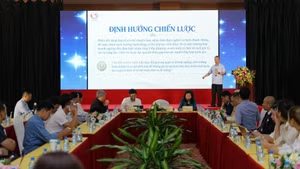
To effectively implement the particularly important “dual mission” of the shipbuilding industry under Resolution No. 220, Deputy Minister of Construction Nguyen Xuan Sang has requested SBIC leadership and its member units to focus on studying and shaping a clear “post-restructuring picture” of SBIC and its subsidiaries, while developing a core team of managers and technical personnel to meet the requirements of the new period. With extensive management experience, this workforce is expected to continue serving as the backbone force for the development of Viet Nam’s shipbuilding industry.