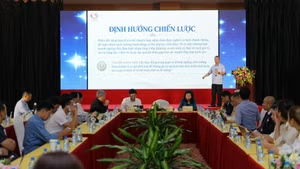
Speaking at the seminar titled “Drivers for Double-Digit Economic Growth and Agricultural Prospects for 2026”, held on March 31, journalist Nguyen Van Hoai, Editor-in-Chief of Nong Thon Ngay Nay/Dan Viet Newspaper, noted that Viet Nam’s economy has recorded many positive results in recent years. However, amid ongoing global uncertainties, rising protectionism and potential supply chain disruptions, traditional growth drivers are gradually revealing their limitations. This underscores the urgent need to identify, nurture and promote new, sustainable growth drivers with strong spillover effects.
Dr Can Van Luc, Chief Economist of BIDV and Member of the National Financial and Monetary Policy Advisory Council, affirmed that growth is not a short-term matter but a long-term strategy that could extend to 2045 and beyond. In discussing economic growth, he particularly emphasised four key pillars of “security”: food security, energy security, supply chain security, and cybersecurity and data security.

“Maintaining stable interest rates is considered a crucial condition for promoting growth. In addition, restructuring the economy and improving the quality of growth through enhanced productivity and investment efficiency are also key priorities. The goal of reducing the ICOR (Incremental Capital Output Ratio) from around 5 to 4 is regarded as an important benchmark for improving capital efficiency,” he stressed.
Experts also highlighted the need for decisive policies to unlock capital flows and remove bottlenecks in stalled projects, thereby bringing substantial resources back into the economy.

At the same time, specific policies are required to support agriculture, ranging from preferential credit schemes to the development of scientific research systems and high-quality human resources. According to Dr Tran Cong Thang, Director of the Institute of Strategy and Policy on Agriculture and Environment under the Ministry of Agriculture and Environment, science and technology constitute the core pillar determining agriculture’s endogenous strength. However, rather than focusing solely on “visible” technologies, there is a need to invest in fundamental research areas such as genetics, breeding, vaccine technology and climate change forecasting systems.
Furthermore, to ensure sustainable development, agriculture requires close coordination among the “four stakeholders”: the State, scientists, enterprises and farmers. In this framework, cooperatives should be repositioned as modern enterprise models, playing a central role in the value chain. At the same time, improving the skills of the rural workforce is an urgent requirement. Farmers need to be equipped with new knowledge and technologies to transition from traditional to modern production methods.