Q: Looking back over the course of agricultural development throughout the country’s Doi Moi journey, what would you identify as the most fundamental achievements, if we do not measure them solely by output or export turnover?
A: I believe the key point is that agriculture has successfully fulfilled its role in ensuring national food security and sustaining the livelihoods of tens of millions of farmers. At the same time, the position of Viet Nam’s agriculture has been affirmed internationally, not merely in terms of export figures, but more importantly, Viet Nam is regarded by international organisations as one of the world’s centres for innovation in food systems.
Moreover, agriculture has preserved rural cultural spaces and community relationships, factors that carry long-term significance for the country’s sustainable development. Vietnamese agriculture is not only an economic sector; it is also a crucial social foundation, as the old saying goes, “without agriculture, there is no stability”. In practice, whenever the economy faces difficulties, rural areas continue to absorb and regulate labour, while also serving as a major source of raw materials for the processing industry in urban areas.
Q: It could be said that the hallmark of your tenure as Minister of Agriculture and Rural Development was the effort to promote a shift from agricultural production to an agricultural economy. Yet there remain bottlenecks hindering the wider spread of this transition. Why is that, in your view?
A: Fragmented, small-scale and spontaneous agricultural production remains a major challenge in the transition towards a modern, professional agricultural sector. The biggest barrier at present is a production mindset that still places excessive emphasis on output, whereas an agricultural economy requires a comprehensive approach based on value chains and the added value generated along those chains. In many places, farmers are still seen merely as producers, rather than being positioned as central actors in agricultural transformation strategies.
In addition, one of today’s major challenges lies in viewing agriculture and farmers mainly from a top-down perspective, without sufficient bottom-up insight. Agricultural activities take place day in, day out; agricultural prices may fluctuate several times within a single season. If policymaking and management rely only on periodic reports and aggregated figures, they can easily fall out of step with reality.
When two-tier local administrations focus primarily on output and export turnover, while lacking close engagement with market developments and farmers’ livelihoods, value chains are prone to disruption, linkages become loose, and sectoral ecosystems grow fragmented. Therefore, local authorities must serve as the hub connecting sectoral ecosystems.
More broadly, we need strong, genuinely functioning sectoral ecosystems, with local governments acting as key connectors. The authorities should neither intervene too deeply in the market nor leave everything entirely to market forces. This is the essence of a facilitative, enabling mindset and the guiding role of socialist orientation. Policies are needed to encourage stable, long-term cooperative relationships, rather than short-term support.
To fundamentally remove these barriers, I believe we must place particular emphasis on enhancing farmers’ capacities. Farmers need to be equipped with knowledge, skills and thinking that enable them to absorb science and technology, participate in digital transformation, thereby creating higher added value for agricultural products and improving labour productivity in the agricultural sector.
Q: You have just mentioned farmers’ capacity to absorb science and technology. Without timely solutions, is there not a risk that they could remain vulnerable and fall behind in the digital era?
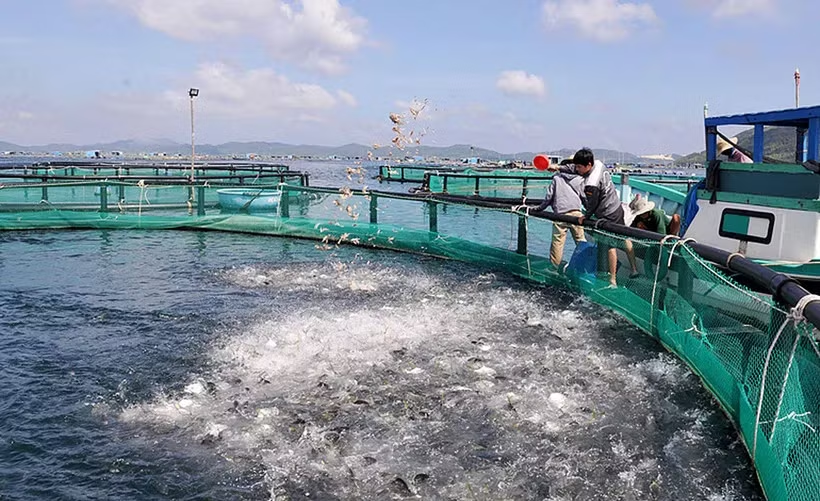
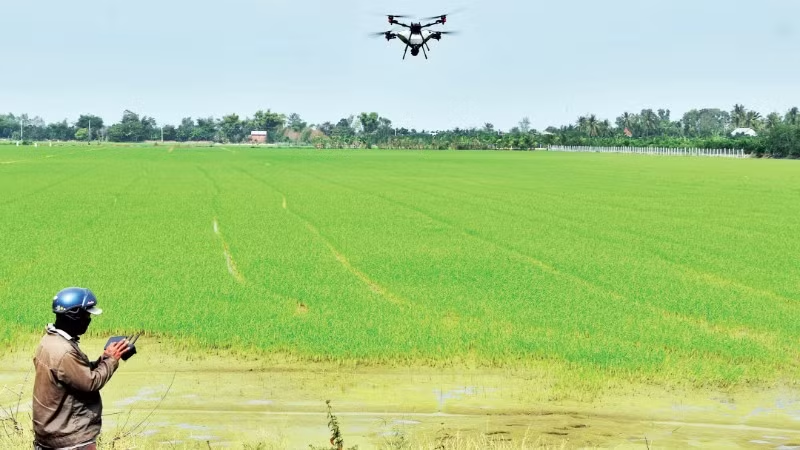
A: In fact, the greatest risk is not a lack of technology, but rather that farmers are not substantively involved in the digital transformation process. This process must help farmers access information, knowledge and markets more conveniently. Once farmers truly master technology, they will not be left behind in the digital transformation wave.
I have proposed that each locality establish an innovation centre to link science and technology and digital transformation with local conditions through concrete projects in specific areas. This would also be where academic science is transformed into popular science, reflecting the spirit of knowledge dissemination enshrined in the Law on Science, Technology and Innovation.
Digital transformation in agriculture must begin with changes in mindset and production organisation. When farmers are better organised through cooperatives and value-chain linkages, technology and data can truly be effective. Technology only unleashes its power when farming communities and cooperatives use it collectively, connect and share. Technology cannot replace people; it can only support them to perform better the tasks inherent in agricultural production and business.
Q: Your reflections remind me of a story you once shared about finding a dried rice grain left by chance in a drawer in your office at the National Assembly. Was that grain symbolic, a reminder to policymakers of the people’s starting point in every decision?
A: No matter how technology, data or management methods change, the ultimate goal of policy is still to improve people’s lives. Policymakers need to stay close to the grassroots and listen to real-life experiences. If they drift away from reality, even the best-intentioned and most humane policies will struggle to take effect. It is essential to understand farmers’ psychology and rural sociology so that policies are welcomed by the people, policies that are not distant or overly complex, and that come with support during implementation.
Farmers often produce based on traditional experience and may sometimes follow the crowd, resulting in products that do not align with market characteristics. Therefore, there is a need for systems of standards, technical regulations, processes, certification and traceability that are better suited to production scales. Logistics infrastructure and market information systems also need to be developed in a coordinated manner.
Q: In your role as National Assembly Vice Chairman, how do you assess the legislature’s role in creating a legal framework for the rapid and sustainable development of Vietnamese agriculture in the new period?
A: Good policy is not merely about providing additional resources; it must also achieve the objective of strengthening the collective economy and value-chain linkages. In reality, however, there is still fragmented and uncoordinated implementation among policies on land, credit, science and technology, and markets, making it difficult for farmers and enterprises to access resources.
Land issues remain a long-standing challenge, particularly the accumulation and consolidation of agricultural land for large-scale production. Agricultural credit still places heavy emphasis on collateral, while the greatest value often lies in indigenous knowledge, community trust and value-chain linkages.
Support is needed for cooperative models with long-term strategies to mobilise multi-channel resources from society, rather than relying solely on a single channel from the government. Science and technology often fail to reach the fields due to the lack of effective intermediary mechanisms for transfer. Meanwhile, the market remains the weak link, where farmers typically occupy the lowest position in the value chain.
More fundamentally, the biggest bottleneck lies in a policymaking mindset that still focuses on managing inputs rather than facilitating outputs, and that remains accustomed to “fragmenting in order to manage” instead of “connecting to develop together”. When the law does not strongly encourage value-chain linkages or create incentives for enterprises to accompany farmers over the long term, risks continue to be borne by the most vulnerable.
I believe the National Assembly plays a pivotal role in improving the legal system and creating a stable, transparent legal framework for sustainable agricultural development. Law should not merely regulate; it must also create momentum for innovation and production linkages. At the same time, the National Assembly needs to strengthen oversight to ensure that policies, once issued, truly come into life and serve the people’s interests.
In that way, the law will not only be a safety barrier, but will become a genuine lever for development, helping Vietnamese agriculture go further, develop more sustainably, and move forward with greater confidence on its path of integration.
Thank you very much.