With its important orientations on mechanisms and policies, Conclusion No. 219-KL/TW is expected to serve as a “lever” creating new opportunities for agriculture, farmers and rural areas in the coming period.
After more than three years of implementing Resolution No. 19-NQ/TW, agricultural development has shown positive changes, but has also clearly revealed shortcomings in science and technology, value chain linkages and production organisation that need to be addressed in a fundamental and comprehensive manner.
Breakthrough mechanisms for high-tech agriculture
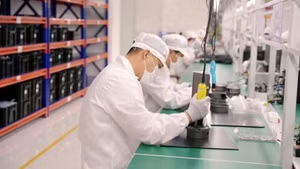
Conclusion No. 219-KL/TW clearly identifies the key driving force for fast and sustainable development of agriculture and rural areas, resource management and environmental protection as prioritising investment, experimentation and piloting of breakthrough mechanisms and policies for agricultural production models based on high technology, innovation, digital transformation, green development and climate change adaptation across all stages of production, preservation, processing, logistics and trade. According to Nguyen Van Long, Director of the Department of Science and Technology at the Ministry of Agriculture and Environment, the system of legal documents related to science and technology activities is currently quite diverse. However, investment resources for science and technology in agriculture remain limited, the science and technology market is underdeveloped, and incentives for competition and talent attraction are insufficient. Therefore, removing the “bottlenecks” in science and technology is one of the key solutions to create new momentum for the entire sector.
After more than three years of implementing Resolution No. 19-NQ/TW, agricultural development has shown positive changes, but has also clearly exposed limitations in science and technology, value chain linkages and production organisation that need to be addressed promptly and comprehensively.
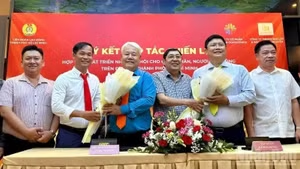
From a business perspective, Tran Manh Bao, Chairman of the Board of Directors of ThaiBinh Seed Group Joint Stock Company (ThaiBinh Seed), stressed that breakthrough mechanisms and policies for high-tech agriculture are critically important. In particular, there is a need to establish effective public–private coordination mechanisms among research institutes, enterprises and farmers to drive breakthroughs in science and technology and innovation. In recent years, ThaiBinh Seed has remained steadfast in its strategy of taking science and technology as the main driver of growth, investing strongly in research activities to deliver high-yield, stable-quality crop varieties that are well adapted to climate change. The company is currently one of the pioneering science and technology enterprises in the crop seed sector, with nearly 8,000 hectares of raw material zones and annual output of almost 30,000 tonnes of seeds, generating tangible value for partners and tens of thousands of farming households nationwide.
Towards regional and global leadership
To promote exports of agricultural, forestry and fishery products, enhance competitiveness and access diversified markets, one of the core solutions is to form a strong cohort of leading enterprises capable of guiding key industries in building national brands and participating deeply in global value chains. Accordingly, Conclusion No. 219-KL/TW sets out the task of supporting the development of agricultural enterprises, with the goal that by 2030 Viet Nam will have several agricultural companies leading the region and the world. At present, export sectors with high turnover all feature enterprises with integrated production–processing–distribution chains, and with sufficient financial, technological and human resources to expand into international markets.
As a spearhead export sector, fisheries stand out as a field with many enterprises possessing strong global competitiveness. In 2025, the fisheries sector made a notable mark with export turnover exceeding 11 billion USD. Nguyen Hoai Nam, Secretary General of the Viet Nam Association of Seafood Exporters and Producers (VASEP), noted that Viet Nam is assessed as having modern seafood processing technologies, particularly in the shrimp sector, with leading enterprises such as Soc Trang Seafood Joint Stock Company (Stapimex), Minh Phu Seafood Corporation, and Sao Ta Foods Joint Stock Company (Fimex VN). These companies have been the “locomotives” driving growth in the fisheries sector for many years.
For fruit and vegetables, a sector experiencing rapid growth with export turnover surpassing 8.5 billion USD in 2025, there has also been a strong presence of pioneering enterprises investing in raw material areas, deep processing and value addition. According to Nguyen Thanh Binh, Chairman of the Viet Nam Fruit and Vegetable Association, enterprises play a pivotal role in sustaining rapid and sustainable growth in the sector.
When enterprises are strong in production organisation, processing investment and market development, agricultural products can enter global value chains, especially as importing countries tighten phytosanitary measures and impose increasingly stringent quality requirements. Therefore, mechanisms are needed to encourage enterprises to make bold, long-term investments and to forge close linkages with farmers and cooperatives, thereby forming stable value chains.
Thanks to advantages in land resources, climate and a diverse product structure, Vietnamese agriculture still has considerable room to improve the quality of its growth.
To fully capitalise on these advantages, it is essential to effectively implement the key tasks outlined in Conclusion No. 219-KL/TW on science and technology, agricultural credit, sectoral brand development, enterprise support and technology transfer to farmers. This is not only a continuation of major orientations on agriculture, farmers and rural areas, but also serves as a strategic framework that provides momentum for restructuring production and enhancing the competitiveness of Vietnamese agriculture in the new context.