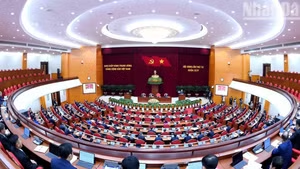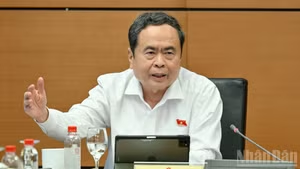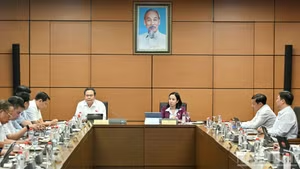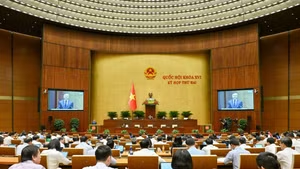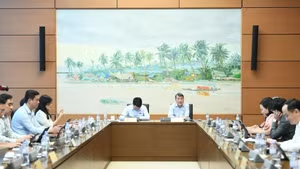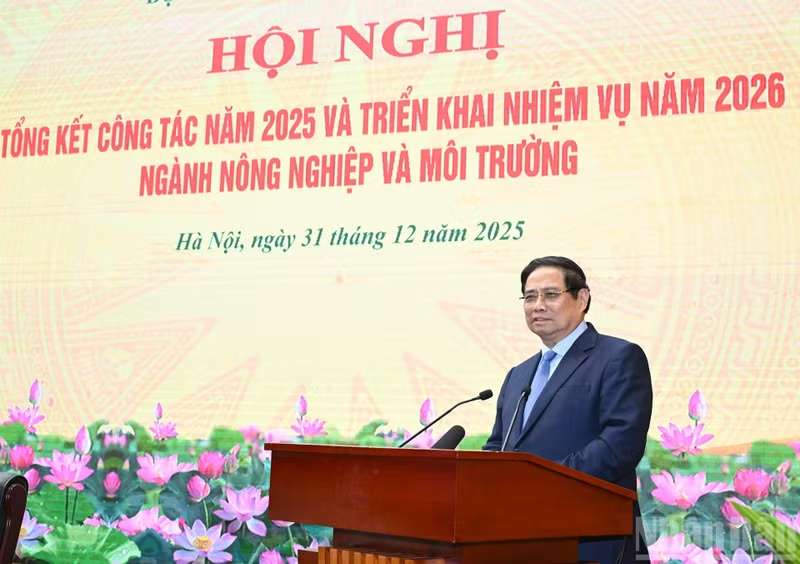
Prime Minister Pham Minh Chinh on December 31 attended a conference reviewing the performance of the agriculture and environment sector in 2025 and the 2021–2025 period, and outlining tasks for 2026.
A report by the Ministry of Agriculture and Environment (MAE) showed that despite global economic volatility, intensifying climate change and natural disasters, the sector completed or exceeded all nine targets assigned by the Government.
The sector's GDP growth is estimated at 3.7–3.92%; exports of agro-forestry-aquatic products were projected at 70 billion USD, exceeding the 65-billion-USD target; the trade surplus surpassed 20 billion USD; nearly 80% of communes met new rural standards; forest coverage reached 42.03%; 95% of urban solid waste was collected and treated to standards; and the multidimensional poverty rate fell by 0.8 - 1 percentage point.
For 2026, the ministry set priorities on strengthening natural resources management and environmental protection, enhancing climate resilience, and effectively mobilising land, water, forest and biodiversity resources to support sustainable agriculture and socio-economic development.
Key tasks include improving institutions and policies, accelerating sectoral restructuring to raise productivity, quality and added value, promoting green transition, proactively adapting to climate change, and expanding domestic and export markets. The sector will also focus on improving forecasting and disaster response, mobilising resources from land and minerals, promoting large-scale commodity production, and accelerating the disbursement of public investment.
Addressing the event, PM Chinh hailed achievements that the sector has gained in 2025 and its contributions to national development, particularly its role in ensuring food security and macroeconomic stability.
He said that in the 2021–2025 period, especially in 2025, the sector faced unprecedented challenges, but fulfilled all assigned targets, with several exceeded, thanks to the Party and Government’ strong leadership, broad social consensus as well as international support.
Reaffirming agriculture’s role as a pillar of the economy, the PM stressed that farmers are the central actors, agriculture as the driving force, and rural areas as the foundation of development.
He underscored that while industrialisation helped Viet Nam reach middle-income status, agriculture remains indispensable as the country advances towards high-income development.
Looking to 2026 - the first year of implementing the 14th National Party Congress's Resolution and the 2026–2030 socio-economic development plan, with a target of double-digit growth, the PM said the agriculture and environment sector must help drive rapid and sustainable development, macroeconomic stability, inflation control and major economic balances.
Agriculture remains a pillar, but it must be digitalised, modernised and industrialised, applying science, technology and innovation; and developing ecological agriculture, modern rural areas and civilised farmers, he stressed.
The leader called on the MAE and the sector to pursue the approach of “modern governance; enabling institutions; science-driven development; prosperous agriculture, farmers and rural areas; sustainable resources; and a safe environment,” with key task groups, focusing on effectively implementing directions and policies from the Party, Government and National Assembly.
Alongside, it is important to concentrate on improving institutions and policies; accelerating digital transformation and innovation; building smart farmers and integrated national databases; developing strategic infrastructure; restructuring production along national, provincial and local product lines; strengthening linkages among farmers, the State, businesses, banks and scientists; promoting sustainable fisheries and combating illegal, unreported and unregulated fishing; expanding high-quality, low-emission rice cultivation; scaling up the OCOP programme; and effectively implementing national target programmes.
He also stressed the importance of market expansion, brand building for Vietnamese agricultural products, sustainable natural capital management, administrative reform, decentralisation, and building a capable and ethical workforce.