Alongside these achievements, businesses are urgently implementing solutions to boost productivity and enhance value, thereby ensuring operational efficiency and meeting their set targets.
Facing numerous challenges
Truong Van Cam, Vice Chairman and Secretary General of the Viet Nam Textile and Apparel Association (Vitas), stated that during the early months of the year, the industry faced significant challenges due to market fluctuations. These ranged from changes in US trade policies and tariffs to geopolitical conflicts in the Middle East, which drove up logistics costs and impacted businesses.
Thanks to the concerted efforts of the entire sector, total export turnover for the first seven months exceeded 27 billion USD, up 2.7% year-on-year. In July alone, exports reached 4.67 billion USD—an increase of 8.2% compared to June and 4.3% compared to the same period last year.
Although July is not typically a peak month, this impressive figure not only reflects the industry's drive to ramp up production and business activities but also demonstrates its resilience and adaptability in the face of global volatility.
During the early months of the year, the Vietnamese textile and garment industry faced significant challenges due to market fluctuations, ranging from changes in US trade policies and tariffs to geopolitical conflicts in the Middle East that drove up logistics costs and impacted businesses.
Truong Van Cam – Vice Chairman and Secretary General, Viet Nam Textile and Apparel Association (VITAS)
Than Duc Viet, General Director of Garment 10 Corporation, added that the company has recently faced significant pressure due to declining consumer demand and a drop in orders; products such as dress shirts and knitwear have been particularly hard hit by US tax hike policies.
Furthermore, prolonged global political instability and escalating military conflicts in the Middle East have driven up the costs of raw materials and logistics, thereby squeezing corporate profit margins.
A determined mindset to overcome challenges and boost production and exports enabled the company to generate 2.99 trillion VND in revenue during the first seven months of the year—reaching 109% of its planned target.
To meet its objectives ahead of schedule, the company continues to closely monitor market trends, seek new sources of raw materials and sales outlets, and evaluate customer profitability.
It is also focusing on product research and transformation, developing new products, and accelerating sample production and quality improvements, all with the aim of enhancing product value and market competitiveness.
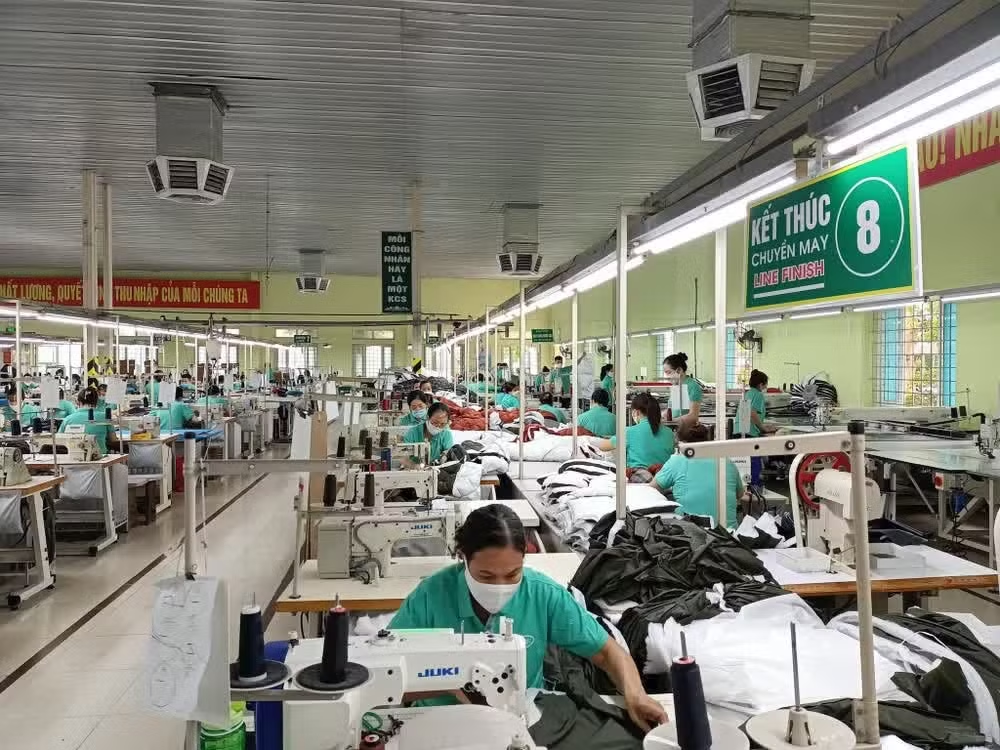
By investing in supply chain development and spearheading the growth of its member enterprises, the Viet Nam National Textile and Garment Group (Vinatex) has maintained positive growth in both revenue and profit.
However, the group also faces significant pressures regarding market conditions, order volumes, and rising costs. Despite these challenges, Vinatex General Director Cao Huu Hieu noted that the group's revenue and profit figures met or exceeded planned targets.
Nevertheless, exports have shown a downward trend—particularly in the garment sector—as many clients delay both production and the receipt of goods. While the yarn sector has secured orders for August, the rate of finalised orders has dropped markedly from September onwards.
These developments indicate a cautious market sentiment and slow order confirmation by clients, alongside mounting pressure to secure work for the final months of the year.
In the garment sector, companies have secured orders through December; however, clients continue to place short-term orders and delay confirmations. Purchasing power is recovering slowly, while competition remains fierce and cost pressures are high.
“Opportunities and challenges remain intertwined for the remainder of the year: demand in the US is improving, yet demand in the European Union (EU) stays weak, and competition from Bangladesh and China is intensifying. Meanwhile, geopolitical risks, logistics costs, and exchange rate fluctuations continue to exert pressure on businesses,” Hieu emphasised.
Market diversification
On July 24, the US terminated the 10% tariff under Section 122 and shifted to applying Section 301 tariffs, which target partners that have not established or effectively enforced bans on the import of goods produced using forced labour.
Viet Nam is subject to an additional 12.5% tariff added directly to the Most-Favored-Nation (MFN) rate—2.5 percentage points higher than the rates applied to competitors such as Bangladesh, Cambodia, Indonesia, and India.
Furthermore, Viet Nam has faced a disadvantage compared to countries benefiting from the “net of MFN” mechanism. These tariff levels will undoubtedly have a significant impact on business operations and the competitiveness of Vietnamese textiles and garments in the market.
Commenting on this issue, Hoang Manh Cam, Chief of the Board of Directors’ Office at Vinatex, affirmed that while the new tariff rates place Viet Nam at a disadvantage compared to certain competitors with lower rates, they do not fundamentally alter the position of the Vietnamese textile and garment industry within the US supply chain.
Viet Nam has remained a key supplier, boasting a balanced foundation regarding costs, flexible responsiveness, and supply chain integration. Experience from previous rounds of tariffs indicates that the primary impact involves the adjustment and reallocation of orders among suppliers, while the feasibility of reshoring garment production to the US market remains relatively limited.
Competitive pressure is set to intensify in 2027 as brands rebalance their sourcing across countries and increasingly concentrate orders with more capable suppliers. Consequently, Viet Nam’s ability to maintain and expand its market position will hinge on continuously enhancing productivity, speed, flexibility, product development capabilities, and standards regarding traceability and compliance.
“While tariff disadvantages are a factor that must be managed, the position Viet Nam has established within the supply chain remains a vital foundation for the country's textile and garment sector to continue competing and seizing opportunities in the period ahead”, Cam emphasised.
Cam stated that the US is currently the largest export market for Viet Nam’s textile and garment industry, accounting for approximately 40.13% of the sector’s total export turnover.
Consequently, changes in US tariff policies directly impact business operations. The challenge lies not merely in the 2.5-percentage-point tariff differential, but in the price competitiveness between Vietnamese enterprises and their rivals.
Amid rising production and logistics costs, this tariff gap can directly affect selling prices, the ability to retain orders, and export market share. Therefore, enterprises must prepare the necessary documentation, data, and capabilities to meet partner requirements, while also strengthening collaboration between brands and manufacturers to share costs and risks across the supply chain.
To achieve their objectives, enterprises need to maintain existing orders while proactively seeking new markets and diversifying their export destinations. This approach reduces dependency, creates room for maneuver, and enhances resilience against market fluctuations.
Simultaneously, businesses must continue investing in quality, productivity, raw materials, digital transformation, and green initiatives; doing so increases the value of each order, improves production efficiency, and solidifies their position within the global supply chain.