Facing multiple pressures
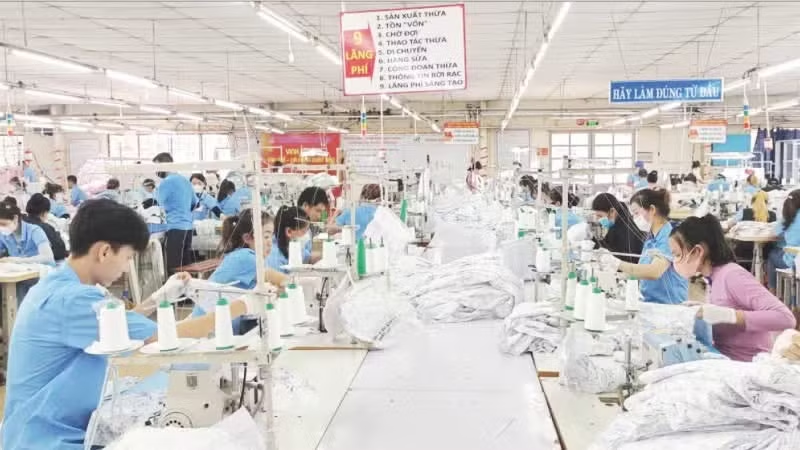
Nguyen Dang Loi, General Director of Dong Xuan Knitting One Member Co., Ltd., said that the company recorded total revenue of 109.6 billion VND (4.19 million USD) in the first quarter of 2026, with pre-tax profit of more than 4.17 billion VND (159,400 USD) and an average monthly income for workers of around 13.4 million VND (512 USD), ensuring stable employment. Despite market volatility, flexible management measures enabled the company to offset output shortfalls, maintain jobs, and stabilise business operations.
“In the second quarter, the company targets production value of approximately 84.2 billion VND (3.22 million USD), revenue of 95 billion VND (3.63 million USD), and profit of 6.1 billion VND (233,300 USD). It will continue expanding markets, enhancing competitiveness, efficiently utilising existing equipment capacity, strictly controlling production costs, and gradually improving working conditions and workers’ skills,” Loi added.
The recent global energy crisis has pushed logistics costs up by more than 20%, disrupting supply chains and increasing financial costs for businesses.
According to Vien Minh Dao, General Director of Eight March Textile Company Limited, the company has faced significant pressure as average interest rates rose from 4.8% to 7.5%, while earlier delivery deadlines and rising input and logistics costs have “eroded” profits. In response, the company has proactively expanded domestic sourcing, reduced transport costs, maximised productivity, and balanced orders.
To share difficulties with workers, the company has applied travel support allowances since March, increasing from 12,000 VND to 22,000 VND (0.46–0.84 USD) per person per day.
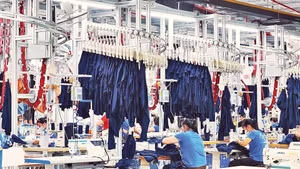
Rising input and operating costs have also placed significant pressure on profit margins at Nha Be Garment Corporation. Rapidly changing partner requirements, especially delivery timelines, have forced management to “spin like a top” in reallocating machinery and switching production between product lines to avoid order cancellations.
Thanks to flexible solutions, despite the challenging context, Nha Be Garment’s first-quarter revenue still increased by 10%, with profits exceeding the annual plan by 19%.
Alongside boosting productivity, the company is allocating bonuses to employees based on annual savings performance, prioritising direct workers with additional bonuses equivalent to 0.5–0.8 months’ salary added to their monthly income. It also supports travel costs for workers at 200,000–300,000 VND (7.6–11.5 USD) per person per month to help ease their burden.
Making good use of opportunities
Market fluctuations, disrupted supply chains and delays of one to three weeks in imported materials from China have significantly disrupted production plans. To avoid falling behind, textile enterprises have been forced to accelerate production to meet delivery schedules and avoid additional costs.
Vu Duc Giang, Chairman of the Viet Nam Textile and Apparel Association (Vitas), said that to improve efficiency, enterprises must diversify products, markets, and customers; enhance productivity; optimise costs; control cash flow; and improve product quality to strengthen competitiveness. At the same time, they need to improve forecasting, build risk response scenarios, and accelerate investment in technology, automation, robotics and AI, with a gradual shift towards green and sustainable production models to meet increasingly stringent market and customer requirements.
According to Cao Huu Hieu, General Director of Viet Nam National Textile and Garment Group (Vinatex), although first-quarter business results were relatively positive, with units such as Hoa Tho, Hue Textile and Garment, and Nam Dinh Textile and Garment reporting profits and yarn prices rising by 20–30%, this is only a short-term advantage as yarn demand has surged suddenly within a short period.
According to economic experts, as geopolitical risks remain unpredictable and electricity costs are expected to continue rising, the third and fourth quarters of 2026 will be a “test by fire” period.
Textile and garment enterprises need to shift from a passive mindset of waiting for the market to proactively adapting, focusing on accelerating at the right time and controlling slowdowns in a disciplined manner. In particular, they must maximise output, expand markets, diversify products and customers, optimise capacity, and maintain stable orders across the entire system.
Cao Huu Hieu, General Director of Viet Nam National Textile and Garment Group (Vinatex)
In this context, Vinatex leadership has advised enterprises in the sector to focus on managing supply chain and logistics risks, optimising input materials, improving efficiency and cost savings, managing cash flow, and accelerating in-depth investment. Companies need to closely monitor oil prices and transport costs, work directly with each customer segment to respond flexibly to new US tariff barriers, and quickly implement investment projects without delay to fully capitalise on market opportunities.
“2026 will no longer be merely a recovery phase; the market is entering a period of deep adjustment with many unpredictable variables. Therefore, textile enterprises must shift from waiting for the market to proactively adapting, focusing on accelerating at the right time and managing slowdowns with discipline. Specifically, they must maximise output, expand markets, diversify products and customers, optimise capacity, and maintain stable orders across the system,” Hieu emphasised.
At present, Vinatex leadership is not placing heavy emphasis on requiring enterprises to secure FOB (full-package) orders, but encourages flexibility, allowing companies to take on CMT (cut-make-trim) or medium-value orders, with the goal of ensuring efficiency and making the most of market opportunities to promote production.
In the first quarter of 2026, total textile and garment export turnover reached nearly 10.6 billion USD, up more than 2.3% compared with the same period in 2025, continuing to adhere to the strategy of market and product diversification to boost exports and improve production efficiency.