Than Duc Viet, General Director of Garment 10 Corporation, said: “Following the February 20, 2026 ruling by the US Supreme Court to end global reciprocal tariffs, competition has intensified significantly. At the same time, supply chain restructuring and shifts towards countries with lower costs and tariffs are accelerating.
Some clients have retained basic shirt orders in India instead of transferring them to Garment 10 as previously agreed. Meanwhile, the expected signing of the C3 agreement between Indonesia and Europe by the end of 2026 is being closely monitored by many brands and suppliers.
Once the agreement takes effect, textile exports from Indonesia to Europe will see tariffs reduced from 10 per cent to zero, prompting brands to shift orders to that market to take advantage of lower duties. In the face of ongoing uncertainty, the company continues to implement various solutions, including daily market updates, direct engagement with clients on plans, pricing and trends, and proactively buying raw materials early to enhance production efficiency.”
Hoang Thuy Oanh, Deputy General Director of Hoa Tho Textile Garment Joint Stock Corporation, said that basic, high-volume orders are increasingly shifting to Bangladesh, India and several African countries with lower tariff rates to offset rising costs and duties. The remaining orders tend to be smaller in volume, more complex in structure, and involve new materials and fabrics.
As a result, large-scale factories specialising in basic products are facing significant challenges and losing their competitive edge, particularly in terms of pricing. Following the ruling by the US Supreme Court to end global reciprocal tariffs, the administration of Donald Trump announced the invocation of Section 122 of the Trade Act of 1974 to impose temporary tariffs of 10% (which could rise to 15%) on imports for a period of 150 days, prompting customers to reassess their entire supply chains.
In the short term, partners have either increased purchase prices or offered only minimal cost-sharing. The company continues to work with clients and suppliers to review product origins, explore suitable domestic sourcing options, and further negotiate cost-sharing arrangements under the new global conditions.
According to Oanh, escalating tensions between the US and Iran have disrupted routes through the Red Sea, potentially prolonging shipping times to Europe and, in particular, to the US East Coast.
Amid container shortages and rising freight costs, the company is coordinating with clients to revise production plans and delivery schedules in order to avoid supply chain disruptions.
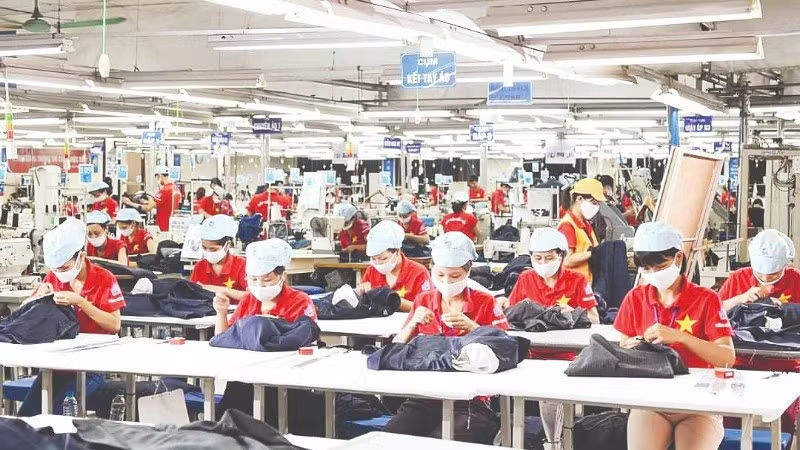
In the early months of the year, the textile and garment sector has shown positive signs, with abundant orders, larger volumes and more complex products generating higher added value. However, as product structures shift while unit prices remain unchanged and delivery times shorten, enterprises are required to reorganise production and optimise product allocation to improve productivity amid increasingly narrowing profit margins.
According to Nguyen Hong Lien, General Director of Hue Textile Garment Joint Stock Company, although orders are plentiful, businesses must remain cautious and closely monitor their reliability, as orders frequently change in design, delivery schedules and volumes.
In the coming period, the company will focus on identifying appropriate solutions to strengthen negotiations and improve order efficiency, while closely monitoring developments and updating information from sources, including clients and diverse markets to mitigate risks.
Le Tien Truong, Chairman of the Board of Viet Nam National Textile and Garment Group, noted that armed conflicts have driven up oil prices, leading to higher costs for energy, transportation, insurance and petroleum-based materials such as polyester fibre. However, the greatest concern lies in shifting consumer behaviour in key markets, particularly the US and Europe.
At present, the company is focusing on fulfilling existing orders with a commitment to maximising speed and efficiency. This includes shortening production time in Viet Nam to offset part of the longer delivery times caused by logistics constraints, while still ensuring effective access to key markets.
Similarly, Vu Duc Giang, Chairman of the Viet Nam Textile and Apparel Association, noted that escalating tensions in the Red Sea have disrupted global maritime trade, forcing vessels to reroute around the Cape of Good Hope and extending delivery times by 14 to 20 days; posing significant challenges for fast fashion products, which have short life cycles.
Freight rates for container shipments to the US and the European Union have risen two to threefold, while routes to the US East Coast are subject to additional war risk surcharges of 2,000 to 4,000 USD per container. At the same time, longer vessel turnaround cycles have led to shortages of empty containers at major ports such as Cat Lai and Hai Phong.
Viet Nam’s textile and garment industry remains dependent on imported materials for more than 70% of its inputs. As crude oil prices exceed 100 USD per barrel, the cost of synthetic fibres such as polyester and nylon, as well as dyeing chemicals, has surged. Coupled with rising domestic fuel prices, this has increased factory operating and inland transport costs, eroding profit margins.
“Despite mounting pressure from logistics costs and competition, the sector’s export target of 49 to 49.5 billion USD remains achievable, provided that enterprises stay flexible and focus on solutions such as adjusting commercial terms, diversifying transport modes, restructuring material sources and product lines, and expanding markets and customer bases to mitigate risks and sustain production,” Giang emphasised.