As Viet Nam embraces a new growth model based on science and technology, innovation and digital transformation, Resolution No. 10-NQ/TW on developing the foreign-invested sector (Resolution 10) sets out the goal of making the country a competitive destination for high-quality medium- and long-term foreign investment to support development.
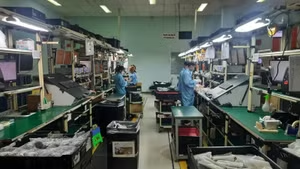
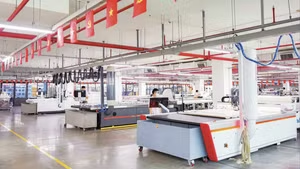
The Resolution also calls for the effective management and utilisation of foreign capital to enhance production capacity, strengthen linkages and spillover effects with the domestic economy, promote technology transfer, workforce development and deeper participation in global supply chains, thereby helping establish the country's new growth model.
Restructuring the foreign investment attraction strategy
Lawyer Nguyen Hong Chung, an investment policy expert, said Resolution 10 provides clear answers to many of the issues facing Viet Nam’s current foreign investment strategy. Indicators such as the number of projects and total registered investment capital are no longer regarded as the primary measures of success in attracting foreign investment.
Similarly, tax incentives, land rental rates and investment support policies are no longer the decisive tools for attracting foreign investors, particularly as many countries have adopted the global minimum tax and competition for investment has shifted from cost advantages to quality. Increasingly, competitiveness is measured by governance capacity, institutional quality, digital infrastructure, clean energy, a highly skilled workforce and the stability of the investment environment.
In a rapidly changing global landscape, Resolution 10 calls for a shift from input-based incentives to support linked to investors’ actual performance. In practice, investors seeking greater incentives will need to demonstrate their ability to transfer technology, invest in research and development (R&D), train workers, develop domestic suppliers and fulfil green transition commitments. This approach will ensure that state resources are used more effectively while generating tangible spillover benefits for the wider economy, representing a fundamental shift in Viet Nam’s foreign investment strategy.
This also reflects the country's broader effort to restructure its foreign investment strategy. “Resolution 10 demonstrates that Viet Nam is moving away from an at-all-costs approach to attracting foreign investment towards a strategy of selectively attracting investment that serves national development objectives. More importantly, for the first time, the foreign-invested sector is positioned within the broader strategy of strengthening national self-reliance and competitiveness, rather than simply being viewed as an additional source of economic growth,” Nguyen Hong Chung said.
Resolution 10 also sets targets for average localisation rates of between 45 and 50% in key manufacturing industries, while aiming for around 80% of the workforce to receive formal training. By 2045, the foreign-invested sector is expected to account for around 25% of total social investment and contribute approximately 30% of GDP.
Three strategic breakthroughs to implement the Resolution
One of the most significant aspects of Resolution 10 is its ambitious focus on R&D, technology and innovation, as well as strengthening linkages between foreign-invested enterprises and domestic firms to transform Viet Nam from an investment destination into an innovation hub.
Specifically, the Resolution targets 200–300 billion USD in newly registered foreign investment during the 2026–2030 period, equivalent to 40–50 billion USD annually, with realised investment reaching 150–200 billion USD, or 30–40 billion USD per year. Of this, 75% is expected to come from developed economies with strong technological capabilities, financial resources and advanced management practices. The Resolution also seeks to attract multinational corporations to establish research, design, innovation, data and regional headquarters, as well as operational centres in Viet Nam.
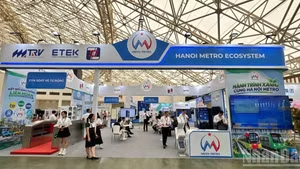
The goal is to attract at least three of the world's leading technology companies to establish headquarters, representative offices or R&D centres in Viet Nam. It also aims for around 10,000 domestic enterprises to join the value chains and supply chains of foreign-invested companies, including between 500 and 1,000 first-tier suppliers.
According to Dr Bui Quy Thuan of the School of Economics at Phenikaa University and Head of the General Research Committee of the Viet Nam Industrial Park Finance Association (VIPFA), these specific targets reflect a breakthrough in policy thinking and accurately capture Viet Nam’s ambition to move up the global value chain. However, achieving these goals will require addressing four major challenges.
The first is the substantial gap in technology and management capabilities between next-generation foreign-invested enterprises and domestic firms, the majority of which are small and medium-sized enterprises facing constraints in capital, technology and governance.
Another challenge lies in implementing a performance-based investment incentive mechanism. This includes developing objective methods to assess technology transfer and measure innovation contributions without creating additional administrative procedures, increasing compliance costs or reducing the predictability of the investment environment.
Other major challenges include shortages of highly skilled technology professionals, geopolitical risks, and increasing competition for foreign investment as Viet Nam raises its standards on environmental protection and localisation rates, while countries such as India, Malaysia and Indonesia are introducing large-scale, flexible financial incentive packages to attract Fortune 500 corporations.
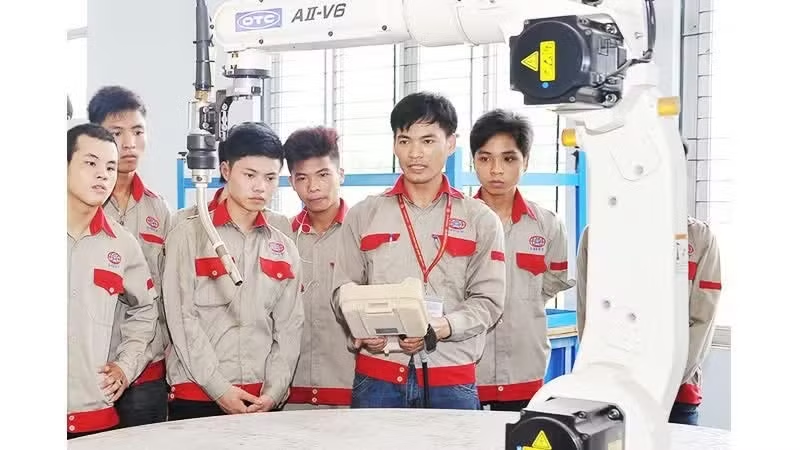
Dr Phan Huu Thang, former Director of the Foreign Investment Agency, said both domestic and foreign-invested businesses have warmly welcomed Resolution 10. To achieve its objectives, he stressed that Viet Nam should immediately implement a national human resources strategy focused on training semiconductor engineers, specialists in green technologies, data and artificial intelligence, as well as internationally qualified business managers.
He added that Resolution 10 is more than simply a policy on foreign investment. It is a strategic blueprint for restructuring Viet Nam’s growth model during its next stage of development, centred on three strategic breakthroughs: developing a highly skilled workforce, enabling domestic enterprises to participate in global supply chains, and building a national innovation ecosystem. This, he said, is the pathway for Viet Nam to achieve its ambition of becoming a high-income developed country by 2045.