The economic outlook has been overshadowed by the conflict, which has triggered a series of shocks to energy markets, supply chains and consumer confidence, with negative repercussions worldwide. In its latest Global Economic Prospects report, the WB forecast global growth at just 2.5% this year, down from 2.9% last year, while inflation is projected to reach 4%.
The economic fallout from the conflict is spreading across most regions, prompting the WB to downgrade growth forecasts for two-thirds of the world’s economies. China’s economy is expected to grow by only 4.2% this year, down sharply from 5% last year.
India is forecast to expand by 6.6%, compared with 7.7% last year, but is still expected to remain the world’s fastest-growing major economy.
Meanwhile, the Eurozone is projected to record modest growth of 0.8%, significantly lower than last year’s 1.4%. The region is considered particularly vulnerable because of its heavy dependence on imported energy. Inflation is unlikely to ease and economic recovery may remain elusive next year if the Middle East conflict drags on and fuel prices stay elevated through the end of this year.
One bright spot, however, is the US, whose growth forecast remains unchanged at 2.2% this year, slightly higher than the 2.1% recorded in 2025. As a major energy producer, the world’s largest economy is better positioned to withstand the crisis than countries reliant on imported oil and natural gas. The US economy is also benefiting from large-scale tax cuts and a wave of investment in artificial intelligence (AI).
Disruptions to energy supplies and surging fuel prices have undermined confidence and economic activity on a broad scale, hitting emerging and developing economies particularly hard. As a result, the WB has lowered its 2026 growth forecast for these economies by 0.4 percentage points to 3.6%, the weakest post-pandemic performance.
According to the WB’s Chief Economist Indermit Gill, Asia is currently the hardest-hit region. Western Asia, comprising 21 Arab countries including the Gulf states, has suffered heavily from the combined effects of the energy shock, infrastructure damage and severe disruptions to oil production, trade and tourism.
Among the countries facing the largest downward revisions to growth forecasts are the United Arab Emirates (UAE), Saudi Arabia, Türkiye and Bangladesh. Persistently high prices for energy, fertilisers and petroleum-related products are expected to place significant pressure on developing economies, where household spending on food and energy accounts for a substantial share of consumption.
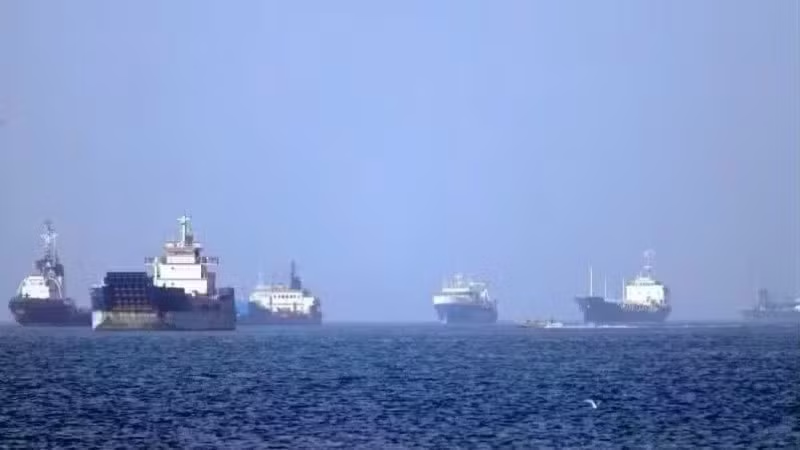
Since the US and Israel launched military operations against Iran, prompting retaliatory actions by Tehran and the closure of the Strait of Hormuz, global energy markets have come under intense strain as supplies tightened and prices surged. Fertiliser supplies have also been severely disrupted, as much of the global trade in fertilisers passes through the Gulf region, raising concerns among experts about the risk of serious food shortages. Rising fertiliser prices have increased production costs, adding further pressure to food prices.
Current forecasts for the global economy appear to be based on two main scenarios. The first assumes short-term disruption, with the impact of the conflict gradually brought under control and energy prices stabilising from mid-2026. The second envisages prolonged disruption, resulting in deeper and more lasting economic consequences.
The longer instability persists, the greater the economic and social costs. Global investment could weaken, including in energy-intensive sectors such as AI, potentially leading to higher unemployment.
The outlook for the global economy remains largely dependent on the unpredictable course of the conflict in the Middle East. Although a global recession is not yet expected, mounting economic difficulties are already affecting the lives of billions of people. If the energy shock lasts longer than anticipated, inflation could continue to rise, while weakening confidence and financial strains could dampen consumer demand, becoming a cloud hanging over the global economy.