The event brought together senior officials and experts from institutions, economic organisations and regional security agencies, underscoring a shared determination to address one of the continent’s most serious challenges.
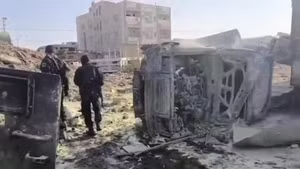
Selma Bakhta Mansouri, Algeria’s Secretary of State in charge of African Affairs, warned that terrorism in Africa is no longer a temporary phenomenon or confined to specific geographical areas, but has evolved into a cross-border threat, adaptable and fuelled by complex interactions that combine transnational organised crime, illicit economies, and illegal trafficking of resources, alongside the increasing exploitation of modern technologies against a backdrop of persistent structural weaknesses in many countries.
Africa has overtaken the Middle East as the world’s most severe terrorism hotspot. Mansouri noted that more than 70% of all terrorism victims worldwide are now in Africa. The Sahel region and sub-Saharan Africa have emerged as epicentres of terrorist attacks, accounting for nearly half of all global terrorism-related deaths in recent years.
The most prominent violent extremist groups operating in Africa include Al-Qaeda affiliates such as JNIM, which is highly active in the Sahel; Islamic State (IS)-linked groups such as ISWAP in West Africa; Boko Haram, which remains active in Nigeria and neighbouring Chad, Cameroon and Niger; and Al-Shabaab, which continues to pose a serious threat in Somalia and Kenya.
The drivers behind the surge in terrorism across Africa are complex. The continent has been plagued by prolonged political instability, coups and armed conflicts that create security vacuums. More than 30 African countries are experiencing various forms of armed conflict, accounting for nearly half of all armed conflicts worldwide, while incidents of political violence have increased by around 20% annually over the past two years.
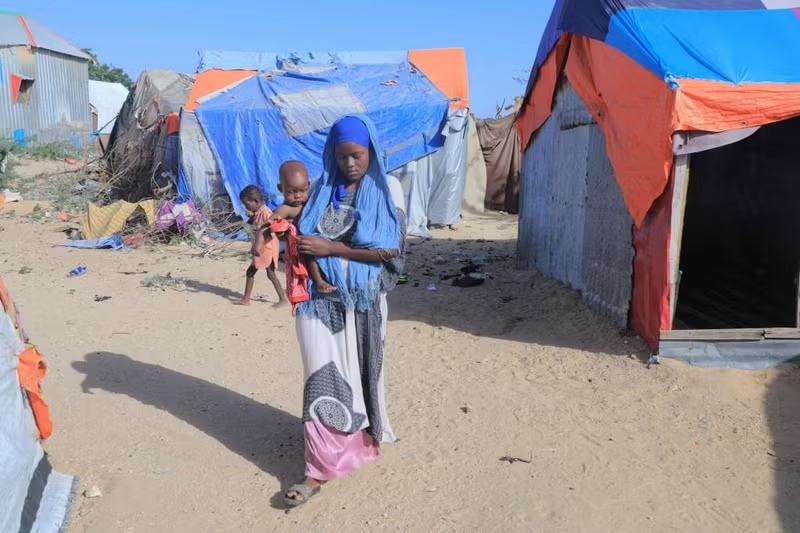
In addition, a lack of investment, extreme poverty and limited development opportunities provide fertile ground for terrorist recruitment. An estimated 438 million people in Africa live in extreme poverty, earning less than 2.15 USD a day. More than one billion people, nearly two-thirds of the continent’s population, cannot afford a healthy diet.
Nigeria and the Democratic Republic of the Congo together account for 23% of the world’s extremely poor. The poorest areas are also often the scene of the deadliest terrorist attacks, such as the killing of 71 people in September 2025 in the Democratic Republic of the Congo.
Terrorism in Africa is further exacerbated by factors including organised crime, where terrorism intersects with transnational criminal activities such as drug trafficking, kidnapping for ransom and livestock theft, providing financial resources for armed groups.
The infiltration of foreign fighters through porous borders from other conflict zones, including Libya, Iraq and Syria, has also contributed to the problem.
The rise of terrorism in Africa not only undermines state authority and hampers development, but also perpetuates a vicious cycle of instability. The world’s poorest continent is trapped in a downward spiral of climate change, coups, humanitarian crises, terrorism and armed conflict. As a result, around 64 million people in the Horn of Africa are in need of urgent humanitarian assistance in 2025.
At the workshop in Algeria, a representative of the host country recalled that at the African Union’s special summit in Equatorial Guinea in 2022, leaders called for a comprehensive review and the mobilisation of political will at the highest level to strengthen the continent’s counter-terrorism strategies.
Mansouri highlighted the need to forge a more unified, coherent and comprehensive continental approach, thereby affirming Africa’s role as a strategic actor in global counter-terrorism efforts.
The strategic action plan currently under review will serve as a central reference framework for cooperation at continental, international and bilateral levels.
Efforts to eradicate terrorism in Africa require comprehensive solutions that go beyond military measures. These must address root causes such as poverty, inequality and weak governance, enhance regional cooperation and intelligence-sharing, promote socio-economic development in affected areas, and provide humanitarian assistance to millions of displaced people and refugees.