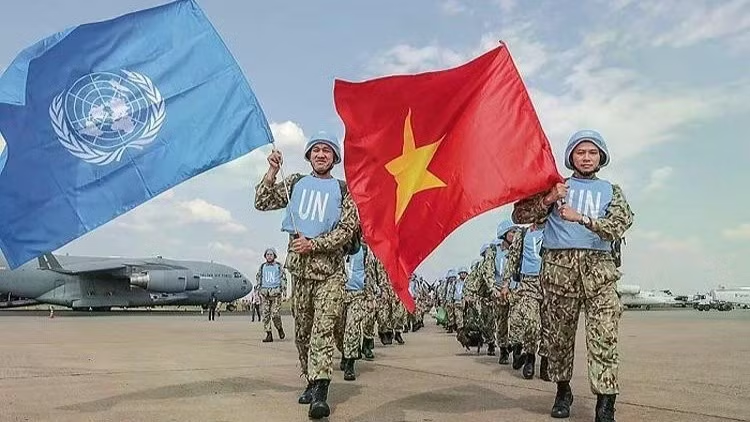
However, amid an increasingly fragmented world undergoing profound changes, the world’s largest multilateral organisation faces an urgent need to reform and adapt to new circumstances if it is to continue playing its role as a “captain”. This issue is once again on the agenda at the 81st session of the United Nations General Assembly, currently underway in New York, the US.
Just months after the end of World War II, in January 1946, the United Nations General Assembly held its first session in London, the UK, to discuss efforts to maintain international peace and security.
Many decades have passed, marked by the ups and downs and transformations of history, leading to the 81st session. While the question of how to maintain international peace and security remains ever-present, the challenges facing the United Nations have multiplied many times over.
The global geopolitical landscape today is fundamentally different from that of more than 80 years ago, when the United Nations was established.
Addressing the opening of the 81st session of the United Nations General Assembly, Secretary-General Antonio Guterres stressed that the world is engulfed in conflicts and deep geopolitical divisions, with the risk of nuclear escalation looming, persistent poverty and inequality, and an increasingly devastating climate crisis.
The explosive development of information technology, particularly artificial intelligence, has opened up opportunities for development while also posing risks in the absence of robust and transparent governance.
Above all, confidence in multilateral institutions, including the United Nations, is at serious risk of erosion and is under mounting pressure from complex shifts in global geopolitics.
Against this backdrop, reforming the United Nations has become essential for the multilateral organisation to fulfil its mission in the new circumstances.
From an internal perspective, reform is also an urgent requirement for the United Nations itself, as some structures established more than 80 years ago are considered no longer suited to the current context.
One example is the representativeness of the membership of the Security Council. Many argue that the Council's current structure still reflects the global balance of power in 1945 and lacks a “voice” from Asia, Africa and Latin America — regions that are increasingly becoming pillars of the new multipolar international system. In addition, fierce competition among major powers has made the process of adopting resolutions more difficult.
Former President of the United Nations General Assembly Annalena Baerbock stressed that changing working methods, which are no longer suited to the current situation, is the way forward for the United Nations to continue pursuing its core principles and objectives of maintaining peace and security and building a fairer and better world.
Efforts to reform the Security Council have also received support from the UN Secretary-General and many member states, including Russia, Germany, Japan, India and African countries, with the aim of enhancing the Council's representativeness, effectiveness and efficiency.
Despite facing a number of challenges, the United Nations' broad presence over the past decades demonstrates that its role and core purpose remain as relevant as ever.
Over its 80-year journey of existence and development, through tireless efforts, the United Nations has not only become the “common home” of 193 member states, but has also established itself as a multilateral organisation of vital importance to international political life, with no other mechanism or organisation able to replace it.
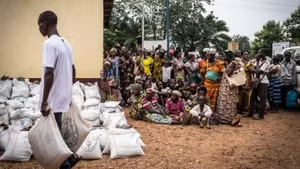
Under the blue flag of the United Nations, millions of vulnerable people receive essential assistance every day, while peace and security continue to be promoted. The United Nations has led efforts to strengthen cooperation and support development, not only in terms of economic growth but also in formulating and implementing policies on hunger eradication, poverty reduction, gender equality, healthcare and the environment.
Under the theme “Restoring Trust, Managing Transformation: A United Nations that Delivers for All”, the 81st session of the United Nations General Assembly is expected to help restore public confidence in the world's largest multilateral organisation. Secretary-General Antonio Guterres has called on member states to advance UN reform at this session in order to improve its effectiveness and strengthen the central role of the United Nations in global governance.