An urgent need
The unmanned aerial vehicle (UAV) market in Ho Chi Minh City is forecast to grow by around 40% annually, however the supply of highly specialised personnel meets only about 5-7% of demand. UAVs have been identified as one of the key sectors at Saigon Hi-Tech Park (SHTP), but the shortage of skilled workers is constraining the industry's development. Beyond UAVs, businesses at SHTP are also in urgent need of personnel in AI, semiconductors, biotechnology, automation to expand production. Developing a highly skilled workforce for the city is therefore an urgent priority.
According to the city's Department of Home Affairs, Ho Chi Minh City will need between 800,000 and one million additional workers by 2030, with services and high-tech industries accounting for as much as 70% of demand.
As Ho Chi Minh City shifts towards a growth model underpinned by science and technology and innovation, developing human resources for its key industries has become an urgent task. According to Foreign Direct Investment (FDI) enterprises, workforce quality is one of the factors that investors pay particular attention to. As the city pursues the development of high-tech industries, core technologies, the digital economy, the circular economy, and smart cities, improving training quality to meet the workforce needs of emerging industries has become increasingly pressing.
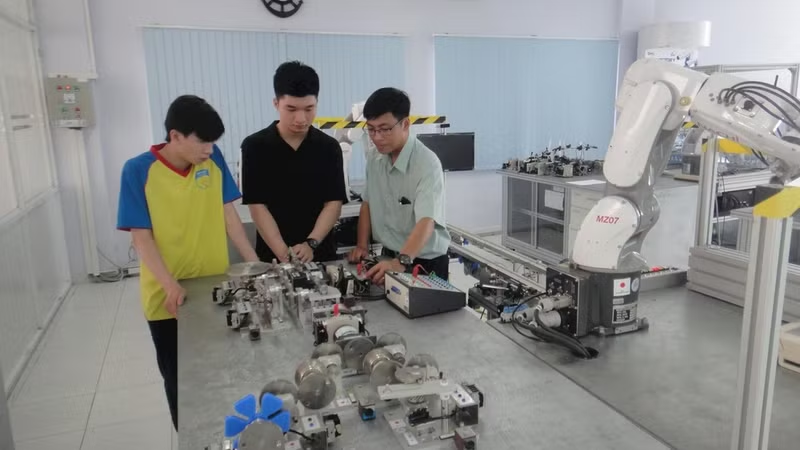
Thue Quist Thomasen, Chairman of the Nordic Chamber of Commerce in Viet Nam (NordCham Viet Nam), said that human resources were the foundation for achieving development goals. Ho Chi Minh City needed to step up the training of highly skilled workers to meet the requirements of FDI enterprises. Accordingly, the city should pilot dual education programmes, combining classroom instruction with practical training at businesses through partnerships between businesses and universities. Such programmes would provide an important foundation for students to develop practical skills and better meet the demands of the labour market and modern industries.
Meanwhile, Dr. Chung Thi Van Anh from Ba Ria-Vung Tau University in Ho Chi Minh City noted a paradox in practice: demand for workers in core industries was rising, but the training system had not kept pace in terms of scale, quality, and occupational structure. The gap between training and businesses' actual needs remained a major challenge in the development of Industry 4.0.
The issue is not simply one of equipping workers with knowledge and vocational skills; it also involves the need to renew mindsets and strengthen their capacity to adapt. As science and technology play an increasingly decisive role, the question is not merely what requirements workforce training should meet, but also how to develop a workforce capable of innovating, mastering technology, and adapting to rapid economic change.
Aligning training with development needs
In the semiconductor sector alone, Viet Nam had attracted more than 170 FDI projects by the end of 2025. Of these, 54 were located in Ho Chi Minh City, with total registered capital exceeding 5.1 billion USD. However, human resources remain one of the main bottlenecks hindering the industry's development. Viet Nam needs around 5,000-10,000 semiconductor engineers each year, while current training capacity meets less than 20% of demand. In response, Ho Chi Minh City has set a target of training 9,000 semiconductor engineers and providing advanced specialist training for 1,500 experts by 2030.
Meeting demand for highly skilled workers requires not only expanding training capacity but also improving quality and narrowing the gap between educational institutions and businesses.
Assoc. Prof. Dr. Nguyen Tan Tran Minh Khang, Rector of the University of Information Technology, Viet Nam National University, Ho Chi Minh City, candidly acknowledged that the gap between training and production practice in chip design had gradually narrowed. In the past, businesses typically spent six to eight months training newly graduated engineers in corporate culture, skills, technology, and their own design processes. That period has now fallen to around one to two months. This progress shows that university curricula are increasingly focused on equipping students with industrial design skills and an understanding of design processes.
However, to address the workforce challenge at its root, the city needs a training strategy aligned with its economic structure and development orientation for the new period, rather than focusing solely on individual industries. Le Nhu Hung, a master's degree holder and Chairman of the Viet Nam–Ho Chi Minh City Association for Human Resource and Talent Development Science, argued that the city should promptly build and implement a strategy for developing highly skilled human resources and talent for the 2026-2030 period, with a vision to 2050. At the same time, it should establish clear priorities for workforce development in each sector, avoiding the dispersal of investment or the pursuit of advanced technologies without first fully assessing available resources and existing capabilities.
Human resource development must be based on cooperation among the State, educational institutions, and businesses. Businesses, in particular, should be involved throughout the training process, from identifying workforce needs and designing curricula to organising practical training, and assessing learners' competencies. Developing a workforce suited to the new growth model is both an urgent requirement and an opportunity for the city to make a breakthrough amid the Fourth Industrial Revolution.
Therefore, developing a highly skilled workforce requires more than expanding training scale; it also calls for comprehensive reform of the education, science, and technology ecosystem. By aligning training with development needs, businesses and the labour market, the city can gradually remove workforce bottlenecks, strengthen its competitiveness, promote innovation, and accelerate the transition towards a growth model based on knowledge, technology, and higher added value.