Practical experience in Dak Lak Province shows that when capital flows are channelled in the right direction, aligned with real needs and production characteristics, agriculture not only maintains stability but also creates notable development highlights.
Capital flows aligned with reality, supporting production
It is not difficult to observe that in areas where bank credit is deeply embedded in production, agriculture operates more smoothly and is less prone to disruption amid market fluctuations. This is clearly reflected in the credit structure of Agribank’s Dak Lak branch, where lending to agriculture and rural areas consistently accounts for more than 80% of total outstanding loans.
According to statistics, as of March 31, total outstanding loans of the branch exceeded 25.11 trillion VND (954 million USD), of which agriculture, forestry and fisheries accounted for more than 9 trillion VND (342 million USD), while agricultural procurement and processing activities made up over 40%. These figures not only reflect the scale of credit but also show how capital is positioned to move from production to processing and trade, gradually forming closed value chains.
This approach is significant, as one of the long-standing weaknesses of Viet Nam’s agriculture lies in fragmented production, weak linkages and low added value. When credit extends beyond production to processing and distribution, the long-standing issue of “bumper crops, falling prices” can gradually be addressed.
At the same time, flexible credit mechanisms help narrow the gap in access to capital. The effective implementation of unsecured lending policies under Decree 55/2015/ND-CP has enabled many farmers to access loans more easily, reducing dependence on collateral. Preferential interest rates, 0.5–1% lower than in other sectors, are also an important factor, encouraging people to invest and expand production.
The effectiveness of agricultural credit is not measured solely by growth figures, but by changes in specific production models. In Ea Kar Commune, the household of Tran Van Than is a typical example.
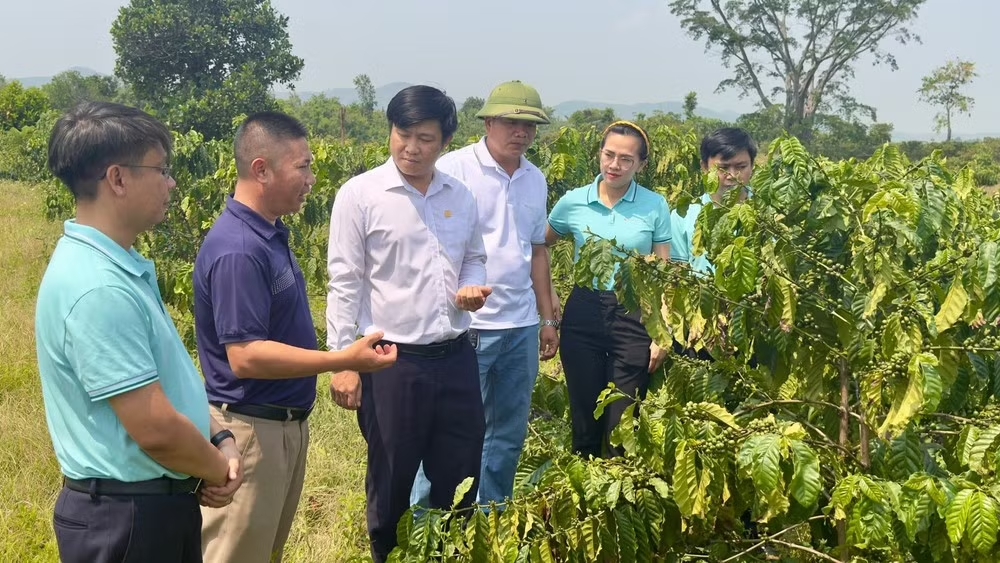
With outstanding loans of 3 billion VND (114,000 USD), his family has developed an integrated production model across 7 hectares, combining coffee cultivation, replanting with new varieties, intercropping with durian and rambutan, and improving fish ponds. What is notable is not only the scale of investment, but also the shift in production mindset.
Moving away from reliance on a single crop, the diversified model helps spread risks, maximise land resources and improve economic efficiency—an approach well suited to the context of climate change and increasingly unpredictable markets.
In another case, Nguyen Van Anh Tuan has boldly borrowed 4 billion VND (152,000 USD) to invest in pig farming at a scale of 1,200 pigs per cycle. This scale reflects a transition from small-scale husbandry to commodity production, associated with stricter disease control and productivity requirements.
If at the household level capital helps transform production methods, at the enterprise level credit serves as a “springboard” for technological innovation and market expansion. Viet Thang Production, Trade and Services Co., Ltd. is a typical example. With a credit limit of over 33 billion VND (1.25 million USD), the company has invested in modern production lines, reducing energy consumption, lowering costs and improving product quality.
According to Nguyen Thi Dung, Director of Viet Thang Company, these changes go beyond internal operations. The factory’s capacity has increased from 3 million to 6 million products per year, while the defect rate has fallen by around 10%, opening up opportunities to serve both domestic and international markets. More importantly, the company is gradually asserting its role as a key link connecting with farmers, organising production and guaranteeing output—crucial elements in forming agricultural value chains.
It is clear that when capital is used effectively, it not only creates products but also reshapes production structures, linking farmers, enterprises and markets more closely.
Bottlenecks that remain difficult to resolve
However, a realistic assessment shows that credit flows to the agriculture sector still face many systemic barriers. The first is the issue of collateral, a long-standing bottleneck that has yet to be fully resolved. Agricultural land is often undervalued, while assets on land—such as plantations, livestock facilities and greenhouses—are difficult to appraise and liquidate in case of risk. This forces banks to remain cautious and makes it harder for borrowers to access large-scale capital.
The second challenge lies in the nature of agricultural cash flows. Unlike industry and commerce, agricultural production depends heavily on seasons, weather and market prices. Production cycles are long, capital recovery is slow and risks are high, placing pressure on both borrowers and lenders.
Another fundamental issue is the lack of sustainability in value chain linkages. In practice, many linkage models break down due to weak commitments among stakeholders, with off-take contracts easily disrupted when markets fluctuate. When value chains are unstable, credit risks inevitably increase.
Notably, financial management capacity among many enterprises and cooperatives remains limited. A lack of transparency in cash flows and inadequate business planning make it difficult for banks to assess and approve credit.
These bottlenecks are not confined to borrowers or banks alone but reflect broader challenges within the agricultural ecosystem. Therefore, the key requirement is not only to expand credit but also to transform how credit operates in the agriculture sector.
First, it is necessary to improve the legal framework governing assets on agricultural land, particularly those involving high-tech investments. When these assets are properly recognised and valued, access to medium- and long-term financing will improve significantly.
At the same time, the development of agricultural insurance must be strengthened. This serves not only to protect producers against risks such as natural disasters and disease, but also as a safeguard that gives banks greater confidence in lending.
Another important pillar is the development of sustainable value chains. When enterprises act as central coordinators, taking responsibility for output, cash flows become more stable, thereby reducing credit risks.
However, the decisive factor ultimately lies in mindset. Agricultural credit can no longer rely primarily on collateral, but must shift towards evaluating project efficiency and actual cash flows. This is an inevitable trend, aligned with the characteristics of agricultural production. As Nguyen Thi Dung, Director of Viet Thang Company, suggested: “To address these challenges, more appropriate credit mechanisms tailored to agriculture are needed, shifting from collateral-based lending to assessments based on value chain efficiency and actual project cash flows.”
In reality, agricultural credit remains a difficult, high-risk and low-profit sector. Yet, in a broader perspective, it holds strategic importance for macroeconomic stability and social welfare. In Dak Lak, practical production models clearly demonstrate that when capital flows are properly unlocked, they not only sustain production but also drive restructuring, enhance value and strengthen competitiveness.