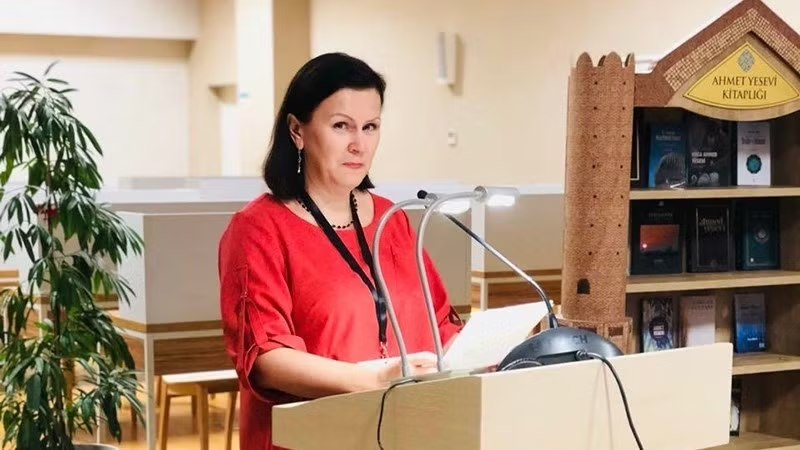
According to Albina Legostaeva, Viet Nam’s standing in the international arena is growing steadily. The decision by the jury of the Lev Tolstoy International Peace Prize to meet and vote to confer the award on the Vietnamese leader is evidence of Viet Nam’s increasing influence in international affairs.
The jury highlighted Viet Nam’s adherence to the rule of law in its foreign policy, as well as its promotion of an approach to regional security based on dialogue, mutual respect, compliance with international law, stronger economic connectivity, and mechanisms for conflict prevention and management.
This approach, grounded in the United Nations Charter and widely recognised norms of international law, reflects the stance of a responsible nation.
Viet Nam’s foreign policy, rooted in its tradition of peace and compassion, has helped the country transform itself from a nation recovering from war into a model of commitment to peace and development.
The presentation of an award named after the great Russian writer and thinker Lev Tolstoy to the Vietnamese leader underscores the universal values of peace, non-violence and intercultural dialogue pursued by Viet Nam.
According to the expert, the Peace Prize bestowed on the Vietnamese leader is also recognition of the path Viet Nam has chosen, harmoniously combining economic strength, cultural depth and a responsible foreign policy.
Culture and national heritage as bridges connecting Viet Nam with other countries
“For me, Viet Nam is a country I love, not only because of its wonderful, rich and distinctive culture. What is important to me is that the country’s development is grounded in family and national values, values that we also share in Russia. These values are passed down from generation to generation. Culture is built on simple yet profound principles: family, respect for ancestors, historical memory and love for the homeland. National heritage therefore becomes a bridge connecting Viet Nam with other countries,” Albina Legostaeva shared.
Importantly, Viet Nam’s leaders, headed by General Secretary and President To Lam, are building the country’s future on these principles. Resolution No. 80-NQ/TW on cultural development has placed culture at the heart of the country’s development strategy, closely linking cultural development with the comprehensive development of people and shifting the focus from merely preserving culture towards transforming it into a resource, an economic value and a source of national soft power.
According to Albina Legostaeva, it is important to recognise that culture is not merely the spiritual foundation of society but also a vital strategic asset.
Viet Nam has so much to introduce to the world. Pho and the ao dai, for example, have long become national cultural symbols promoted internationally. More importantly, Viet Nam is working to increase the number of its intangible cultural heritage elements recognised by UNESCO, thereby showcasing the distinctive culture and people of Viet Nam.
Albina Legostaeva recalled that during his visit to Moscow in May 2025, despite a busy schedule, Vietnamese leader To Lam still made time for a large and warm meeting with representatives of Moscow’s academic, social and cultural communities.
Cultural Days have also been organised in both Russia and Viet Nam. Ngo Phuong Ly, spouse of General Secretary and President To Lam, has actively participated in cultural exchanges between the two countries. Last year, she attended the opening ceremony of the 2025 Vietnamese Culture Festival in Moscow and met Russian Minister of Culture Olga Lyubimova, with the two sides discussing cultural cooperation, particularly in the field of cinema.
“And now, we are all eagerly looking forward to the opening of the Vietnamese Film Festival, which promises a very exciting programme,” Albina Legostaeva said.
Cultural ties between Russia and Viet Nam have become increasingly tangible in recent years. This has been reflected in cultural exchanges, new institutions and initiatives, growing mutual trust, and many other forms of cooperation.