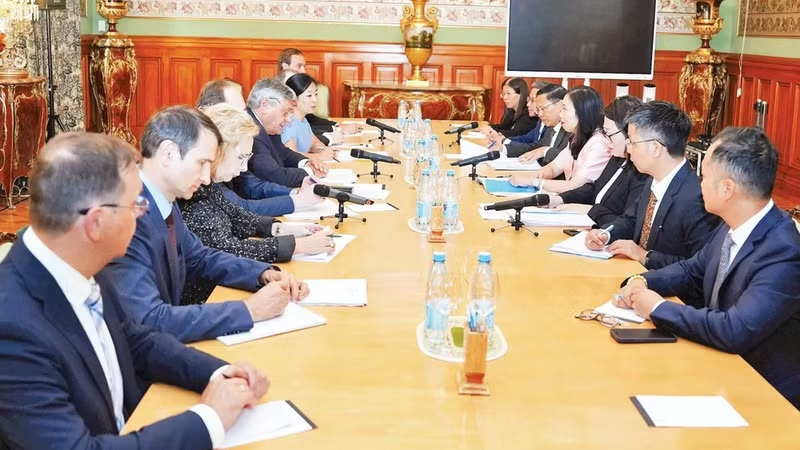
In recent months, exchanges and contacts between agencies, ministries, sectors and localities of Viet Nam and Russia have been intensified. Notably, alongside maintaining existing cooperation frameworks, the two sides have increasingly focused on seeking new areas of cooperation and creating additional momentum for bilateral relations.
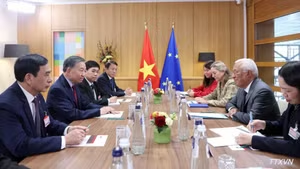
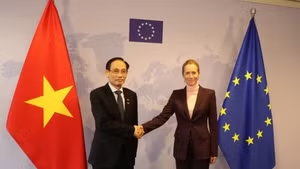
At the recent Viet Nam-Russia political consultations in the capital city of Moscow, in a friendly, open and trusting atmosphere, Deputy Minister of Foreign Affairs Le Thi Thu Hang and Russian Deputy Minister of Foreign Affairs Andrey Rudenko expressed their pleasure at the positive results achieved in bilateral relations. Economic and trade cooperation has maintained positive growth momentum, with bilateral trade turnover in each year higher than the previous year. Energy cooperation has been expanded into new, green and sustainable energy sectors with high technological content.
Building on the results achieved, the two Deputy Ministers agreed to continue strongly promoting cooperation in all fields; at the same time, they agreed on the need to effectively utilise the Free Trade Agreement between Viet Nam and the Eurasian Economic Union to increase trade turnover, expand investment, and facilitate the penetration of goods and products from the two countries into each other’s markets on a balanced and sustainable basis. The two sides also emphasised the need for close coordination and for urging the implementation of high-level commitments and agreements, thereby bringing the comprehensive strategic partnership into ever greater depth, substance and effectiveness.
In the picture of Viet Nam-Russia cooperation, tourism, which is emerging as a bright spot, cannot go unmentioned. Figures exchanged at a meeting between Russian Deputy Prime Minister Dmitry Chernyshenko and Vietnamese Ambassador to the Russian Federation Dang Minh Khoi clearly demonstrate the strong growth of two-way tourist flows. If Viet Nam welcomed around 690,000 Russian visitors in 2025, the figure is forecast to surpass 1 million in 2026. The number of Vietnamese visitors to Russia is also increasing, amid the continued expansion of air connectivity between the two countries.
These flows of visitors travelling between the two countries are bringing them closer together. Viet Nam is becoming increasingly familiar to people in the Land of the White Birch. From the “northern capital” of Saint Petersburg to the Taman Peninsula in southern Russia; from the westernmost point of Kaliningrad to Vladivostok in the Russian Far East, the presence of Viet Nam is becoming increasingly visible. It seems very easy to encounter the topic of Viet Nam in almost every conversation. Once they know that the person they are speaking to is from Viet Nam, they happily recount their trips, Vietnamese food and people, or mention relatives and friends who have recently returned from there.
The increase in two-way tourist flows has created additional momentum for economic activities, while also promoting exchanges and mutual understanding between the peoples of the two countries. More convenient connectivity is opening up further opportunities for trade, investment, education, cultural exchanges and cooperation between localities.
The Vietnamese and Russian peoples remain proud of the two countries’ relations, which have a special political and emotional foundation. Trust that has stood the test of time and been nurtured through generations is an important condition for the two countries to maintain cooperation across many fields, as well as seek new results. In order to create sustainable growth momentum, Russian Deputy Prime Minister Dmitry Chernyshenko stressed that Russia and Viet Nam need to focus on promoting cooperation in new and potential areas.
For experts, Vietnamese studies scholars and those in Russia who have long been closely connected with Viet Nam, new advances in bilateral relations are creating significant impetus, but still do not fully meet expectations. Many hope that the two countries will continue to expand and enrich people-to-people diplomacy, while promoting greater and more active participation by younger generations in nurturing bilateral relations. In their view, the political foundation and people-to-people sentiments are values to be proud of, but trade, market understanding and connections between the younger generations of the two countries still need to be promoted much more strongly.
Ambassador Dang Minh Khoi affirmed that Viet Nam always attaches importance to and wishes to work with the Russian Federation to continue strongly promoting substantive and effective cooperation, not only in traditional areas such as politics, energy and oil and gas, but also expanding into science, education, culture, sports and tourism, bringing bilateral relations into ever greater depth and delivering practical benefits to the peoples of the two countries.
As the two countries enter a new era of cooperative relations, the goals set are greater, requiring cooperation to also become more substantive and effective. To elevate the bilateral relationship, it is not enough merely to maintain positive development momentum in areas where cooperation has already been and is being effective; instead, new thinking, new determination and new momentum are needed.