Q: Looking back on the past term, what do you consider the most significant achievements of the Viet Nam Red Cross Society in fulfilling its humanitarian mission?
A: If I were to summarise the 11th term in a single phrase, I would describe it as a period of profound transformation. Beyond expanding the scale of its activities, the Viet Nam Red Cross Society has fundamentally renewed its development mindset and operating methods to meet the country's evolving needs and increasingly complex humanitarian challenges.
During the term, the society mobilised more than 21.1 trillion VND (802.3 million USD) for humanitarian programmes, benefiting over 52 million people.
The past five years were marked by unprecedented challenges. The COVID-19 pandemic left lasting impacts, while increasingly severe natural disasters, climate change, population ageing, regional disparities, and emerging humanitarian risks placed greater demands on relief efforts. Against this backdrop, the society strengthened its role as the specialised humanitarian organisation entrusted by the Party and State to serve as the core force, bridge, and coordinator of humanitarian work, mobilising the entire political system and society to support the poor, vulnerable groups, and disadvantaged people.
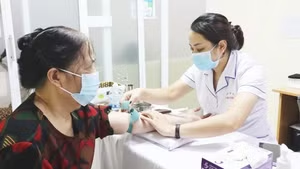
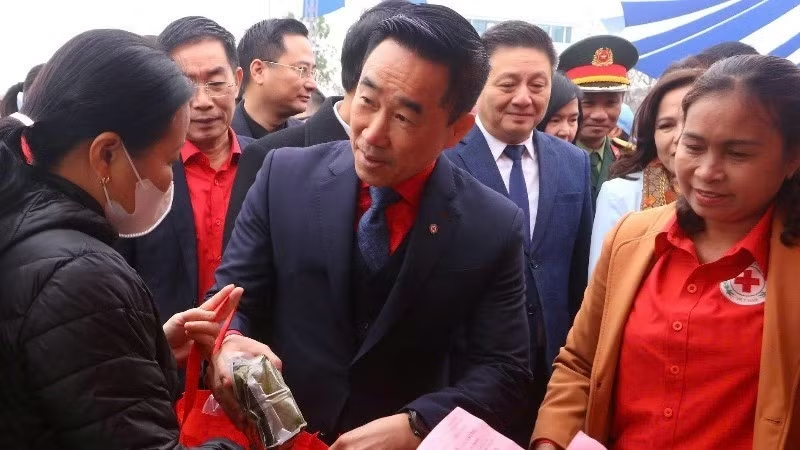
During the term, the society mobilised more than 21.1 trillion VND (802.3 million USD) for humanitarian programmes, benefiting over 52 million people. Flagship initiatives such as Tet of Compassion and the Humanitarian Month campaign have gained wider public support. Community healthcare, voluntary blood donation, disaster preparedness and response, and international humanitarian cooperation have also recorded notable progress.
These achievements reflect not only the scale of our work but also the enduring spirit of compassion across society. More importantly, however, the greatest accomplishment has been a shift in development thinking. Rather than focusing primarily on emergency relief, the society has adopted a more comprehensive approach that combines immediate assistance with livelihood recovery and community resilience. We have also moved from directly delivering aid towards connecting and coordinating social resources, while gradually integrating data and digital technologies into humanitarian governance.
Q: Digital transformation is reshaping every sector. How has the Viet Nam Red Cross Society embraced this opportunity?
A: For us, digital transformation is not simply about adopting new technologies; it is about transforming humanitarian governance. Humanitarian work demands that assistance reaches the right people, addresses the right needs, arrives at the right time, and is delivered in a transparent and accountable manner. As humanitarian needs become more diverse and resources increasingly complex, data and digital technology have become indispensable.
Over the past term, we have gradually introduced digital tools into management, communications, fundraising, humanitarian campaigns, and donor engagement. Digital platforms have enabled humanitarian assistance to be delivered more quickly and transparently while encouraging greater participation from individuals and businesses.
However, this is only the beginning. During the 2026–2031 term, we aim to establish a nationwide digital humanitarian governance system. This includes developing an integrated database covering the society's organisation, members, volunteers, humanitarian beneficiaries, and social resources; building a shared digital management platform across the entire system; and digitising every stage of the process, from fundraising and resource mobilisation to allocation and management.
In the longer term, we aspire to build a comprehensive digital humanitarian ecosystem where individuals, businesses, organisations, and international partners can easily connect, collaborate, and contribute to humanitarian activities in a transparent and efficient manner.
No matter how advanced technology becomes, compassion will always remain at the heart of the Red Cross. We regard data as the foundation of governance, digital transformation as the engine of innovation, transparency as the cornerstone of public trust, and people as the centre of every humanitarian activity.
Q: The 2026–2031 term marks a shift from "direct implementation" to "connecting, coordinating, and leading the humanitarian ecosystem." Could you elaborate on the significance of this strategic transition?
A: I believe this is the most important strategic direction of the 12th National Congress. The key question is not how much the Red Cross Society can do on its own, but how effectively it can mobilise resources, bring different stakeholders together, and generate greater collective impact.
The society will continue to directly implement humanitarian operations whenever necessary, particularly during natural disasters, epidemics, and other emergencies. At the same time, we will place greater emphasis on our role as a facilitator, coordinator, and leader by connecting the state, businesses, civil society organisations, international partners, donors, and local communities to build a modern, professional, transparent, and sustainable humanitarian ecosystem.
Achieving this vision requires a stronger organisation, a more professional workforce, accelerated digital transformation, enhanced coordination mechanisms, expanded domestic and international partnerships, and greater public trust built through transparency, accountability, and effective governance.
Our goal is to build the Viet Nam Red Cross Society into a truly professional and modern humanitarian organisation that serves as the core force, bridge, and coordinator of humanitarian work, contributing to safer, more resilient, and more sustainable communities while ensuring that no one is left behind.
When every citizen has the opportunity to participate in humanitarian activities, every business regards social responsibility as part of its development strategy, and every organisation is willing to contribute to the common good, humanitarian action will no longer be the sole responsibility of the Red Cross. Instead, it will become a defining value of national development and a hallmark of Vietnamese culture.
That is the aspiration of the 12th National Congress: to build a professional, modern, and trusted Viet Nam Red Cross Society that serves as the core force, bridge, and coordinator of humanitarian efforts, helping create safe, resilient, and sustainable communities where no one is left behind.
Thank you so much!