Humane and progressive policies
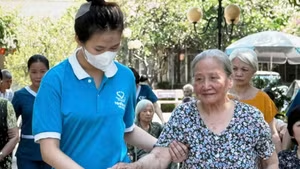
One of the important policies is Politburo Resolution No. 72-NQ/TW on strengthening the protection and care of people's health, which places a focus on healthcare for older people amid population ageing.
The Government has also issued the National Strategy on Older People under Decision No. 383/QD-TTg dated February 21, 2025, and the Prime Minister's Directive No. 35/CT-TTg dated December 23, 2025 on strengthening work concerning older people. Government Resolution No. 36/NQ-CP dated March 6, 2026 also addresses the promotion of high-quality healthcare services for older people, a key pillar of the “silver economy”.
In addition, the 2025 Population Law, which took effect on July 1, 2026, sets out requirements for caring for the well-being of older people. Specifically, the law requires individuals to proactively prepare for old age in terms of health, finances and psychological well-being; participate in social and health insurance; and study and improve their knowledge and skills in order to maintain their physical and mental health and social functions.
It also calls for the development of diverse forms of elderly care, including self-care, home-based and community-based care, as well as the development of a workforce to provide care for older people, including both formal and informal caregivers.
Most recently, Decision No. 1116/QD-TTg dated June 22, 2026, issued by the Prime Minister, amended and supplemented Decision No. 1579/QD-TTg dated October 13, 2020, approving the programme on healthcare for older people through 2030.
Under the new regulations, from 2026, older people are entitled to at least one free regular health check-up each year. Each commune, ward and special administrative zone is to have at least one elderly care club, while day-care models for older people are to be developed to cover at least 20% of the target by 2030. By 2030, all provinces and centrally-run cities are expected to have socialised elderly care facilities, as well as geriatric hospitals or general hospitals with geriatric departments.
According to statistics from the Viet Nam Association of the Elderly, as of September 2026, more than 3.53 million older people nationwide were receiving monthly social insurance benefits, including around 2.35 million pensioners and 530,000 people receiving social insurance allowances. The State is also providing social assistance to more than 1.2 million people.
Healthcare for older people has received greater attention, with nearly 15.7 million holding health insurance cards. More than 69% receive regular health check-ups, while 80% have their health monitored through health records. At the same time, the role of older people continues to be promoted. More than nine million remain engaged in employment, production and business activities; over 733,000 participate in Party, government and mass organisation work; and more than 1.1 million take part in maintaining public security and order.
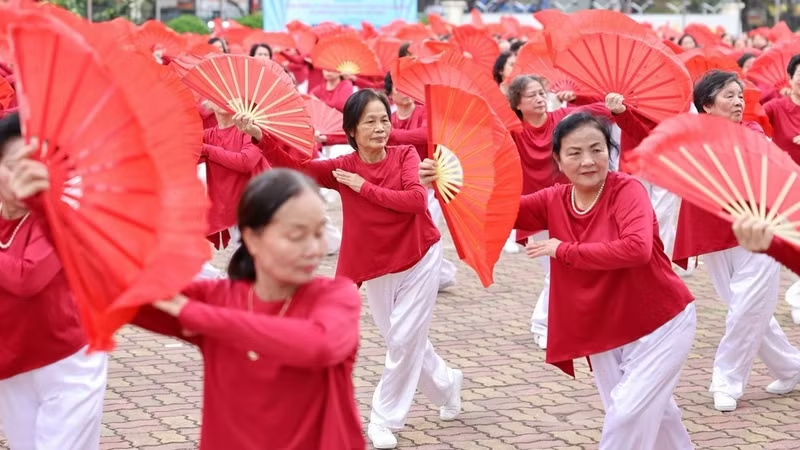
In addition, nearly 80,000 cultural and sports clubs attract more than three million older people, while more than 9,000 intergenerational self-help clubs contribute to strengthening community ties.
Many challenges remain
Despite the achievements, many challenges remain. Rapid population ageing is placing increasing pressure on the healthcare system, social welfare, the labour market and care services. Older people in remote and mountainous areas continue to face difficulties, while support facilities and care services remain inadequate. Socialised resources are limited, while older people still face barriers to accessing employment and adapting to digital transformation.
In the coming period, the Viet Nam Association of the Elderly will prioritise resources to improve the lives of older people in remote and mountainous areas and ethnic minority communities, where many older people continue to face difficulties. Its goal is for 100% of commune-level administrative units to have intergenerational self-help clubs and for these clubs to operate effectively and meet the practical needs of older people. The model has contributed to providing healthcare, increasing incomes, supporting disadvantaged older people and creating a cultural and social environment for members.
Nguyen Thanh Binh, Chairman of the Viet Nam Association of the Elderly
According to Nguyen Thanh Binh, Chairman of the Viet Nam Association of the Elderly, the association will prioritise resources to improve the lives of older people in remote and mountainous areas and ethnic minority communities, where many older people remain disadvantaged. The goal is for 100% of commune-level administrative units to have intergenerational self-help clubs and for the clubs to operate effectively and meet the practical needs of older people. The model has contributed to healthcare, income generation, support for disadvantaged older people and the creation of a cultural and spiritual environment for members.
In addition, to improve the living conditions of older people without pensions or with low incomes amid continued increases in living costs, the Ministry of Health has proposed that the Government consider adjusting and raising the social retirement allowance to ensure an adequate standard of living for older people.

The Ministry of Home Affairs is currently seeking opinions on a draft law amending and supplementing several articles of the Law on Social Insurance. Under the new proposal, the age of eligibility for this policy could gradually be lowered to 70, creating greater opportunities to strengthen social welfare for older people in the coming period.
On the occasion of Viet Nam's 2026 Month of Action for Older People and the 35th anniversary of the International Day of Older Persons (October 1, 1991–2026), numerous meaningful activities have been organised nationwide to raise public awareness of caring for older people and promoting their role and position in society.
On this issue, Deputy Prime Minister Pham Thi Thanh Tra, Chairwoman of the National Committee on Older Persons, has stressed that whereas the focus in the past was primarily on caring for and supporting older people, it is now necessary to shift towards recognising them as a resource and a driving force for sustainable development.
This must represent a substantive change in thinking, particularly as Viet Nam is experiencing rapid population ageing, requiring a new approach that does not view older people merely as a group in need of support.