IPOs by FDI enterprises and untapped potential
According to Nguyen Son, Chairman of the Members’ Council of the Viet Nam Securities Depository and Clearing Corporation (VSDC), for Viet Nam’s stock market to truly enter a new stage of development after its upgrading, the core issue does not lie in technical indicators but rather in the ability to unlock supply and complete capital mobilisation mechanisms. As the capital market is expected to become a pillar providing medium- and long-term funding for the economy, the shortage of high-quality listings is reducing the market’s attractiveness and its capacity to absorb capital flow.
Nguyen Son noted that over the past approximately three years, the equitisation of SOEs as well as IPOs by FDI enterprises have slowed markedly. New share supply, especially from large-scale enterprises with solid foundations, has been virtually absent. Meanwhile, the “big stories” that once created strongly attraction in the market, such as FPT or Vinamilk, took place long ago and can no longer play a leading role in shaping expectations for a new development phase.
Nguyen Son noted that legal bottlenecks, particularly those related to land and enterprise valuation, are only part of the problem. “Acceleration is necessary, but moving too fast also carries risks,” he said. However, actual market developments over the past three to five years show that excessive caution has caused the market to miss many opportunities. When global capital flows shift, a lack of readiness in terms of available listings prevents the market from taking advantage of favourable timing.
It is time to restart this process, instead of being overly concerned about risks such as transfer pricing. Investors are sufficiently prudent to value enterprises. Not every FDI enterprise that lists will automatically attract strong buying.
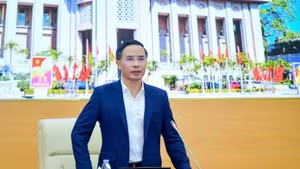
Nguyen Son, Chairman of VSDC Members’ Council
In addition to SOE equitisation, the VSDC Chairman particularly emphasised the issue of IPOs by FDI enterprises — a potential source of listings that has been largely neglected for many years. He recalled that in 2003, the government issued a decree piloting the transformation of FDI enterprises into joint-stock companies. Although the legal system at that time was still relatively rudimentary, with only the Law on Foreign Investment and the Law on Investment in place, the pilot mechanism enabled many FDI enterprises to participate in the stock market.
Quite a number of enterprises became fully domestic-owned companies after equitisation, especially in the case of Thanh Thanh Cong Sugar. However, after a pilot phase deemed successful, IPO activities by FDI enterprises were almost suspended. According to Nguyen Son, it is time to restart this process rather than worry excessively about risks such as transfer pricing. “Investors are sufficiently prudent to value enterprises. Not every FDI enterprise that lists will attract strong buying,” he stressed.
To develop the market, Nguyen Son also proposed building mechanisms that allow enterprises to publicly issue bonds. Currently, bond fundraising is mainly conducted through private placements to professional investors, which narrows the market’s scale. Expanding public offerings would give enterprises more fundraising options, while providing the market with new and more diverse listings.
At the same time, he argued that market infrastructure also needs to be adjusted to increase leverage effects and operational flexibility, including mechanisms such as intraday trading, selling securities pending settlement, as well as developing additional financial products and fund models such as voluntary pension funds, open-end funds, and closed-end funds. These factors would not only add depth to the market but also enhance its long-term capital absorption capacity.
Notably, Nguyen Son emphasised the role of investment funds in attracting individual investors. After the Covid-19 pandemic, the performance of many investment funds has outperformed that of individual self-directed investing, highlighting an increasingly clear trend towards indirect investment.
Under the guidance of the Ministry of Finance, from 2026 Viet Nam will begin applying an internationally standardised system to evaluate the performance of investment funds, honouring those with strong multi-year performance. Nguyen Son expects this mechanism to build greater confidence among individual investors — those with investment needs but limited time and analytical capacity — thereby helping to broaden the investor base of the market.
Removing land-related bottlenecks and the need for coordinated implementation
From a market perspective, Nguyen Minh Hoang, Director of Analysis at Nhat Viet Securities Joint Stock Company (VFS), said Viet Nam is facing an opportunity to attract very large capital inflow in the coming period. However, the core issue remains whether the market has sufficient listings to absorb this capital. Reviewing the progress of SOE equitisation during the 2016–2020, 2021–2023, and 2024–2025 periods shows that the pace has remained quite slow, even falling short of the needs of the Government and the capital market.

According to Hoang, the main causes can be grouped into three categories. First is the issue of land and fixed assets, likened to a “blood clot”, accounting for around 70% of SOEs encountering difficulties during equitisation. Second is the mindset and responsibility of managers; many implementing officials are risk-averse and concerned about personal liability when carrying out equitisation. Third is internal conflicts of interest within SOEs, which hinder restructuring and transparency.
In this context, Nguyen Minh Hoang cited comparative examples to clarify the issue. He noted that some private enterprises successfully conducted IPOs in 2025 thanks to clear business models and transparent asset handling. The Airports Corporation of Viet Nam (ACV) is considered a typical case with two outstanding factors. First, the enterprise separated land issues from business operations, especially public infrastructure assets such as airports and runways, making valuation more transparent and reducing the risk of public asset loss. Second, ACV’s business model is relatively clear and simple, with revenue mainly derived from core activities, few complex subsidiaries, and transparent handling of legacy assets. This has created favourable conditions for capital mobilisation to serve major Government projects such as Long Thanh International Airport.
By contrast, Viet Nam Posts and Telecommunications Group (VNPT) has faced greater difficulties due to its complex land structure, with more than 2,000 locations nationwide, many in central areas with diverse usage purposes that are not fully transparent. Valuation and asset separation have therefore been challenging, leading to prolonged stagnation in the equitisation process.
From these examples, Nguyen Minh Hoang has identified three key points. First, decisively resolving land-related “blood clots” is crucial to advancing SOE equitisation. Second, transparency in asset structures is a prerequisite for building investor confidence. And third, mechanisms are needed to protect implementers and create a “safe zone” for decision-makers, enabling them to carry out equitisation without excessive concern over liability risks.
From a broader perspective, Dr. Phan Huu Thang, Chairman of the Viet Nam Industrial Park Financial Association (VIPFA), said that Viet Nam currently has more than 43,000 FDI enterprises, yet fewer than 20% participate in the stock market — a very low proportion relative to potential. Meanwhile, the FDI sector plays a vital role in the economy, accounting on average for around 25% of total investment, contributing more than 70% of export value in certain periods, and creating over 5 million direct jobs.
According to Dr. Phan Huu Thang, the question is how to encourage more FDI enterprises to participate in the stock market. This is not the responsibility of a single agency or group but of the entire system. Although policies are relatively clear, organisation and implementation remain limited, making FDI enterprises less inclined to list and raise capital via the stock market.
From a legal standpoint, he argued that the legal framework must continue to be improved to ensure the stock market operates transparently, stably, and with sufficient appeal to foreign investors. With a clearer and more consistent legal environment, FDI enterprises will have stronger incentives to participate and thereby contribute to the sustainable development of Viet Nam’s stock market.
Dr. Phan Huu Thang also raised a key question attracting attention from many investors and experts: why many large-scale FDI enterprises, with capital of up to hundreds of billions of USD, have yet to participate in Viet Nam’s stock market. This issue requires in-depth analysis through conferences and specialised reports. According to him, mobilising even a portion of these resources into the stock market would generate significant spillover effects for the economy and capital market.
It is evident that SOE equitisation and IPOs by FDI enterprises are crucial components in the development of the capital market and the restructuring of the economy. In practice, delays in bringing new listings to the market are affecting capital mobilisation and allocation in the new development phase. Given the need to enhance the role of the stock market, addressing land, asset, and implementation bottlenecks must be carried out in a coordinated manner. At the same time, more effective exploitation of the potential of the FDI enterprise sector will help expand market scale and improve quality. When solutions are implemented consistently and effectively, Viet Nam’s stock market will have the necessary conditions to develop in a stable and sustainable manner, meeting the requirements of the new development phase.