Practical implementation in Ho Chi Minh City and southern localities showed that besides positive changes, there are still issues that need to be addressed soon, including supplementing and stabilising personnel, and improving the capacity of grassroots officials to meet the new situation, which is an urgent task.
Revelations from practice
Pham Trung Kien, Secretary of the Party Committee of An Nhon Ward, Ho Chi Minh City, shared: “Currently, the People’s Committee of the ward is short eight civil servant positions; some areas such as education and information technology lack personnel with suitable experience.”
The Party Committee of Sai Gon Ward has nearly 11,000 party members, while the Party Building Department currently only has seven staff members and three non-specialised personnel. According to Le Tien Si, Head of the Party Building Department of the Sai Gon Ward Party Committee: “On average, a specialist in the Party Building Department handles 10 party membership files per day, which takes up all their time. Therefore, the Department needs at least five more civil servants to handle areas such as internal political security, training policies, and emulation and commendation.”
Along with the shortage of specialised personnel, the work of building party organisations in the non-state sector also faces obstacles. In An Lac Ward (currently with 182 Party organisations and 3,335 Party members), establishing Party organisations in businesses, especially small and medium-sized enterprises, still faces many difficulties.
Deputy Secretary of the Ward Party Committee, Nguyen Thi Kim Huong, shared: “Some business owners have not fully understood the role of Party organisations, so they have not yet given their consent; meanwhile, the lives of workers are still difficult, so the work of developing Party members has not achieved the desired results.”
In addition, the localised surplus coupled with a shortage of highly specialised personnel is also creating an urgent need for restructuring the workforce. In Cao Lanh Ward, Dong Thap Province, some areas such as urban management, land management, and construction still lack qualified personnel.
The Public Administrative Service Centre of Binh Dai commune, Vinh Long province, has eight staff members, six of whom are law graduates, with only one land management engineer and one information technology engineer. This reality forces staff to proactively study and receive training in many other fields to meet job requirements.
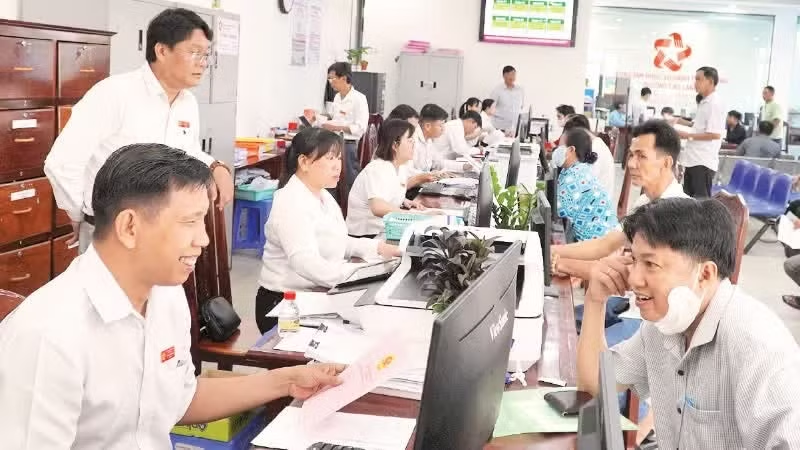
In addition, the workload at public administrative service centres is also increasing. According to Le Chi Hieu, Director of the Cao Lanh Ward Public Administrative Service Centre (Dong Thap Province), with 23 staff members, the centre has to process an average of about 700 applications per day.
“In the first month of operation under the new model, the centre received and processed more than 16,000 applications. Many applications require same-day results, demanding very close coordination between specialised departments, creating significant pressure and requiring high levels of proactiveness and flexibility,” Director Le Chi Hieu shared.
In Ho Chi Minh City’s wards, after mergers, the workload has increased significantly while staffing levels have been streamlined.
Le Van Minh, Secretary of the Dien Hong Ward Party Committee, shared: “The ward’s Public Administrative Service Centre receives an average of 3,000 applications and documents daily. Although the on-time processing rate is projected to reach 99.96% in 2025, the pressure on the reception and results delivery department is immense; some days, staff have to work until 8 PM without finishing their tasks.”
In the context of a shortage of specialised personnel, the phenomenon of staff multitasking has become common. Vo Thi Ngoc Diem, a civil servant from Binh Dai Commune, Vinh Long Province, who has worked in the judicial and civil registration field for over 10 years and now handles many other areas, said: “Taking on new responsibilities forced me to learn and participate in training to meet the requirements. The work is gradually stabilising, but the pressure is immense, and the workload has doubled compared to before.”
In practice, after reorganising and streamlining the organisational structure, localities have reduced the number of administrative units, staff, and intermediaries, saving budget and overcoming overlapping functions and responsibilities.
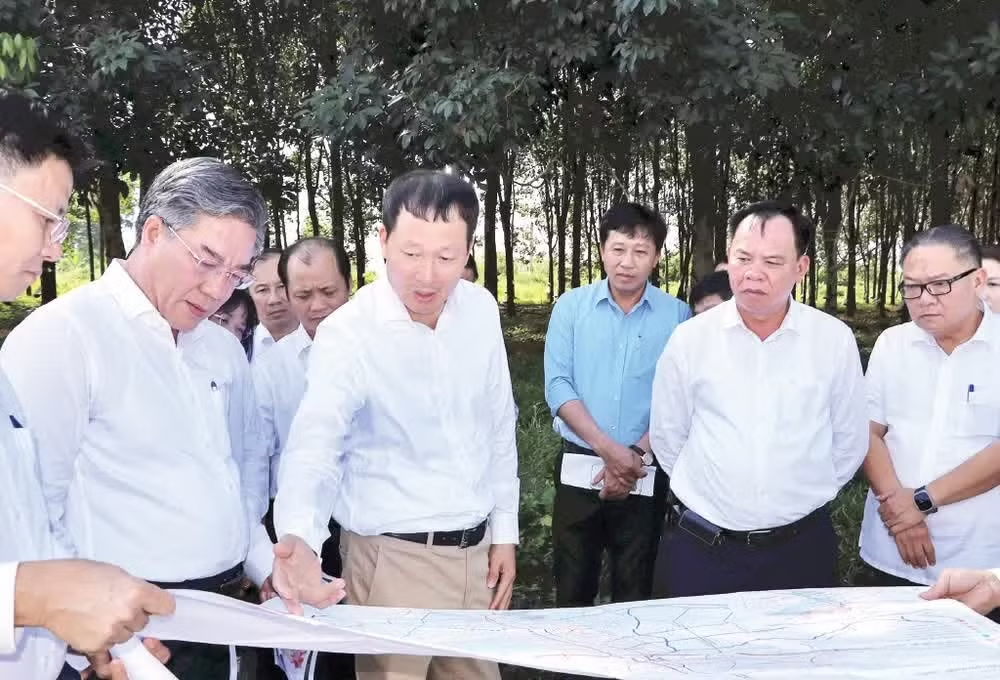
However, in many places, grassroots officials, especially at the commune (ward) level, have to take on more responsibilities and cover larger areas, while their professional capacity, management skills, and ability to handle emerging situations have not kept pace with new requirements.
Some officials are still hesitant in receiving citizens and handling administrative procedures; in some places, coordination between departments is not smooth, and some have even resigned due to the pressure. This highlights the need to streamline the administrative apparatus while simultaneously improving the quality of grassroots officials.
The need for innovation in service methods
Faced with difficulties and challenges, many localities have proactively innovated their leadership and management methods, seeking suitable models. In Dau Giay Ward, Dong Nai City, the “Morning Coffee — Listening and Exchanging with the People” model, implemented since October 2025, has created positive changes.
Pham Dinh Ban, Deputy Secretary of the Party Committee of Dau Giay Ward, emphasised that when operating the new administrative apparatus, the locality determined that the satisfaction of the people would be the benchmark.
“The public administrative service centre must treat the people as customers, ensuring ‘people are happy when they arrive and satisfied when they leave.’ With the large area after the merger, we proactively built connection channels to bring the government closer to the people and listen to them more promptly,” he said. Based on the initial effectiveness of this model, many wards and communes in Dong Nai have implemented it, contributing to strengthening social consensus and creating a solid foundation for the reform process.
When operating the new administrative apparatus, the locality determined that the satisfaction of the people would be the benchmark. “The public administrative service centre must treat citizens as customers, ensuring ‘people are happy when they arrive and satisfied when they leave.’
With the large area after the merger, we proactively built connection channels to bring the government closer to the people and listen to them more promptly,” he said. Based on the initial effectiveness of this model, many wards and communes in Dong Nai have implemented it, contributing to strengthening social consensus and creating a solid foundation for the reform process.
Pham Dinh Ban, Standing Deputy Secretary of the Party Committee of Dau Giay Ward, Dong Nai City
Similarly, in Phu Loi Ward, Ho Chi Minh City, forums like “Morning Coffee — Exchange with Businesspeople” or meetings with non-public educational institutions have contributed to resolving difficulties for businesses, while also promoting the building of Party organisations in the non-state sector.
With the new model, the functions and tasks of the grassroots level are expanded, requiring the comprehensive improvement of the staff. Phan Van Thang, Deputy Secretary of the Dong Thap Provincial Party Committee, shared that the Provincial Party Standing Committee has focused on training and improving the professional skills, expertise, and political theory of cadres; and has also transferred and appointed more than 120 leading cadres from provincial departments and agencies to key positions at the commune level, especially in key areas, areas with development potential, and areas still facing difficulties. This has both met immediate task requirements and created an environment for training and challenging the cadres to enhance their political acumen, leadership, and management capabilities.
In the same spirit, the Vinh Long Provincial Party Committee has issued a specific action programme to innovate cadre work, linked to the streamlining of the organisational structure towards greater efficiency and effectiveness.
The programme clearly outlines tasks, assigns specific responsibilities to each agency and unit, and includes an implementation roadmap and a mechanism for inspection and supervision. The implementation covers many areas, from propaganda work and institutional improvement to personnel management, inspection, and supervision, ensuring consistency and uniformity in implementation.
Tran Van Lau, Member of the Party Central Committee and Secretary of the Vinh Long Provincial Party Committee, said that the locality is focusing on rectifying working methods and improving the efficiency of the political system; strictly implementing working regulations; and closely linking the rectification of thinking and working style with administrative reform and digital transformation.
“The immediate focus is on rectifying thinking and awareness; promoting a spirit of initiative, creativity, daring to think, daring to act, and daring to take responsibility; tightening administrative discipline and order, thereby improving the quality of service to the people,” he emphasised.
Many localities have deployed and rotated cadres to grassroots levels for training and development. Dong Nai City issued more than 230 decisions on personnel matters in the first phase of restructuring. Two deployments have sent 61 personnel to support commune-level administrations; simultaneously, 113 candidates were selected for recruitment as commune-level civil servants, prioritising those with practical experience. In parallel, policies and regulations for officials affected by the restructuring process were fully and promptly implemented, contributing to stability and consensus.
In Tan Hung Commune, Dong Nai City, where over 30% of the population are ethnic minorities, although poverty has been largely eradicated, people’s lives still face many difficulties.
Upon being assigned to work there, Mac Dinh Huan, Secretary of the Party Committee and Chairman of the People’s Council of the Commune, shared: “Through practical surveys, we have found that although people’s lives have improved, they are still low, and purchasing power is limited. Therefore, the locality is promoting economic restructuring and planning the development of industry and services to create jobs and increase people’s income…”