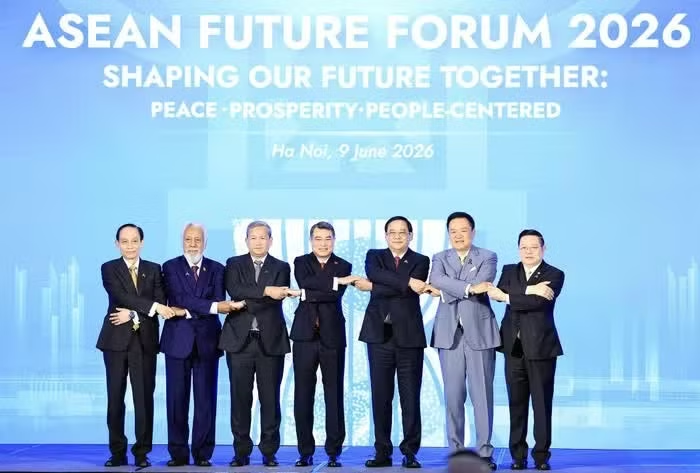
The ASEAN Future Forum (AFF) 2026, currently underway in Ha Noi, has drawn strong attention from diplomats, policymakers and scholars around the world. The event not only reaffirms ASEAN’s central role in an increasingly complex global landscape but also underscores Viet Nam’s ability to help foster regional solidarity, resilience, and sustainable development.
Imprint of the opening keynote address
A key highlight of this year’s forum was the opening keynote address delivered by Vietnamese Prime Minister Le Minh Hung.
Speaking on the sidelines of the event, Canadian Ambassador to Viet Nam Jim Nickel described the PM’s message as powerful. Against a backdrop of intensifying geopolitical competition, economic fragmentation and growing challenges to international norms and institutions, Nickel said the speech clearly conveyed Viet Nam’s view that ASEAN members and their partners must work together to address common challenges and safeguard shared interests.
French Ambassador to Viet Nam Olivier Brochet likewise praised the address, describing it as an important continuation of the messages delivered by Party General Secretary and State President To Lam at the recent Shangri-La Dialogue in Singapore. He underscored Viet Nam’s strong commitment to supporting ASEAN’s development efforts, promoting peaceful relations and preserving regional stability.
The French diplomat noted that this year’s forum reflected a more optimistic atmosphere despite ongoing international crises. France, he added, remains committed to strengthening cooperation with both Viet Nam and ASEAN member states in support of efforts towards dialogue, stability and development in the region.
Meanwhile, Ambassador Julien Guerrier, head of the EU Delegation to Viet Nam, commended Viet Nam’s organisation of the event, which brings together the Prime Ministers of Viet Nam, Thailand, Cambodia, Laos and Timor-Leste for high-level discussions on peace, stability and inclusive growth in the region.
Upholding ASEAN's centrality and unity
International participants agreed that the forum carries profound strategic importance. Ambassador Nickel emphasised that this year’s theme – “Shaping Our Future Together: Peace, Prosperity and People-Centred” – demonstrates ASEAN’s potential to contribute to not only regional but also global peace.
Singaporean Ambassador to Viet Nam Rajpal Singh described the forum as a useful platform for regional leaders to directly exchange views. The key message emerging from this year’s AFF is that ASEAN must remain strong, uphold its centrality and preserve its unity and cohesion. By acting together as one community, ASEAN will be well-positioned to address these challenges while seizing the growth and development opportunities available to the region, he added.
In the context of growing competition among major powers, Jaideep Singh of Malaysia’s Institute of Strategic and International Studies (ISIS) argued that ASEAN’s long-standing approach of neutrality and non-alignment continues to serve the region well.
He noted that international relations scholars often describe this strategy as hedging – avoiding alignment with any single major power while maintaining balanced and constructive relations with all partners. Such an approach, he said, helps position ASEAN as a reliable, safe, and stable destination for investment and economic development.
Thai scholar Seksan Anantasirikiat, a senior researcher at Thailand’s Centre for International Studies, pointed out that the forum addressed many pressing issues, including geopolitical competition, climate change, energy transition and youth engagement. Beyond identifying challenges, discussions also generated practical policy recommendations, including reducing non-tariff barriers to deepen regional economic integration.
Viet Nam's stature and bridging role
Viet Nam’s role at the forum received particularly positive recognition from international delegates.
Anantasirikiat stated that the event is a clear demonstration of Viet Nam’s leadership role within ASEAN. Thanks to its extensive network of friendly international partnerships, Viet Nam is increasingly viewed as an important contributor to shaping ASEAN’s future trajectory.
Jaideep Singh highlighted Viet Nam as one of ASEAN’s most notable success stories in economic integration and development gap narrowing. He noted that narrowing gaps between the ASEAN-5 economies (Malaysia, Singapore, Indonesia, the Philippines and Thailand) and the newer CLMV members (Cambodia, Laos, Myanmar and Viet Nam) remains one of the bloc’s longstanding challenges. Viet Nam’s remarkable progress in integrating into the region and the world and steadily reducing development disparities provides valuable lessons for other countries in the region.
The Canadian Ambassador sees Viet Nam as a key partner for Canada in both bilateral and multilateral partnerships. He noted that Viet Nam plays an important role in advancing negotiations on a Canada – ASEAN free trade agreement, expected to be concluded this year, and also serves as an important bridge between members of the Comprehensive and Progressive Agreement for Trans-Pacific Partnership (CPTPP) and the European Union.
Belarusian Deputy Ambassador to Viet Nam Oleg Shloma praised Viet Nam’s proactive approach to promoting dialogue and trust-building by creating a platform where countries can identify shared interests, bridge differences, and address disagreements through dialogue instead of confrontation or the use of force.
Therefore, this forum serves as an important venue for identifying common ground and for discussing potential solutions to the challenges currently facing the international community, Shloma said.
Green future and human-centred technological development
Looking ahead, delegates also highlighted the importance of a green future and human-centred technological development. Ambassador Rajpal Singh stressed that clean energy cooperation remains a priority for ASEAN, with the ASEAN Power Grid expected to play a crucial role in enabling member states to share and benefit from sustainable energy sources.
On technology, Ambassador Nickel emphasised that artificial intelligence and high technologies should be developed to serve societal needs and improve people’s lives.
Echoing this view, Deputy Ambassador Shloma underscored that human beings must remain at the centre of technological progress, including the development and application of AI.