According to the 2025 rural and agricultural census, the country possesses nearly 57,800 high-capacity tractors and 35,400 combine harvesters serving agricultural production. Furthermore, the application of science and technology has been implemented extensively and comprehensively, with nearly 7,000 drones deployed to support agriculture, forestry, and aquaculture.
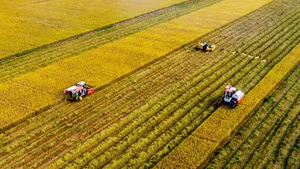
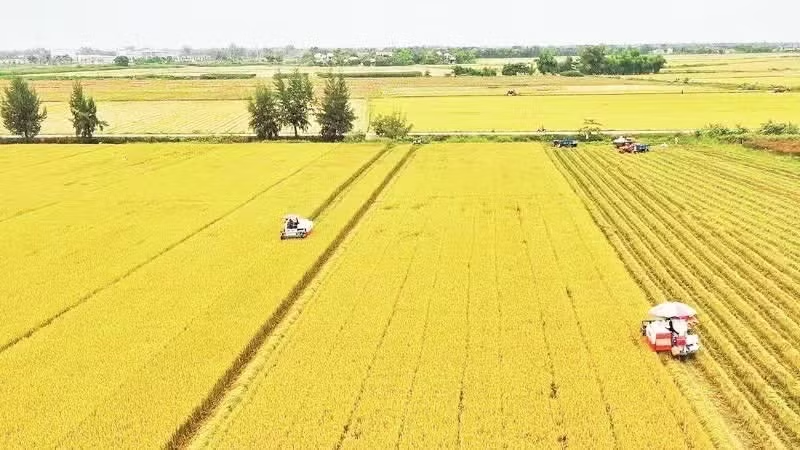
Mechanisation in rice production has yielded significant results, with machine-based land preparation covering 89.2% of the cultivated area and machine-based harvesting accounting for over 86% of the rice area.
The Mekong Delta is the country’s key rice-producing region, contributing approximately 90% of total rice exports. Currently, local farmers in the region are accelerating mechanisation and automation to boost productivity, reduce costs, and move towards sustainable rice production.
The Mekong Delta is the country’s key rice-producing region, contributing approximately 90% of total rice exports. Currently, local farmers in the region are accelerating mechanisation and automation to boost productivity, reduce costs, and move towards sustainable rice production.
According to the Mekong Delta Rice Research Institute, mechanisation rates for land preparation and irrigation pumping have reached nearly 100%, driven by the widespread use of tractors, plows, tillers, and field-leveling machines.
Additionally, drone-based seeding has helped reduce seed usage by 30–60%. Meanwhile, combine harvesters are widely used—with an adoption rate exceeding 95%—contributing to reduced post-harvest losses and improved rice quality.
Equipment for collecting, rolling, and chopping straw is opening up new avenues for utilising agricultural by-products to support the circular economy and reducing the practice of burning straw in the fields.
An Giang is a major rice-producing locality in the Mekong Delta, with an annual cultivation area of 1.32 million hectares and an output exceeding 8.8 million tonnes.
The An Giang Agricultural Extension Centre reports that, in recent years, local farmers have widely adopted mechanisation across most stages of rice production, thereby boosting labour productivity.
Notably, over 98% of the rice area is sown using mechanised means, with drones becoming particularly common for seeding.
Furthermore, cluster seeding models and transplanters are being expanded in high-quality rice production zones, helping to reduce seed usage to 70–80 kg/ha.
The harvesting stage is 98–99% mechanised, which minimises losses and ensures schedules are met even under adverse weather conditions.
Despite these positive results, the process of agricultural mechanisation and automation still faces certain limitations.
According to Doan Van Chien, Deputy Director of the Mekong Delta Agricultural Extension Centre, current mechanisation levels remain uneven across different commodity sectors, localities, and production stages.
Many sectors face deficiencies and weaknesses across various stages, including planting, crop care, selective harvesting, preservation, processing, and logistics.
Specifically within the fruit sector, the preservation and processing stages account for less than 20%, while the mechanisation rate for harvesting is very low—reaching only about 4%.
Furthermore, a mismatch between production scale and infrastructure drives up operating costs and hinders automation; the domestic agricultural machinery industry fails to meet specialised needs, with a heavy reliance on imported equipment; and there is limited capacity to design machinery suited for small plots, soft soil, or hilly terrain.
To promote mechanisation in agricultural production, experts in the field emphasise the need to refine policies and mechanisms that foster value-chain-based mechanisation, while also encouraging the research, manufacture, and adoption of agricultural machinery tailored to specific production conditions.