Consequences of the overuse of agricultural inputs
Climate change has had and continues to have many negative impacts on agricultural production, including durian and coffee cultivation. Nguyen Van Son, Chairman of the Viet Nam Pesticide Association (VIPA), said erratic weather disrupts growth, hinders flowering and fruit setting, and causes yields of durian and coffee to decline. In addition, hot and humid conditions create favourable conditions for diseases to spread.
Whereas diseases such as coffee leaf rust and branch dieback previously appeared only seasonally, fungal diseases now proliferate and spread year-round. On durian trees, diseases such as stem canker, mealybugs, and fruit borers are also becoming increasingly complicated. Of concern is that climate change also reduces the effectiveness of plant protection products.
Specifically, high temperatures cause pesticides to evaporate more easily, while extreme storms and rainfall can wash away freshly applied pesticides, reducing their effectiveness. In addition, because early symptoms of diseases are difficult to identify and specific treatments are in short supply, farmers often fall into a vicious cycle of chemical overuse.
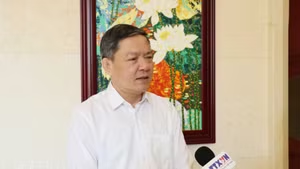
Former Deputy Director of the Viet Nam Academy of Agricultural Sciences Pham Van Toan said that the consequences of the habit of overusing plant protection products are not merely wasteful, but also include the destruction of beneficial organisms, disruption of ecosystems, and a rapid increase in pest and disease resistance.
When pests and diseases become “resistant” to pesticides, farmers continue to increase application rates in subsequent crops. This practice, combined with failure to observe the required pre-harvest safety intervals, has caused chemical residues in agricultural products to exceed permitted limits, affecting consumer health as well as agricultural exports.
The consequences of the habit of overusing plant protection products are not merely wasteful, but also include the destruction of beneficial organisms, disruption of ecosystems, and a rapid increase in pest and disease resistance. When pests and diseases become “resistant” to pesticides, farmers continue to increase application rates in subsequent crops. This practice, combined with failure to observe the required pre-harvest safety intervals, has caused chemical residues in agricultural products to exceed permitted limits, affecting consumer health as well as agricultural exports.
Pham Van Toan, former Deputy Director of the Viet Nam Academy of Agricultural Sciences
Heavy metal contamination can originate from natural sources or human activities such as mining, fuel combustion, agricultural activities, waste and refuse disposal, and wastewater discharge. These activities contaminate soil and water, leading to the accumulation of heavy metals in crops and livestock and negatively affecting agricultural production.
In 2024, the fact that 589 consignments of Vietnamese durians were flagged by China for cadmium (Cd) contamination highlighted the urgent need to implement safe agricultural production measures.
Meanwhile, the trading of counterfeit and substandard fertilisers and plant protection products, violations of labelling regulations, infringement of industrial property rights, and the circulation of unauthorised products remain widespread and complicated in the market, seriously affecting cultivation efficiency and the quality of agricultural products.
Addressing challenges through an integrated strategy
Against this backdrop, Nguyen Van Son said competent authorities needed to urgently complete the legal framework and tighten management of pesticide residues and heavy metals in key agricultural products. National technical regulations on maximum residue limits for pesticides and heavy metals in durian and other key fruits should be issued soon.
At the same time, provisions on traceability related to pesticide and heavy metal residues should be supplemented and clarified in Decree No. 15/2018/ND-CP detailing the implementation of a number of articles of the Law on Food Safety and the Law on Crop Production.
Strict controls and sufficiently strong sanctions should be imposed on the production and trading of counterfeit, substandard, and untraceable plant protection products and fertilisers, while violations involving growing-area codes and trade fraud should be dealt with severely.
A comprehensive and effective system for screening agricultural products should be established at durian and coffee production and trading facilities, with strict penalties imposed for acts resulting in pesticide and heavy metal residues in agricultural products and food exceeding prescribed limits.
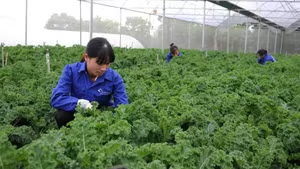
There is a need to shift cultivation practices towards Integrated Plant Health Management (IPHM) instead of focusing solely on eliminating pests and diseases. IPHM focuses on nurturing orchard ecosystems, including soil and water health. Farmers need to be guided to use chemical plant protection products only when truly necessary and strictly observe the “four rights” principle and pre-harvest safety intervals.
There is a need to shift cultivation practices towards Integrated Plant Health Management (IPHM) instead of focusing solely on eliminating pests and diseases. IPHM focuses on nurturing orchard ecosystems, including soil and water health. Farmers need to be guided to use chemical plant protection products only when truly necessary and strictly observe the “four rights” principle and pre-harvest safety intervals.
In addition, priority should be given to biological solutions and soil improvement. The State should introduce preferential tax policies and registration procedures to encourage businesses to invest in the production of biological plant protection products.
For cultivated soil, pH and heavy metal levels should be tested regularly so that early remedial measures can be taken. Adding organic fertiliser combined with biochar made from rice husks and coffee husks will help improve soil structure, retain nutrients, and limit the toxicity of heavy metals. Training networks based on the TOT (Training of Trainers) and TOF (Training of Farmers) models should be strengthened to develop a core group of farmers. Training courses should provide practical knowledge of circular agriculture, methods for self-monitoring chemical residues, and regulations on growing-area codes, among other areas.