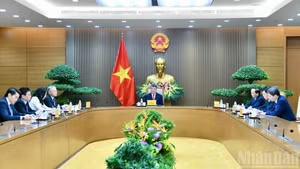
Specifically, Dien Bien province is carrying out the reorganisation and streamlining of public service units in accordance with Government Resolution No. 105/NQ-CP (dated April 8, 2026) regarding the action programme to implement Conclusion No. 210-KL/TW of the 13th Party Central Committee.
The province is implementing this process comprehensively, aligning it with the operation of a two-tier local government model. All reorganisation plans adhere to the requirement of ensuring no disruption to professional operations while safeguarding the rights and interests of citizens, organisations, and businesses during the transition period.
Based on central directives and actual conditions, the Provincial People’s Committee has proactively adjusted organisational models and redefined management authority, while also transferring the management of numerous public service units, as well as educational and healthcare facilities, to the commune level.
Nguyen Tien Dat, Deputy Head of the Provincial Party Committee’s Organisation Commission and Director of the Dien Bien Department of Home Affairs, stated that reorganisation has been comprehensively implemented across several sectors and fields, including Health; Education and Training; Home Affairs; Culture, Sports and Tourism; Justice; Science and Technology; and Agriculture and Environment.
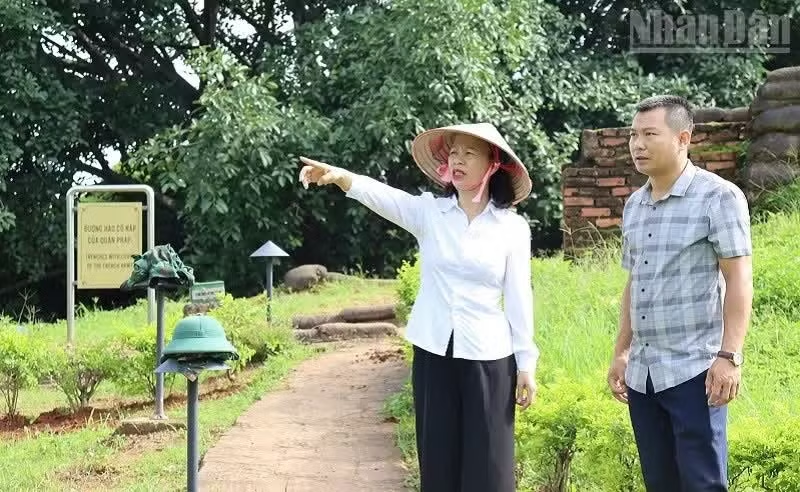
Specifically, in the culture, sports, and tourism sector, seven units—comprising the Sports Training and Competition Centre, the Provincial Library, the Dien Bien Provincial Culture and Cinema Centre, the Dien Bien Relics Management Board, the Provincial Museum, the Dien Bien Phu Victory Museum, the Provincial Ethnic Art Troupe, and the Culture and Cinema Centre—were reorganized into three units: the Dien Bien Phu Museum, the Provincial Art Troupe, and the Provincial Culture and Sports Centre.
Following this reorganisation, the Dien Bien Department of Culture, Sports and Tourism reduced its number of subordinate units by four and cut thirteen internal division-level units.
Regarding the Department of Home Affairs, the Employment and Persons with Meritorious Services Centre was established through the reorganisation of two existing units: the Employment Service Centre and the Center for Receiving Martyrs’ Relatives and Convalescence for Persons with Meritorious Services to the Revolution.
The Department of Justice established the State Legal Aid and Asset Auction Centre by reorganising two units: the State Legal Aid Centre and the Asset Auction Service Centre.
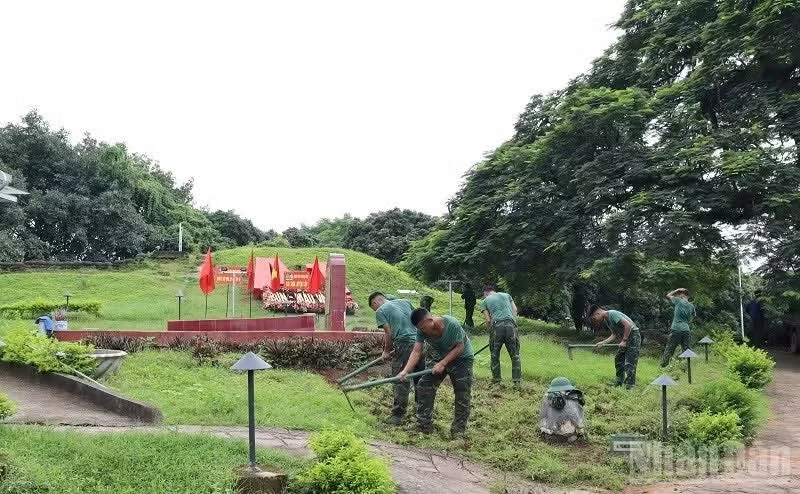
Following the reorganisation, the total number of public service units under the provincial People’s Committee and various departments in Dien Bien province was reduced from 102 to 84. A notable aspect is that the province did not simply merge entities mechanically; instead, it simultaneously reviewed and integrated functions with overlapping or interconnected scopes.
Nguyen Tien Dat, Director of the Dien Bien Department of Home Affairs, cited an example: alongside reorganising the Dien Bien Innovation Centre—formed by merging the Science Center and the Innovation Center (both previously under the Department of Science and Technology)—the provincial People’s Committee assigned the new center tasks involving scientific and technological research, application, and transfer; startup support; digital transformation; and work related to standards, metrology, and the enhancement of product productivity and quality.
Assessing the initial results of reorganising public service units across local departments and sectors, Nguyen Tien Dat noted that the process not only streamlined organisational structures and units but also clarified their functions and duties, while reducing the fragmentation of human, financial, and physical resources.
Consolidating related tasks under a single entity facilitates the enhancement of professional expertise, strengthens coordination, and allows for more efficient use of state resources. Throughout the transition, state management activities and the provision of essential public services remained stable, ensuring no gaps or disruptions in service to the public.
Not only were organisational structures and units streamlined, but the functions and duties of the reorganised entities were also more clearly defined; ...while simultaneously reducing the fragmentation of human resources, finances, and facilities. Consolidating related tasks under a single point of coordination facilitates the enhancement of professional expertise, strengthens collaboration, and enables more efficient use of state resources...
Nguyen Tien Dat, Director of the Department of Home Affairs, Dien Bien Province
The results demonstrate that Dien Bien has implemented the central government’s directives on organisational restructuring in a serious, proactive, and focused manner.
Streamlining public service units aims not merely to reduce the number of entities, but to create a cohesive organisational structure with clearly defined functions, ensuring effective and efficient operations while bringing services closer to the people. The ultimate success of this process is measured by the quality of public services, public satisfaction, and the economical and efficient use of state resources.
However, restructuring the organisational framework is only the initial step. To ensure the reorganised units operate effectively, Dien Bien province is continuing to refine regulations regarding their functions and duties; develop job position schemes; staff units based on competence and expertise; handle surplus finances, assets, and facilities; and formulate appropriate financial autonomy plans.
The ongoing reorganisation of the network of schools and educational and healthcare facilities is proceeding cautiously, prioritising service quality and accessibility for the public—particularly in highland, remote, and border areas—as the primary criteria for evaluation.