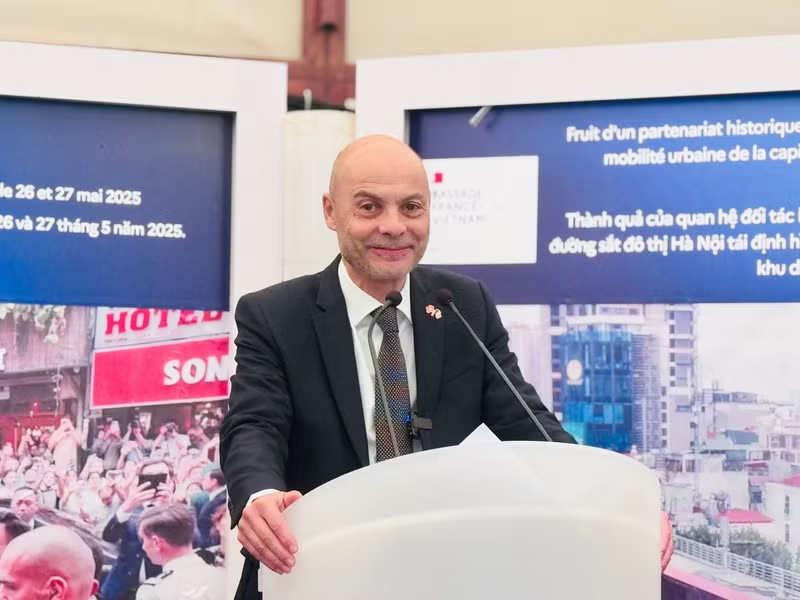
Viet Nam is a dynamic country whose confidence in its development path enables it to remain open to the world, newly-appointed French Ambassador to Viet Nam Didier Le Bret said at a press meeting in Ha Noi on October 30, highlighting the country’s achievements and prospects for expanded cooperation with France.
Sharing his impressions at the start of his new term, Bret said Viet Nam’s hospitality and dynamism have particularly impressed him. He noted that the country’s economic achievements since the Doi moi (renewal) process began are remarkable, with its gross domestic product (GDP) expanding dozens of times to around 500 billion USD. Viet Nam is also among the world’s leading countries in poverty reduction.
Having returned to Viet Nam after 15 years, the ambassador said he witnesses major changes in infrastructure and urban transport. He cited the replacement of bicycles by motorbikes and electric vehicles, as well as the development of modern electric taxi services.
He also praised Viet Nam’s ability to combine modern development with the preservation of its heritage, cultural traditions and historical values.
Core foundation of bilateral relations
Bret identified education – training, scientific research and people-to-people exchanges constitutes the most enduring foundation of bilateral ties. Around 7,000 Vietnamese students are currently studying in France, with approximately 1,500 new students arriving each year.
Three major cooperation programmes – the Excellence in Engineering Education Programme in Viet Nam (PFIEV), the University of Science and Technology of Ha Noi (USTH, also called Viet Nam–France University), and the French-Vietnamese Centre for Management Education (CFVG) – have trained more than 17,000 students in Viet Nam's priority sectors such as engineering, management, high technology, digital technology and space science.
Viet Nam is also home to two French high schools in Ha Noi and Ho Chi Minh City, while 44 Vietnamese schools have received the LabelFrancÉducation quality label.
The ambassador highlighted the role of the Vietnamese community in France, describing it as a highly educated community and an important source of talent for bilateral relations.
Expanding cooperation in key sectors
Bret said bilateral cooperation is moving beyond “producing in Viet Nam” towards “producing with and for Viet Nam”.
In high technology and innovation, the two sides are negotiating an upgraded contract to supply a new-generation Earth observation satellite to replace the existing one, which has been in operation for nearly 20 years. French quantum computing company Quandela has also signed a cooperation agreement with Viet Nam’s FPT group.
Regarding critical minerals essential for the green and digital transitions, the diplomat affirmed that France and the European Union (EU) stand ready to cooperate with Viet Nam in assessing mineral reserve maps, developing local deep-processing capacity and conducting extraction on the basis of mutual benefit.
French companies are also expanding their presence in transport infrastructure, he went on, adding that Airbus is seeking to accelerate aircraft deliveries, Alstom has signed a contract to supply 200 metro cars, and CMA CGM is preparing to operate electric barges linking with Lach Huyen deep-water port in Hai Phong city.
In terms of energy and climate change response, France pledges to support Viet Nam in implementing the 15.5-billion-USD Just Energy Transition Partnership (JETP). It is also helping with projects to expand the Hoa Binh hydropower plant’s capacity and upgrade the power grid. The two sides are also working with scientists and businesses on climate-shock response research serving the 2027 APEC Economic Leaders’ Meeting in Phu Quoc.
Heritage preservation and Francophone cooperation
According to the diplomat, France has completed a pre-feasibility study for the restoration of Long Bien Bridge, a shared historical landmark of the two nations, and plans to implement 40 major cultural projects in Viet Nam over the next four years.
Bret welcomed Viet Nam’s active role in the International Organisation of La Francophonie (OIF), noting French complements English and provides young Vietnamese with access to high-quality education as well as economic and employment opportunities in Africa.
France could learn from Viet Nam’s approach to development, which looks to the future while maintaining deep respect for history, origins and previous generations, he remarked.