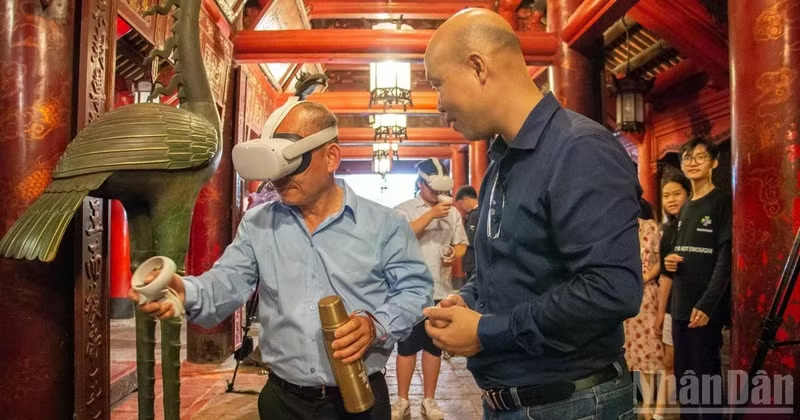
Accelerating the deployment of digital platforms and data in the tourism sector
Digital transformation in tourism is being implemented within the overarching guidelines of the Party and the State, notably Politburo’s Resolution No.57-NQ/TW on breakthroughs in the development of science, technology, innovation and national digital transformation.
On that basis, the Government, followed by the Ministry of Culture, Sports and Tourism, has issued a number of important directives and decisions to concretise digital transformation tasks, linked with Project 06 on population data development, electronic identification and authentication (such as Directive No.07/CT-TTg, Decision No.929/QD-TTg, Decision No. 4220/QD-BVHTTDL, among others). These serve as an important foundation for implementing tourism digital transformation in connection with Project No.06 in line with the Government’s orientation.
Building on this foundation, the Ministry of Culture, Sports and Tourism has promulgated its 2025 Action Plan and related decisions concerning the development of science and technology, innovation, digital transformation, administrative reform and Project No.06.
According to Deputy Minister of Culture, Sports and Tourism Ho An Phong, with regard to digital transformation and the development of a smart tourism ecosystem, over the past year the Ministry has directed its affiliated units to synchronously implement a number of key tasks. First and foremost has been the development of digital platforms and tourism applications, including the national tourism application “Du lich Viet Nam – Viet Nam Travel”, the national digital platform for “Tourism Governance and Business”, the deployment of an electronic ticketing system featuring “online–interconnected–multi-modal” services, and multimedia interpretation systems for tourist sites and attractions.
In addition, the Ministry of Culture, Sports and Tourism has continued to maintain and develop the national tourism database system, while also managing and sustaining the tourism statistical reporting system. At the same time, it has provided support for localities in implementing digital transformation in tourism activities.
In 2025, the tourism sector focused on the implementation of key programmes and projects aimed at building digital platforms, data systems and digital infrastructure. Notably, this includes the promulgation of the Programme to Accelerate Smart Tourism Digital Transformation, comprising three main task groups: developing digital platforms and applications; developing sector-wide data systems; and developing digital infrastructure.
At the same time, the Ministry of Culture, Sports and Tourism has established an appraisal council for the national digital platform on tourism governance and business. This move aims to develop an evaluation mechanism to select digital platforms that meet the standards for participation in the national digital ecosystem, thereby creating a legal corridor and ensuring coherent direction for the sector’s digital transformation.
The Tourism Information Centre (under the Viet Nam National Authority of Tourism) is also continuing to implement ministerial-level scientific research projects entitled “Developing an Index to Assess the Operational Effectiveness of Smart Tourism Destinations” and “Research on the Process of Building a Digital Tourism Map Platform for Sustainable Tourism Development”. These research projects are expected to support state management agencies, destinations and enterprises in improving the effectiveness of tourism management and business operations.
In 2025, the tourism sector focused on the implementation of key programmes and projects aimed at building digital platforms, data systems and digital infrastructure. Notably, this includes the promulgation of the Programme to Accelerate Smart Tourism Digital Transformation, comprising three main task groups: developing digital platforms and applications; developing sector-wide data systems; and developing digital infrastructure.
Proactively applying digital solutions
Sharing insights on the application of digital solutions to attract visitors to destinations, Nguyen Anh Minh, Director of the Viet Nam Fine Arts Museum, stated: “Digital transformation is not a passing trend but an inevitable development of our time. The museum’s creative activities and technological applications in recent years have helped bring it closer to the public, thereby spreading a growing love for art.”
Accordingly, the Viet Nam Fine Arts Museum has implemented a series of major projects, creating pioneering digital products within the sector. One breakthrough initiative was the launch in 2021 of the iMuseum VFA multimedia guide application. Through iMuseum VFA, visitors can freely explore exhibits, search for display locations and even take virtual tours remotely.

To date, numerous digital transformation solutions have been introduced at destinations nationwide. Notably, an “online–integrated–multi-modal” e-ticketing system has been deployed at the Heritage House at 87 Ma May Street and the 22 Hang Buom Relic Site in Ha Noi. This solution has enhanced efficiency in ticket management and control, while improving the visitor experience.
The e-ticketing system has been being applied at various sites in the capital city, including the Viet Nam Fine Arts Museum, the Temple of Literature, the Ho Chi Minh Relic Site at the Presidential Palace and the National Museum of History.
In the process of implementing digital solutions in the tourism sector, artificial intelligence (AI) is regarded as a key driver in improving service quality and delivering modern, innovative experiences for visitors. In practice, many travel companies and accommodation providers across provinces and cities nationwide have stepped up the application of AI to compile and analyse market data and customer behaviour. This enables them to forecast tourism trends and develop products tailoured to different customer segments.
AI is also used to personalise itineraries, recommend services, optimise room rates and tour packages, and enhance customer service efficiency through chatbots and 24/7 virtual assistants. The adoption of AI not only helps businesses improve service quality and increase visitor satisfaction but also strengthens governance capacity and competitiveness in the context of digital tourism.
According to the Viet Nam National Authority of Tourism, the Tourism Information Centre has integrated a train ticket purchasing function into the national tourism application “Du lich Viet Nam – Viet Nam Travel”, directly connecting to the official ticketing system of Viet Nam Railways. In addition, a tourism eSIM solution has been introduced to support visitors throughout their journeys and assist travel service providers in designing customer-oriented services.
Looking back at 2025, localities in general, and tourism organisations and enterprises in particular, have strengthened the coherent and creative application of digital technologies. This process has been implemented across management and operations, as well as in the development and refinement of tourism products and services.
In particular, the increased use of modern presentation technologies, virtual reality, augmented reality and 3D mapping in promotional activities, festivals and cultural tourism events has helped create fresh and engaging experiences for visitors from around the world when travelling to Viet Nam.






![[In Pictures] Nui Chua Rock Park: A million-year-old outdoor museum of landforms on the Khanh Hoa coast](https://en-cdn.nhandan.vn/images/nyM650OGFWrOVWc-xajqNz57td8idIAL_VG9puyG2UZEKOnmq1DVlT1--ZclbO3z2WBaWZhbt6O3e8kjPZqJMWkfEz7RO9qhcwg8o8LQFK8/ndo-br-cao-nguyen-da-moi.jpg.avif)