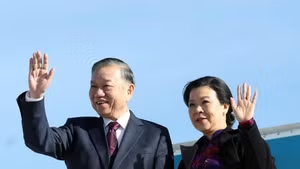
Before the Vietnamese delegation departed for home, the Chairman of the State Great Hural of Mongolia and his spouse, in a particularly warm gesture, invited National Assembly President Tran Thanh Man and his spouse to attend a traditional Mongolian festival showcasing the country’s culture at the Chingisiin Khaanii Khuree Complex.
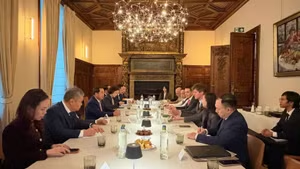
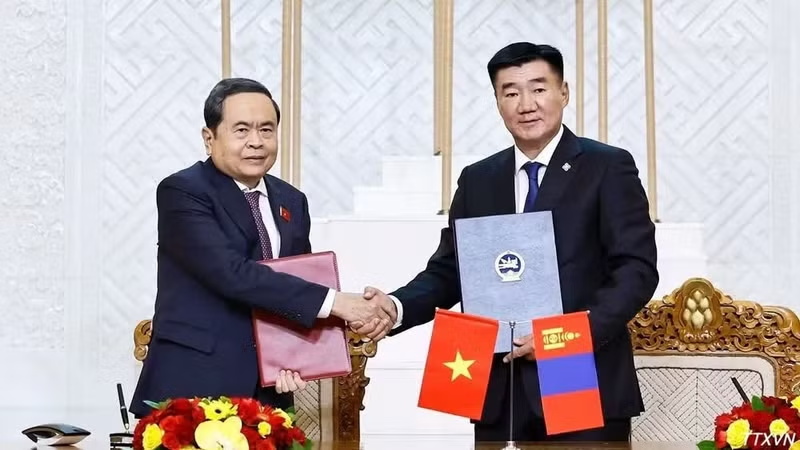
Immediately after their official talks, the two parliamentary leaders signed a Memorandum of Understanding on cooperation between the two legislatures. They also witnessed the signing of a cooperation memorandum between the offices of the Vietnamese and Mongolian parliaments, creating an additional framework for advancing ties between the two legislative bodies in the new period.
During their meetings, Mongolian leaders highly valued Viet Nam’s role, position, potential and development prospects, as well as the strong reform measures recently undertaken by the Vietnamese Party and State. They also highlighted the important role of the two countries’ legislatures in working together to deepen the Comprehensive Partnership with Mongolia in a more substantive manner and create favourable conditions for people and businesses on both sides to expand cooperation.
In recent days, the visit by National Assembly President Tran Thanh Man has attracted particular attention from the Mongolian media and public. Large numbers of reporters and editors from major media outlets covered the delegation’s key activities in Ulaanbaatar. The English-language Ulaanbaatar Post carried reports, analyses and commentaries highlighting the outcomes of talks between the two parliamentary leaders. It also noted Viet Nam’s development achievements, vigorous reforms and clear development path, while expressing confidence that bilateral relations will make significant strides in the years ahead.
Attending key activities between the two countries’ leaders, Permanent Deputy Foreign Minister Nguyen Minh Vu said both sides had devoted considerable attention to a major issue: “turning the commitments and agreements reached into concrete and practical results”.
Speaking to reporters, Le Tan Toi, Chairman of the National Assembly’s Committee for National Defence, Security and External Relations, said the Memorandum of Understanding between the top legislators of Viet Nam and Mongolia covers a broad range of areas, particularly digital transformation, science and technology, artificial intelligence (AI), and the sharing of experience in parliamentary activities. The two sides committed to increasing exchanges of high-level delegations and committee-level delegations, as well as exchanges between parliamentarians and the two parliamentary friendship groups, including through online meetings and other forms of engagement.
The leaders also stressed that cooperation between the two legislatures should go beyond creating favourable legal, institutional and policy frameworks for bilateral cooperation. The parliaments should also strengthen their oversight of the implementation of agreements and commitments, thereby promptly identifying and removing emerging bottlenecks. The two sides agreed to further promote the coordinating role of Viet Nam’s representative agencies in Mongolia, enabling them to continue serving as effective bridges and maintaining close contact with local partners to facilitate the implementation of bilateral agreements.
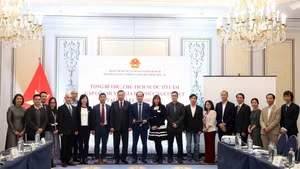
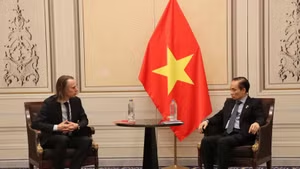
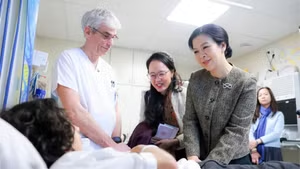
Alongside the official programme, Deputy Prime Minister Ho Quoc Dung and leaders of several Vietnamese ministries and sectors held bilateral working sessions with Mongolian government leaders. Gantsetseg Tsendsuren, spouse of the Chairman of the State Great Hural of Mongolia, warmly invited Nguyen Thi Thanh Nga, spouse of the Vietnamese National Assembly President, to visit several distinctive cultural sites and experience the beautiful seasonal transition as the vast steppe prepared to welcome autumn. For Mongolians, “autumn is regarded as the season of harvest, abundance and happiness”. Nguyen Thi Thanh Nga expressed her deep impressions and warm feelings towards Mongolia and its people, while sharing some of the distinctive cultural similarities between the two nations.
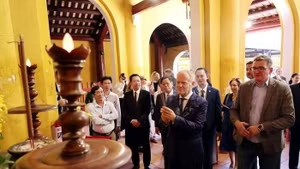
Immediately after arriving at the airport, National Assembly President Tran Thanh Man, his spouse and the high-ranking Vietnamese delegation visited School No.14 named after President Ho Chi Minh, one of the oldest and most tradition-rich schools in Ulaanbaatar. The school was named after the great leader of Viet Nam in 1980 to mark the 90th anniversary of his birth.
Following the important meetings, the Chairwoman of the Mongolia–Viet Nam Parliamentary Friendship Group told accompanying reporters that relations between Mongolia and Viet Nam have a long history and are rooted in a fine tradition of friendship. She said this foundation underscored the need to further expand Mongolia–Viet Nam relations in the coming period, promoting more comprehensive cooperation across all fields and at multiple levels.
The official visit to Mongolia by the Vietnamese National Assembly President carries important significance. Recent high-level visits and exchanges between the two countries demonstrate the growing importance attached to bilateral relations and their positive development. Both sides are working to achieve practical results commensurate with the strong political relationship between the two countries.
J. Bayarmaa, Chairwoman of the Mongolia–Viet Nam Parliamentary Friendship Group, said the two sides had discussed expanding cooperation into a range of areas during the visit, particularly tourism. She also added that Mongolia offers highly distinctive tourism products, including in winter, when visitors can experience snow and ice as well as the unique features of Mongolian nature and culture. This is an area where the two sides still have considerable room to expand cooperation, J. Bayarmaa said.
Bayarmaa and other Mongolian friends of Viet Nam expressed confidence that high-level visits and cooperation mechanisms would help bring marked progress in areas with strong potential for bilateral cooperation.
After hearing Mongolian parliamentarians share their experience and expressing interest in Mongolia’s Open Parliament platform, which is integrated into the national “E-Mongolia” digital platform to advance the goal of “building an open, transparent and people-centred parliament”, National Assembly President Tran Thanh Man called on the two parliamentary friendship groups to maintain close coordination and step up exchanges of legislative and oversight experience in such fields as the digital economy and innovation.
He also stressed the need to further promote cooperation in areas of direct concern to the peoples and voters of both countries, including green agriculture, food security, climate change response and sustainable development.
![[In Pictures] General Secretary and President To Lam and his spouse visit and present books to Royal Library of Belgium](https://en-cdn.nhandan.vn/images/3NY4Z6Du1Md1PrS_s0ZZOrwc5xDfq4rRua69depr-TBkwatGjBcD9lagzrI2BmGDo4nKYA9qjKDjuB3-yYloL_1KbNBr00klMZQFyHQxQ6Jq6GzFfAiY0m5agKw6jNtArN4QnVntX8RQeUmD7pdCq7nwvn3e235v3kufpokBN_s/1-tong-bi-thu-chu-tich-nuoc-va-phu-nhan-tham-tang-sach-cho-thu-vien-hoang-gia-bi.jpg.avif)