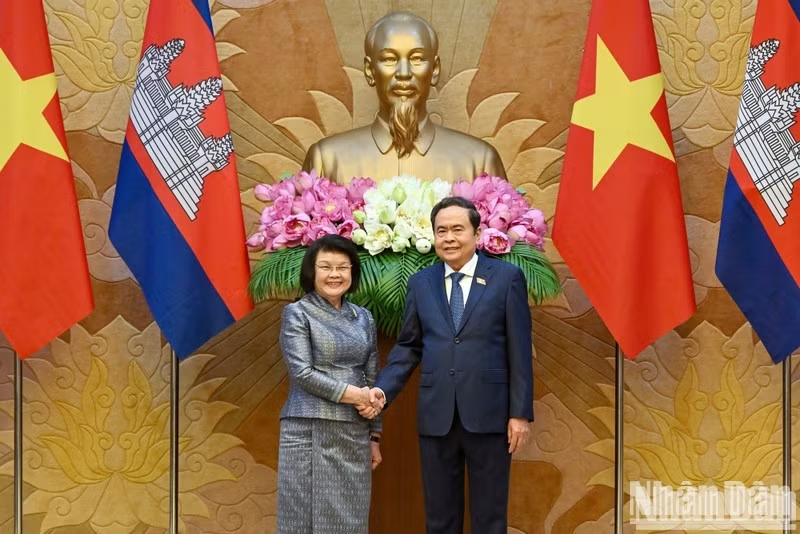
Cambodia and Viet Nam are good neighbours, brothers and sisters, traditional friends, and special strategic partners.
Cambodia and Viet Nam established diplomatic relations on June 24, 1967. Over the past six decades, we have struggled to gain independence together, grown together, and moved forward together, contributing to the realisation of our shared interests.
As Cambodia and Viet Nam approach the 60th anniversary of diplomatic relations in 2027, our relationship has proven resilient and continues to grow in response to the evolving realities and aspirations of our two nations.
Viet Nam has successfully undertaken deep reforms and opening up, achieved strong economic growth, and is advancing toward its vision of becoming a high-income country by 2045.
Cambodia has also pursued robust reforms and strengthened its economic competitiveness to realise its vision of becoming a high-income country by 2050.
We share common goals and a common vision. Our destinies are becoming increasingly intertwined. We also share a commitment to advancing the principles of peaceful coexistence. Our mutual support is essential.
For decades, Cambodia and Viet Nam have cultivated a relationship rooted in mutual respect and trust. This political trust is the foundation of our bilateral relationship.
Since 2005, we have strengthened our friendship and partnership under the framework of "good neighborliness, traditional friendship, comprehensive cooperation, and long-term sustainability."
This relationship is a strategic asset that has contributed to peace, stability, and development in both countries.
Today, as the regional and global landscape becomes increasingly uncertain and dangerous, parliamentary diplomacy plays increasingly relevant role in promoting peace and sustainable development.
Parliamentary diplomacy complements the work of our governments.
Legislatures play an important role in strengthening political trust, translating bilateral commitments into laws and policies, and ensuring continuity in cooperation regardless of leadership transitions. Strong institutions create stronger partnerships.
Our two legislatures have already established a solid foundation.
We have concluded a Memorandum of Understanding and maintained regular exchanges among our leadership, commissions, friendship groups, and secretariats.
The next step is to update and strengthen this framework so that it reflects new national priorities and the evolving international environment.
Economic cooperation is a key pillar of our bilateral partnership. Bilateral trade and investment have increased significantly over the years.
Both countries have agreed to deepen economic connectivity by improving transport infrastructure, logistics, energy connectivity, digital links, and industrial supply chains. They have also set an ambitious target of expanding bilateral trade to 20 billion USD.
Parliamentarians have an important responsibility to support these objectives by creating an enabling legal environment that promotes investment, trade, and cross-border economic cooperation.
The future of Cambodia–Viet Nam relationship depends on the next generation.
Expanding cooperation in education, professional training, and leadership development will strengthen mutual understanding and prepare young leaders to carry this important relationship forward under the motto: "Connect Youth, Connect Generations, and Connect Leadership."
Parliamentary cooperation should also embrace digital transformation.
Cambodia is transforming its National Assembly into a fully-fledged digital parliament, while Viet Nam has accumulated valuable experience in digital governance and public administration.
Greater exchanges on digital legislation, parliamentary modernization, cybersecurity, and information management will help both legislatures become more effective and responsive to citizens' expectations.
Beyond institutional cooperation, our relationship must stay people-centered.
Lasting partnerships are built not only through agreements between governments but also through trust between peoples. Greater exchanges among local communities, youth, scholars, and mass organisations will reinforce mutual understanding and strengthen the social foundation of bilateral relations.
People-to-people connectivity is the strongest guarantee that our friendship will endure from one generation to the next.
Looking ahead, Cambodia and Viet Nam should focus on five practical priorities.
First, maintain regular high-level exchanges between the two countries and strengthen communication and practical cooperation at all levels across sectors.
Second, expand people-to-people exchanges at the national and local levels to deepen mutual trust and understanding.
Third, invest in the next generation by establishing more exchange and training programs for young parliamentarians, researchers, and parliamentary officials.
Fourth, continue supporting one another in regional and international parliamentary forums to protect shared interests and promote ASEAN's unity and centrality.
Fifth, continue working closely together to advance the peaceful settlement of disputes, uphold a rules-based international order, and promote open and inclusive multilateralism, while rejecting the use of force or coercion to alter internationally recognised borders.
As both nations will commemorate their six decades of diplomatic relations next year, we should launch new initiatives that deepen people-centred cooperation across sectors at all levels.