As the most community-rooted economic segment, encompassing a wide range of industries and activities, household businesses vividly reflect the Vietnamese people’s spirit of self-reliance and their legitimate aspirations for prosperity.
Opening new opportunities for household businesses to grow
Recognising the increasing role and contribution of household businesses, the Party has issued Resolution No. 68-NQ/TW and Resolution No. 198/2025/QH15 on transitioning from the lump-sum tax regime to the self-declaration method. This move aims to unlock new opportunities for household businesses to thrive and assert their position in an era of transformation.
Declaring and paying taxes based on actual revenue ensures transparency in business operations. The shift from lump-sum to declaration-based taxation is not about adding procedures, but about a change in mindset and trust: the authorities place trust in taxpayers to declare and pay tax according to their actual income, while the tax authority focuses on support, verification, and fairness through electronic data systems.
In practice, the lump-sum method has revealed shortcomings in terms of fairness and transparency. While enterprises have management tools and specialised staff, many household businesses still operate based on experience, without proper record-keeping, and also remain hesitant about technology and administrative procedures. As a result, the implementation of support measures such as e-invoices and e-tax services has not achieved the desired outcomes.
Therefore, the tax sector aims to assist household businesses in accessing and enjoying the same policies as enterprises, moving towards greater transparency and equity. Once household businesses begin to record their revenues and expenses properly, they gain a clearer understanding of their performance, can adjust their plans accordingly, and improve competitiveness. Transactions through invoices and electronic payments not only enhance credibility and legal standing but also expand access to financing and new customers, enabling household businesses to enter the formal economy with confidence.
Declaring and paying tax on actual revenue provides the foundation for sustainable development. It helps create a transparent and equitable business environment based on real capacity. Accurate revenue data also allows the state to formulate better policies on credit, insurance, vocational training, and targeted support, giving household businesses access to development resources similar to enterprises.
Moreover, the declaration method fosters sound financial management habits, keeping clear records of revenue and expenses, assessing performance, minimising risks, and enabling more informed business decisions. Step by step, household businesses will transition from the informal to the formal sector, gaining protection, encouragement to invest, and opportunities to scale up. Such transparency and proactiveness form the basis for sustainable growth, built on real capacity, real information, and real opportunities.
Technological reform made simple for citizens
Institutional improvement goes hand in hand with modernising tax management. From now on, instead of estimating tax liabilities, household business revenues will be digitally recorded through the rollout of e-invoices, electronic revenue books, and online tax filing tools.
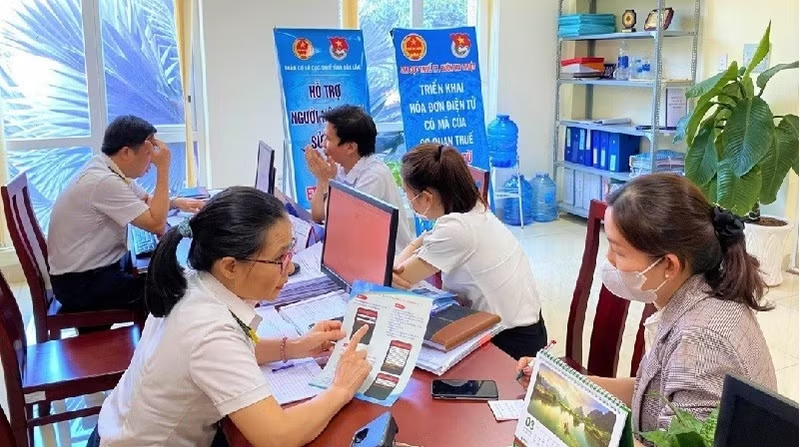
Importantly, these technologies are not a burden, they make tax payment easier and more convenient than ever. From market vendors and café owners to grocery shops and online sellers, everyone can declare and pay tax with just a few taps on their mobile devices. Tax officers now play the role of facilitators, guiding and assisting taxpayers in the spirit of public service, contributing to the goal of a modern administration, with convenience for citizens, efficiency for the state, and fairness for society.
Tax reform cannot succeed through the efforts of the tax sector alone. It requires close cooperation between ministries, sectors, and local authorities. To enhance data integration, especially for e-invoices, the Ministry of Finance is working with the Ministry of Public Security, banks, business registration authorities, and social insurance agencies to build a unified big data system. Specifically, the synchronisation of personal tax codes with citizen ID numbers will help ensure effective management, prevent duplication or omission, and combat tax evasion.
The tax sector also collaborates closely with local People’s Committees, the Vietnam Chamber of Commerce and Industry (VCCI), trade associations, and social organisations in communication, training, and advocacy, encouraging household businesses to comply with tax and invoicing regulations. Local authorities are also encouraged to create credit support, premises, and start-up programmes to help household businesses transition to enterprises once they have the capacity.
At present, provincial tax departments are rolling out communication campaigns, public consultations, and training on e-invoices and online declarations, as well as setting up support points at administrative centres. The effectiveness of these efforts will serve as a measure of public satisfaction and trust in the tax authorities.
Greater access to capital and expanded partnerships
Declaring and paying tax based on actual revenue can be seen as a lever for revenue growth. The shift from lump-sum to declaration-based taxation allows household businesses to unlock three direct revenue-enhancing mechanisms:
First, it strengthens market credibility and trust. When household businesses use e-invoices and declare revenue, their transactions become transparent and legally valid, enabling buyers to record such expenses for corporate tax purposes. E-invoices serve as “passports” for household businesses to join formal supply chains. According to tax law, invoices from self-declaring household businesses are legitimate documents for enterprises to record deductible costs. This gives companies confidence to sign contracts, make bank transfers, and place larger orders. As a result, household businesses can expand from retail consumers to institutional clients, a high-value and stable market segment.
Second, it enhances access to capital and partnership opportunities. Transparent records of revenue, expenses, and profits become a reliable source of credit data for banks and financial institutions in assessing business capacity. Figures on tax returns serve as concrete evidence of financial performance, helping household businesses secure loans, purchase equipment, rent new premises, or open additional outlets. Transactions conducted via bank accounts, e-invoices, and POS systems create clear financial histories, strengthening creditworthiness with partners and suppliers. With broader financing and collaboration, growth comes not only from higher sales but also from the capacity to serve larger customer bases.
Third, it creates genuine motivation for investment and productivity gains. The old lump-sum tax system offered little incentive for household businesses to exceed average revenue thresholds, resulting in stagnation and limited ambition. Under the declaration regime, businesses are encouraged to develop sound management habits, tracking their income, expenses, and profit precisely.
All revenues are recorded and safeguarded through digital documentation, providing a sense of security when expanding operations, investing in equipment, hiring staff, or supplying to larger organisations. Tax declaration thus becomes not merely an obligation, but a modern financial management tool, helping household businesses operate more professionally and access capital, partners, and new markets with ease. This transparency, proactivity, and planning capacity form a sustainable engine for long-term growth, higher productivity, and greater standing in the digital economy.
The transition from lump-sum to self-declaration aims to create a more efficient economy and foster stronger private-sector growth. Accompanying household businesses through this process, the tax authorities are implementing comprehensive measures on policy, resource, management, and communication to ensure that every business has the necessary support to adapt to the new regulations while continuing to grow and thrive.



![[Infographic] Viet Nam's 16 Comprehensive Strategic Partners](https://en-cdn.nhandan.vn/images/nyM650OGFWrOVWc-xajqN-rTZ68Rlmc1fiGJOhBRYHHdkBILL2hAdMw_FHcqH-128bTaQBSOAMd0_NcTypwz7H-j_NBZzuSdgF8ETMmVl1xLtdcCjym8rCUyKZqQgOZtC4ouMEzxlJoQ-MllehtjehDxIkn58uqaoaCRy4fSY54/1792513260540-1528117236743671738-1528117236743671738-9e797c256fe32c7c7b9c1cc03b0ca64e.jpg.avif)