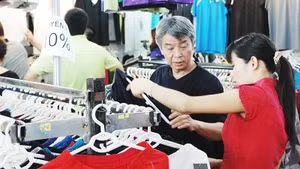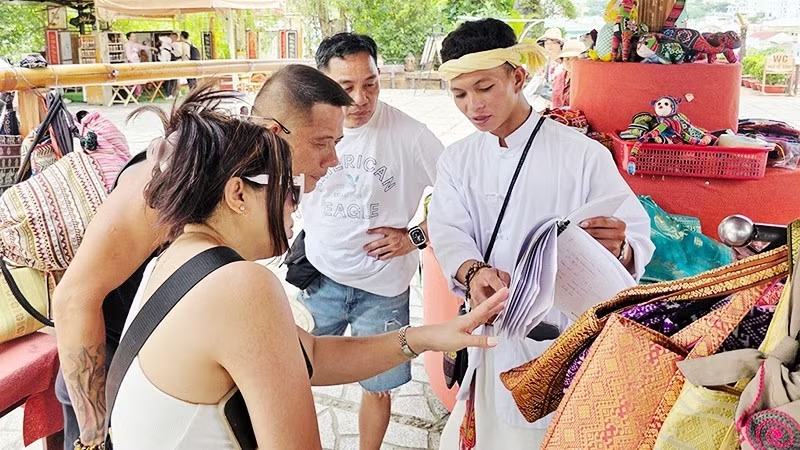
In a jewellery shop in central Ho Chi Minh City, Mai Anh (28 years old, a designer) was not simply looking for a beautiful piece of jewellery. She took the time to listen as the sales assistant talked about the origins of responsibly sourced gemstones, and the journey behind a collection inspired by Cham Pa cultural heritage. In the end, she chose a delicate bracelet — not just for its design, but because the story behind it resonated with her lifestyle, which values sustainability and cultural discovery.
Mai Anh’s choice and purchase offer a vivid illustration of increasingly visible shifts in new consumer trends: a demand for personalisation, greater experiential value and identity of products and servies, rather than decisions driven solely by function or the purely material value of what is being bought.
From a cup of coffee to personal identity
The lifestyle economy is a model in which the value of goods and services lies not only in function or purely material quality, but is largely created through meaning, experience, emotion and the spiritual value they deliver —helping consumers shape, express and elevate their personal lifestyles.
This is an economy in which consumers are willing to pay for products that match the version of themselves they want, rather than simply to own an item. In practice, many Vietnamese businesses have identified and leveraged opportunities from this model effectively.
Le Tri Thong, Chief Executive Officer of Phu Nhuan Jewelry Joint Stock Company (PNJ), said the company has had to shift from selling products to telling stories. Those stories must be anchored in history and society. This transition is not only a matter of survival for a single business; it is opening up opportunities for local economies more broadly.
Sharing the same view, Assoc Prof Dinh Tien Minh of the University of Economics Ho Chi Minh City noted that whereas people once drank coffee simply to stay alert at work, today coffee can also signal a professional start to the day and help set a positive mood. That means a cup of coffee has taken on symbolic identity.
These are the core elements of the lifestyle economy: consumers no longer buy a product purely for its function, but for the experience, emotion, spiritual value and the way it shapes personal “identity”. They seek personalisation in everything — from food and fashion to travel and healthcare.
Experts say the main driver of this shift is Gen Z, a young generation with high expectations around individuality and experience. Alongside this, the rise of Viet Nam’s middle class is a decisive factor. According to a report by McKinsey (a global strategic management consulting firm), by 2035 more than half of Viet Nam’s population is projected to be middle class.
“At that point, this group will shift strongly from consumption for basic living to consumption that affirms a lifestyle,” Dinh Tien Minh emphasised.
Lifestyle as a national policy
One of the pioneers that has successfully “turned” lifestyle into a billion-dollar export industry is the Republic of Korea.
Park Sang Mo, Head of Events and Culture at the Korean Cultural Center in Viet Nam, said that since the 1990s the Republic of Korea has proactively developed its cultural industries (film, K-pop, cuisine, and more). As these fields gained broader reach, they were institutionalised through policy and incorporated into the concept of a “lifestyle economy”.
The key to success lies in systematic intervention of the state. The Republic of Korea set up a dedicated agency to manage content, support businesses from idea to export, and allocate specific budgets to nurture creativity. Thanks to the Hallyu wave, the image of a Korean lifestyle has been promoted globally, driving demand for related products such as cosmetics, fashion and food.
Accordingly, cosmetics export turnover in the first three quarters of 2025 alone reached 8.52 billion USD. Even a service that may seem small—such as hanbok (traditional attire) rental at tourist sites — can generate revenue of hundreds of billions of won each year.
For Viet Nam, Ho Chi Minh City is seen as a locality with significant opportunities to tap into the lifestyle economy as a new growth driver. The city has major advantages: a young, dynamic population; rising incomes; rapid adoption of trends; and a maturing community of creative businesses. Experts note that “demand for personalisation” is a critical factor tand Ho Chi Minh City’s demand is substantial.
However, the biggest challenge is a lack of connectivity and a supportive policy framework. One survey found that as many as 76.2% of respondents believed progress requires combined efforts from businesses and consumers, together with policy support.
At the same time, for Ho Chi Minh City, developing the lifestyle economy is not only a new growth channel but also a key to realising its goal of becoming a creative, liveable city by 2030. It helps diversify the economy, build a distinct urban identity (not Seoul, Bangkok or Singapore, but a city that is dynamic, outward-looking and distinctly Vietnamese), and improve residents’ quality of life.
Overall, the road ahead calls for collective action across the entire system — from businesses willing to innovate and “tell stories”, to discerning consumers who support spiritual values, and authorities with the vision to lead, create an open legal framework, and build platforms that connect multiple industries.
When these pieces fall into place, Ho Chi Minh City in particular — and many other localities in general — can write a new success story, turning their lifestyles into a powerful economic resource that radiates across the region and the world.
Globally, the experience economy is an irreversible trend. Research by Wiseguy (a market research company headquartered in India) forecasts that the size of this economy will exceed 1,200 billion USD by 2035. This is a golden opportunity for creative cities that know how to harness local cultural value and transform it into distinctive experiences.